
March 1970 · Vol. 4 No. 5
March 1970 Magazine (Vol. 4 No. 5)
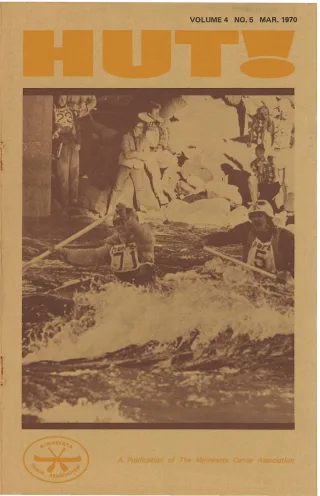
Magazine · 28 pages
Search this issue
March 1970 Magazine (Vol. 4 No. 5)
Captured text — scan page 13
Automatically captured text may contain recognition errors. Compare it with the original scan.
—<_—_—_> A
March 21-22, Saturday & Sunday--St. Francis Slalom
June 6, 1970, Saturday--Grand Rapids "Minnesota State
' Championship" Race.
Professional--4 & 27 canoes
Amateur Standard--3 & 31 canoes
July 25-26, Saturday & Sunday--Glenwood Race
July 31, Friday--Indian Dazes Sauk Rapids, MN
Bob Morey, Sauk Rapids, MN
HYPOTHERMIA
HYPOTHERMIA, KILLER OF THE UNPREPARED by Theodore G. Lath-
rop, M. D. is published by Mazamas, 909 N.W., Portland, OR
97209, 756. A copy was loaned by Joe Goheen with the re-
marks. "Did you know that wet clothing will extract your
body heat up to 240 times as fast as dry clothing? When
wet, the clothing acts as a wick to drain off body heat.
Wool provides some warmth even though it is wet. Keeping
dry will help keep you warm."' In cold, wet, windy situ-
ations death from hypothermia can sneak up on one gradually.
It starts with shivering and inability to perform complex
tasks and progresses through violent shivering, speech
difficulty, sluggish thinking, amnesia, muscular rigidity,
incoordination, jerky movements, dulling of comprehension
of the situation, irrationality, stupor, unconsciousness,
erratic heartbeat, frothing at the mouth and death. An
ingenious "windchill" nomogram shows the relative effects
of wind at varying temperatures. On the early trips this
year and surely on all white-water trips canoeists should
be well prepared with extra warm woolen clothing in water-
proof bags, the means to build a fire and prepare warm
liquids, extra high carbohydrate food for inner warmth,
warm head covering, waterproof and windproof garments. In
case of an upset, and while the rescue is in progress, a
large fire should be built, hot tea prepared, dry clothing
or sleeping bag warmed by the fire. The party should
gather around the victim, spreading tarps to shield him
from the wind and embarrassment while changing clothes.
Victims should be ordered or forced to change.
13
Article contents & approved summaries (0)
No article summaries are available for this view.