
July 1970 · Vol. 4 No. 9
July 1970 Magazine (Vol. 4 No. 9)
Magazine · 32 pages
Search this issue
For the full-resolution original, use Open PDF above. Your browser handles PDF zoom and navigation.
Searchable text for scan page 3
Activities Meeting
Each month the Minnesota Canoe Association holds
a public meeting ona topic of interest to all canoeists.
Topic: Poling Picnic
Date: Wednesday, July 15, 1970, 6:00 p.m.
Place: Bush Lake - Hennepin County Park
located south of Hwy. 494 in West
Bloomington, Minn.
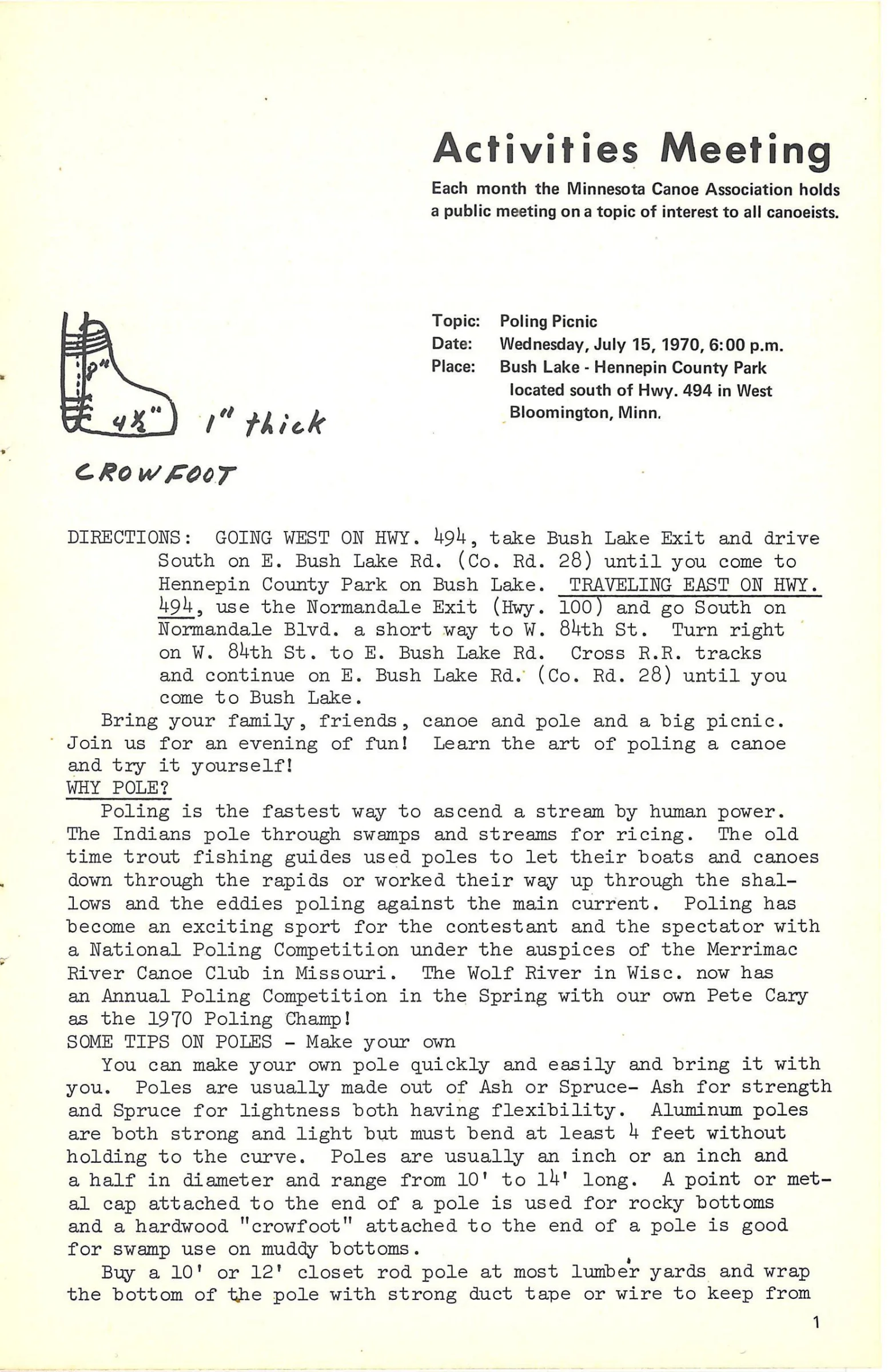
CROW LOOT
DIRECTIONS: GOING WEST ON HWY. 494, take Bush Lake Exit and drive
South on E. Bush Lake Rd. (Co. Rd. 28) until you come to
Hennepin County Park on Bush Lake. TRAVELING EAST ON HWY.
4o4, use the Normandale Exit (Hwy. 100) and go South on
Normandale Blvd. a short way to W. 84th St. Turn right ©
on W. 84th St. to E. Bush Lake Rd. Cross R.R. tracks
and continue on E. Bush Lake Rd. (Co. Rd. 28) until you
come to Bush Lake.
Bring your family, friends, canoe and pole and a big picnic.
* Join us for an evening of fun! Learn the art of poling a canoe
and try it yourself!
WHY POLE?
Poling is the fastest way to ascend a stream by human power.
The Indians pole through swamps and streams for ricing. The old
time trout fishing guides used poles to let their boats and canoes
down through the rapids or worked their way up through the shal-
lows and the eddies poling against the main current. Poling has
become an exciting sport for the contestant and the spectator with
a National Poling Competition under the auspices of the Merrimac
River Canoe Club in Missouri. The Wolf River in Wisc. now has
an Annual Poling Competition in the Spring with our own Pete Cary
as the 1970 Poling Champ!
SOME TIPS ON POLES - Make your own
You can make your own pole quickly and easily and bring it with
you. Poles are usually made out of Ash or Spruce- Ash for strength
and Spruce for lightness both having flexibility. Aluminum poles
are both strong and light but must bend at least 4 feet without
holding to the curve. Poles are usually an inch or an inch and
a half in diameter and range from 10' to 14' long. A point or met-
al cap attached to the end of a pole is used for rocky bottoms
and a hardwood "crowfoot" attached to the end of a pole is good
for swamp use on muddy bottoms. :
Buy a 10' or 12' closet rod pole at most lumber yards and wrap
the bottom of the pole with strong duct tape or wire to keep from
1
Article contents & approved summaries (0)
No article summaries are available for this view.