
To Karl
Title transcribed from original publication
Generated summary: A memorial tribute to Karl L. Ketter, combining an account of his death and loss to canoeing with a poem remembering his ideals and influence.
Open scan page 3August 1970 · Volume/issue not printed or unknown
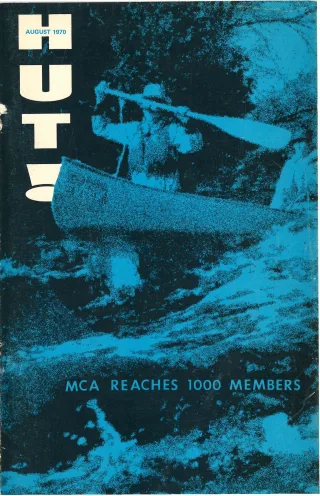
Magazine · 32 pages
August 1970 Magazine
Automatically captured text may contain recognition errors. Compare it with the original scan.
This shows the complete scan page, including any other material on it.
On Wilderness
When Dr. Paul Ehrlich (The Population Bomb) appeared at the Uni-
versity of Minnesota in April of 1970, hewas asked what he believed
an optimum population for the earth might be. He thought Earth
could comfortably support around a half billion people, each having
a maximum of free choice. "You want a population large enough so
that you could have large, active, swinging cities where people who
like that kind of life could live," he replied, "and small enough
so that you could have plenty of room for the hermits, and that
people could essentially live anywhere they wanted on a gradient of
population density, and where you could maximize your cultural di-
versity." First and foremost, the threat to our wilderness repre-
sents a symptom of an overpopulated world. Yet, Ehrlich's state-
ment provides a perfectly simple and valid reason for maintaining
wilderness areas in this country--namely, to guarantee each indivi-
dual's right to choose a wilderness if and when he so desires, to
be it for a weekend or a lifetime. Traditionally, the American has
been a frontiersman, one who could adapt to an environment devoid
of man's civilizing touch and still survive. Most of us no longer
choose a pioneering life, but to know that the wilderness is there
with its challenge is reason enough to maintain it.
Men like Robert Ardrey (African Genesis) and Desmond Morris
(The Naked Ape) have given consideration to man's animal nature and
origins, and have done much to further man's understanding of man.
A good deal of psychological confusion arose when it was decided
that the behavior of captive animals was often quite unlike that of
their free counterparts, thus, laying to rest many Freudian inter-
pretations of human behavior. Inorder to study animal behavior and
obtain meaningful results, they found it necessary to observe the
animal in a natural state, i.e., in the wild, in a wilderness. The
destruction of the world's wilderness areas may lock up forever many
of the secrets of the true nature of man, as well as many other mys-
teries of the biosphere which are under constant and fruitful inves-
tigation. a, ,
A person subjected to the headsplitting roar, of a jackhammer
seeks to remove himself from the source of the painful stimulus as
quickly as possible. A person exposed to the city: passing cars,
honking horns, sirens, throbbing engines, smoke, smells, and smog,
may desize at times to get away from it all. A wilderness is an
area essentially devoid of painful stimuli; the sounds, sights, and
smells are soft, pleasant, refreshing, even euphoric. The psycho-
logical value is incalculable.
There is a purity, a simplicity in nature, the observance of
which is a religion in itself. There is no distortion of values in
nature--no stilted priorities. Man does well to observe, to study,
18
Generated issue overview: The August 1970 issue of HUT!, the Minnesota Canoe Association newsletter, contains canoeing features, club history and news, a wilderness essay, race and cruise coverage, and camp-cookery recipes. It also includes event notices, race results, an advertisement, and a membership card.
Generated summaries are descriptions, not original captured text. Page-range text shows complete scan pages and may include neighboring material.
Title transcribed from original publication
Generated summary: A memorial tribute to Karl L. Ketter, combining an account of his death and loss to canoeing with a poem remembering his ideals and influence.
Open scan page 3Title transcribed from original publication
Generated summary: A biographical tribute describing Karl L. Ketter's early canoeing, racing career, founding and service to the Minnesota Canoe Association, and commitment to his family and the sport. The article concludes by honoring his legacy.
Open scan page 4Title transcribed from original publication
Generated summary: An excerpt from the first issue of a magazine published by Karl and Betty Ketter introduces canoe companies and presents canoeing and retreating to nature as a source of peace.
Open scan page 5Title transcribed from original publication
Generated summary: A report by cruise leader Abner Jones describes a generally pleasant Mississippi trip, slowed by warm weather and an upstream breeze. It emphasizes contacting the trip leader because plans and routes may change.
Open scan page 8Title transcribed from original publication
Generated summary: A humorous first-person account of a beginner's attempt to kayak under Sandy Morrison's instruction, including an unexpected capsize and escape from the kayak and weeds.
Open scan page 9Title transcribed from original publication
Generated summary: A history of the Minnesota Canoe Association from its beginnings as a group of pro racers through its reorganization, newsletter, canoe-building program, incorporation, growth, meetings, races, and cruises. It credits volunteers and leaders for the club's development.
Open scan page 11Title transcribed from original publication
Generated summary: A first-person account of the development of the MCA canoe-building program, including early strip-canoe designs, shared templates, the creation of a guide canoe, and the distribution of building plans.
Open scan page 14Title transcribed from original publication
Generated summary: A feature on the 3 M Canoe Club's organization as an MCA chapter, membership, canoe-building and mold program, and conservation activities.
Open scan page 19Title transcribed from original publication
Generated summary: A professional racing section reports on racers experimenting with bent paddles and previews MCA teams preparing for the Quebec race circuit. It also recounts the Peterson father-son team defeating a Michigan team in a race.
Open scan page 20Title transcribed from original publication
Generated summary: A club update explains how a member and his employer developed a mailing and membership program, and thanks the volunteers who helped enter and proofread the records.
Open scan page 22Title transcribed from original publication
Generated summary: A report on the July meeting at Bush Lake, where members tried canoe poling and heard a demonstration of techniques. It also describes upcoming poling championships and a recent Wisconsin race.
Open scan page 22Title transcribed from original publication
Generated summary: An editorial-style account of a visit to Ely and a wilderness trip, contrasting busy outfitting and tourist access with concerns about crowded campsites and imagining a satirical computer system to manage canoe travel.
Open scan page 23Title transcribed from original publication
Generated summary: An essay argues for preserving wilderness for individual choice, psychological well-being, scientific understanding, and cultural diversity. It criticizes treating the Boundary Waters Canoe Area as a timber or mineral resource and challenges commercial arguments for its exploitation.
Open scan page 24Title transcribed from original publication
Generated summary: A camp-cookery recipe for chicken soup with rice, fruit, onions, and seasonings, including preparation instructions and a note on using uncooked prunes.
Open scan page 29Title transcribed from original publication
Generated summary: A camp-cookery recipe for making a simple berry jam from whichever berries are available, with advice for handling thimbleberries and serving the jam.
Open scan page 30