
August 1970 · Volume/issue not printed or unknown
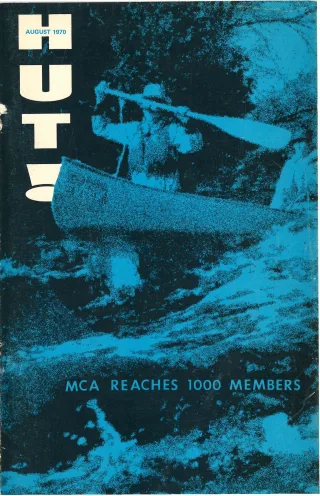
August 1970 Magazine
Magazine · 32 pages
Search this issue
August 1970 Magazine
Captured text — scan page 25
Automatically captured text may contain recognition errors. Compare it with the original scan.
to meditate, but the wilderness is the tabernacle, without which the
theology founders. But what is a wilderness? There are many pos-
sible discriptions, though simply stated, a wilderness is an area
with which man has not and may not meddle.
During a panel discussion of Minnesota's Boundary Waters Canoe
Area, held on the University of Minnesota campus during Earth Week,
1970, Dr. Frank H. Kaufert, Director of the School of Forestry at
Minnesota, considered the BWCA as a timber resource. He spoke of
undesirable and desirable tree species and forest types, stating
that modern sylvicultural techniques should be applied to the BWCA
in order to maintain a health forest community. He failed to see
the difference between a forest and a wilderness. The hemlock and
jackpine which he considers undesirable for both esthetic and com-
mercial reasons were put there bynature. For man to select against
such species would be for him to convert a wilderness into a tree
farm, and simplify a stable, complex ecosystem. A wilderness is a
showcase of nature's ability to get along all right without man at
a time when many people don't believe her capable of doing so.
Why would Americans defile their wilderness? Commercial rea-
sons spawned by the quick-buck ethic provide us with the answers:
men would exploit the wilderness for timber resources, mineral re-
sources, agricultural lands, living space, water resources and
others. Also there is the latent desire to "conquer the wilder-
ness." The classic Judeo-Christian ethic protrays man as a godlike
creature, superior to all other organisms. According to the Bible
God created man in his image and likeness, and gave him the world
for sustenance. Thus assured, most church-going businessmen un-
ashamedly point to their slag heaps, open pits, housing projects
and beer cans and give thanks to God for his kindness. The quick-
buck, cowbody ethic (foul your own nest and mo west) is unrecon-
cilable with wilderness.
What is to be gained from exploitation of a wilderness such as
the BWCA? Considering the finite nature of mineral resources, one
is forced to admit that reserves will one day be used up. Mining
the BWCA would be a stopgap measure, serving only to delay the ex-
haustion of reserves. When it becomes necessary to exploit the
BWCA, then it also becomes necessary to seek alternate minerals and
new retrieval techniques. Why wait till the BWCA is a moonscape of
eroded tailings-piles and open pits to face reality?
In this discussion of wilderness philosophy, I have avoided the
sheer esthetic value of untouched earth. There is no yardstick of
esthetic value. This discussion has also avoided charts, graphs,
and statistics, as there is no mathematical model of the variability
of peace of mind as a function of painful stimuli, no units of mea-
sure to weigh a wilderness against a jardin a la francaise.
I once thought that the preservation of wilderness areas was a
luxury, which wemight one day be unable to afford. I no longer be-
lieve this. Wilderness is essential to guarantee the psychological
stability and cultural diversity of the species, H. sapiens.
Mike Flannery
19
Article contents & approved summaries (0)
No article summaries are available for this view.