
March 1971 · Vol. 5 No. 4
March 1971 Magazine (Vol. 5 No. 4)
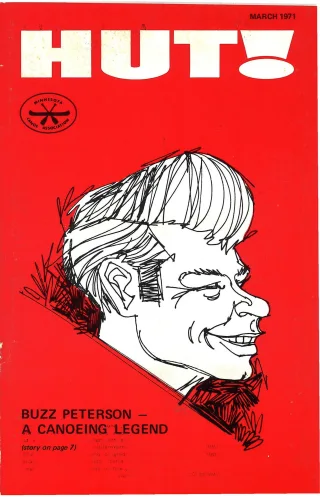
Magazine · 28 pages
Search this issue
For the full-resolution original, use Open PDF above. Your browser handles PDF zoom and navigation.
Searchable text for scan page 9
He’s somewhat profane and irreverent. He has a ready quip
and laugh. He lives and loves canoeing and, despite his
modesty, he is one of the outstanding canoe racers of all time.
He’s
BUZZ PETERSON —
A CANOEING LEGEND
by Larry Johns
A racer for 25 years, Irvin (Buzz) Peterson and in 1964 and 1966, he came home with
can’t even estimate the number of events he has __ first-place money.
won, but his victories include AuSable, Mont
Laurier, Sorel, Flin Flon, Ely-Atikokan, the
Aquatennial race and, with various partners, he — pyjj¢ our canoes in strict secrecy. Not even
has won the most prestigious race of all, the — gy partners would see a new canoe until we
“Classique Internationale De Canots” at were sure there’d be no last-minute
Shawinigan, Quebec, a fantastic nine times! changes.”
“Those were the days of no restrictions. We
“Karl Ketter convinced me to try racing. We
paddled from Little Falls to Monticello in For years the racers used 17 and 18-foot
one day. I’d never paddled more than an canoes. Then, one year, a 20-footer took most
hour at a time before. When Karl asked me of the major prizes, and the race was on. “If a
how I liked it, I was so tired I could barely 20-footer is faster than a 17, then a 22-footer
Site will be even faster.”’ Buzz wasn’t going to be
1 t it. going
REE eke AE OAL eR REE left behind. He built his canoes two feet longer
each year, eventually constructing a 30-footer
that looked as if it would carry all the charter
members of the MCA. These boats were fast
but expensive to build and awkward to trans-
port. In addition, the lack of standardization
caused races to be decided mainly by crafts and
not paddlers. This eventually led to the almost
universal 16-foot, 3-and-27 regulations. Most
canoes were woodstrip, but varnished rather
That was in 1947. Buzz grew up with the
Ketters, Estes, Jensens and Wizniaks in the
Brooklyn Park area, so it was natural that they
would spend a lot of time swimming, fishing,
boating and canoeing on the nearby Mississippi.
Karl was instrumental in starting the members...
of this group in racing — all were proficient and
became the nucleus of the Minnesota Profes-
hehomes i pcan tog Gea ES than fiberglassed. This was a full winter’s
Buzz competed in the Shawinigan Classic for Project, as each strip had to be carefully
the first time in 1952, finishing in eighth place. ‘@"ded, fitted, glued and edge-nailed. One year
His initial victory came in 1955. He finished Buzz experimented with plywood construction
second in 1956, but from 1957 through 1962 and a V bottom. The plywood worked fine, but
the 90-degree bottom made the canoe so tippy
that the paddlers expended as much energy
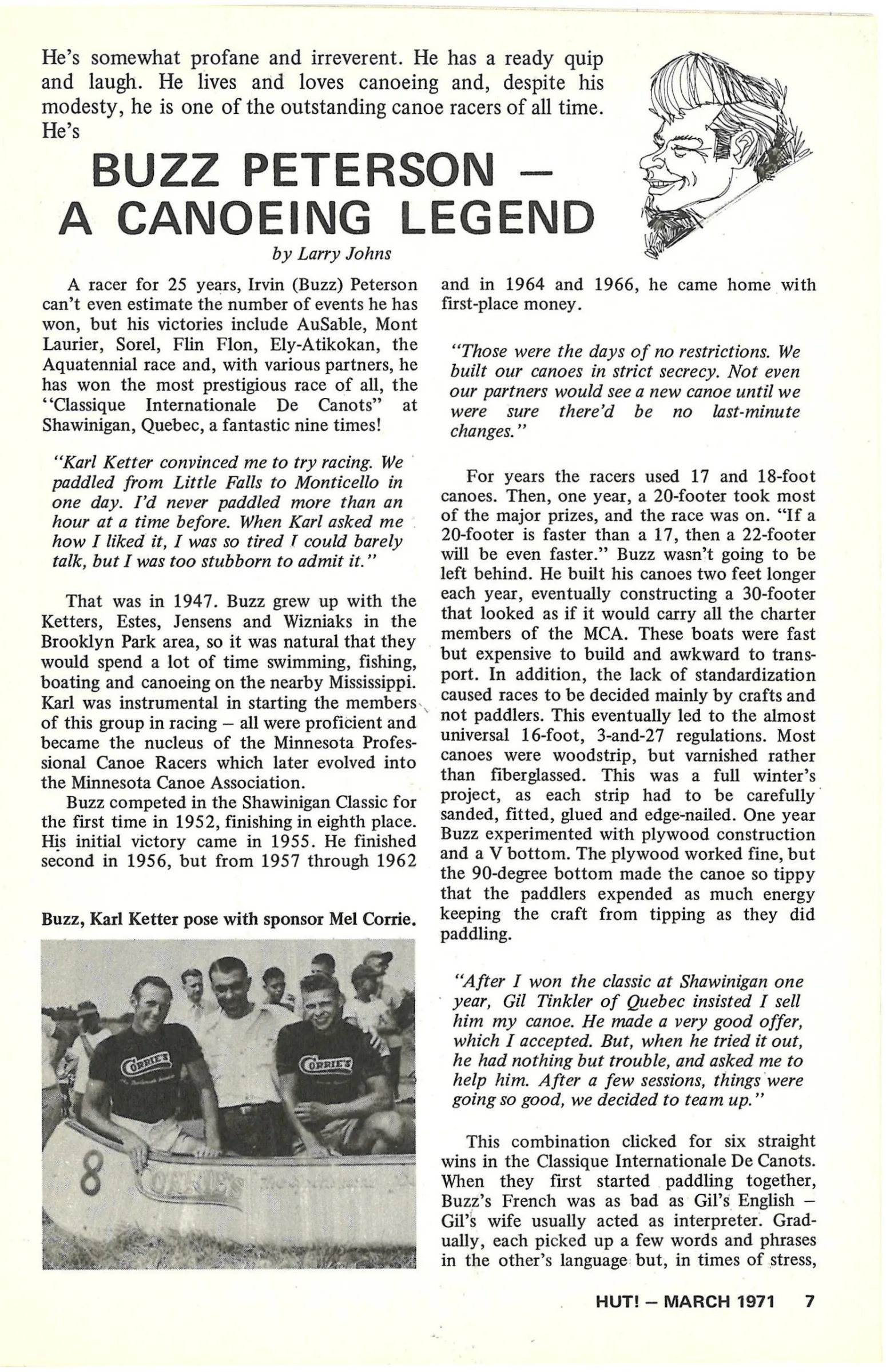
Buzz, Karl Ketter pose with sponsor Mel Corrie. — the craft from tipping as they did
paddling.
“After I won the classic at Shawinigan one
year, Gil Tinkler of Quebec insisted I sell
him my canoe. He made a very good offer,
which I accepted. But, when he tried it out,
he had nothing but trouble, and asked me to
help him. After a few sessions, things were
going so good, we decided to team up.”
This combination clicked for six straight
wins in the Classique Internationale De Canots.
When they first started paddling together,
Buzz’s French was as bad as Gil’s English —
Gil’s wife usually acted as interpreter. Grad-
ually, each picked up a few words and phrases
in the other’s language: but, in times of stress,
HUT! — MARCH 1971 7
Article contents & approved summaries (0)
No article summaries are available for this view.