
April 1971 · Vol. 5 No. 5
April 1971 Magazine (Vol. 5 No. 5)
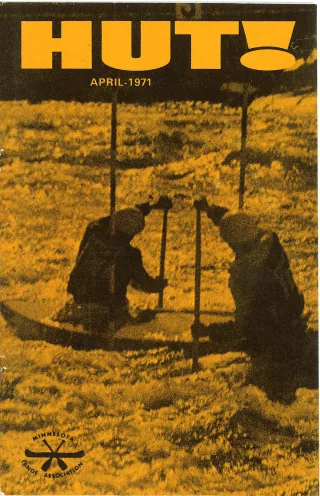
Magazine · 24 pages
Search this issue
April 1971 Magazine (Vol. 5 No. 5)
Captured text — scan page 20
Automatically captured text may contain recognition errors. Compare it with the original scan.
Protecting paddles for
flatwater differs from
whitewater-method
I read Mr. Button’s article on paddle repair
. in which he recommends using 50 oz.
roving and those layers and layers of assorted
weight cloth fastened to the ends of paddles
with epoxy “glue”.
For those who may wish a little less plastic
on their paddles I offer these suggestions (see
photos):
1. Apply fiberglass cloth and resin with the
paddle in a horizontal position to prevent the
resin from running down the blade.
2. Use one layer of 4 oz. glass on each side
of blade. Do not attempt to bend glass over the
Glass extends 1/4 inch over blade edges.
Apply fiberglass without bending over edges of
paddle blade.
16 HUT! — APRIL, 1971
edge, but run the glass past the edges of the
blade.
3. Trim excess glass to 1/4 inch over blade
size after resin has hardened.
4. Using thickened resin, fill in the notch
between the fiberglass extensions.
Karl N. Ketter
For further clarification, the editor asked Al
Button to reply to Karl’s comments.
Several points should be clarified.
1. Our roving is 18% oz., not 50 oz.
2. Only roving strands are used, not the
roving itself. The roving strands prevent the
resin from chipping and cracking, as unrein-
forced resin would do under brutal pounding.
3. Karl’s paddle is lighter, adequate for
cruising and flatwater racing, but would not
hold up well at all under the continual grinding
encountered in paddling upstream in rocky
rapids. I have worn through the 4-oz. cloth on
such a paddle in half a season, and then the
resin bead dropped off; hence the multiple
layers of cloth used on more recent models.
4. Both methods work well — for their
respective purposes. So decide where you will
use your paddle and then choose the best
method for you. (Karl and the other pros are
much more successful at avoiding rocks with
boats and paddles than are we whitewater
paddlers.) : Al Button
Herbst Opposes
BWCA Mineral Search
Minnesota Commissioner of Natural Re-
sources Robert Herbst has registered a strong
objection to announced plans of the USS.
Geological Survey to search for minerals in the
Boundary Waters Canoe Area. On Thursday,
March 4 the USGS revealed that they plan on
sending a mineral mapping team into the BWCA
this summer and that exploratory drilling might
be undertaken later.
Herbst said the mineral exploration is pre-
mature. The USGS says the information is
needed in order to establish a value on minerals
in case the courts decide that private mineral
holdings must either be purchased by the
federal government or allowed to be developed
by their owners. Herbst stated in a letter to
Secretary of Interior Rogers Morton: “It is my
conviction that mineral exploration in the
BWCA is undesirable and unnecessary until a
judgement has been entered by the court in the
lawsuit now pending in federal district court,
Duluth.” Herbst requested Secretary Morton to
reconsider any decision which may have been
made to proceed with the geologic mapping
program.
Article contents & approved summaries (0)
No article summaries are available for this view.