
May 1971 · Vol. 5 No. 6
May 1971 Magazine (Vol. 5 No. 6)
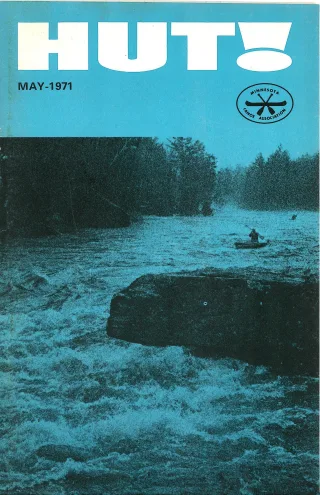
Magazine · 36 pages
Search this issue
May 1971 Magazine (Vol. 5 No. 6)
Captured text — scan page 25
Automatically captured text may contain recognition errors. Compare it with the original scan.
PROFESSIONAL RACING
Simple Formula Determines Bow Seat Placement
by Karl N. Ketter
Undoubtedly, the biggest problem with the factory-produced canoe is the placement of the
front seat. It just does not belong in the middle of the canoe. Most canoes are designed and built
by boat builders whose preoccupation with stability under horsepower does not allow for the
lightness or maneuverability of the man-powered canoe.
Seats should be positioned as close as possible to the ends of the canoe. Generally, the bow seat
is placed first, then the rear seat is mounted so that both the bow and stern draw the same depth.
Some time ago in HUT!, Janice and Janet Robidoux mentioned the simple proportion that can be
» used to position seats. The formula still holds firm as long as care is taken to keep the bowman as
close to the bow as his legs will allow. (Note: Measurements are to the front edge of the seat, as an
approximation of the center of mass of a paddler.) Here is the formula:
bowman’s weight _ sternman’s weight
distance from bow (unknown) distance from stern
or simply:
> . ° . :
distance from stern = St¢®#man’s weight times the distance from the bow
bowman’s weight
A properly-set bow seat makes a draw stroke more effective and less ridiculous than one done
from the center of the canoe. And, obviously, every stroke becomes less painful as the gunnels are
moved out of the way.
\)
|
|<— Bow->| AN l« STERN >
CENTER
distance distance
from bow HINT: Measure from front edge of from stern
both the bow and stern seats. Set
bow seat as close to bow as comfort-
able.
> . average for endurance events in deep water.
Sprinting and shallow water paddling has seen
70 to 90 strokes per minute, of which the latter
is rare. Fifty strokes per minute is about as slow
, as a paddler can stroke and still remain in
contention.
Q. Why are so few of the pro’s canoes Q. Where did nylon webbing for canoe
all-fiberglass? seats get started?
A.- Most racers build their own canoes and, A. In this area, Paul McCarthy of Brainerd
for these one-of-a-kind prototypes, it is easier was building nylon webbing seats in 1958-59.
to build a woodstrip canoe than the plug, mold, One of his canoes took the seats to Quebec in
and canoe process to get a fiberglass hull. Also, 1961, and it was the first there.
many of the top racers question the flexibility Experienced paddlers will answer readers’
of the glass hull. questions through this column. Send questions
Q. How fast do racers move those paddles? { The Oracle, P.O. Box 14177, University
A. Sixty strokes per minute is a good Station, Minneapolis 55414.
HUT! — MAY 1977. 9
Article contents & approved summaries (0)
No article summaries are available for this view.