
November 1970 · Vol. 5 No. 7
November 1970 Magazine (Vol. 5 No. 7)

Magazine · 24 pages
Search this issue
For the full-resolution original, use Open PDF above. Your browser handles PDF zoom and navigation.
Searchable text for scan page 7
Test That “Waterproof” Bag
lf You Value That Camera
by Ham Kurtz
Ever get water in your canoe? Ever swamp?
Ever sink? Ever ruin a camera? A watch?
Something valuable?
Interested in a waterproof bag? Some place
to put small valuables to protect them from
brief (several days perhaps) immersion?
Here are two suggestions which might help
you. One is a specific suggestion for a small bag
that has proved its value. The other suggestion
is a set of ways to check a bag for effectiveness
before it is put into use.
First, there are many types of containers
that can be used to protect small valuables.
Some are commercially available and others are
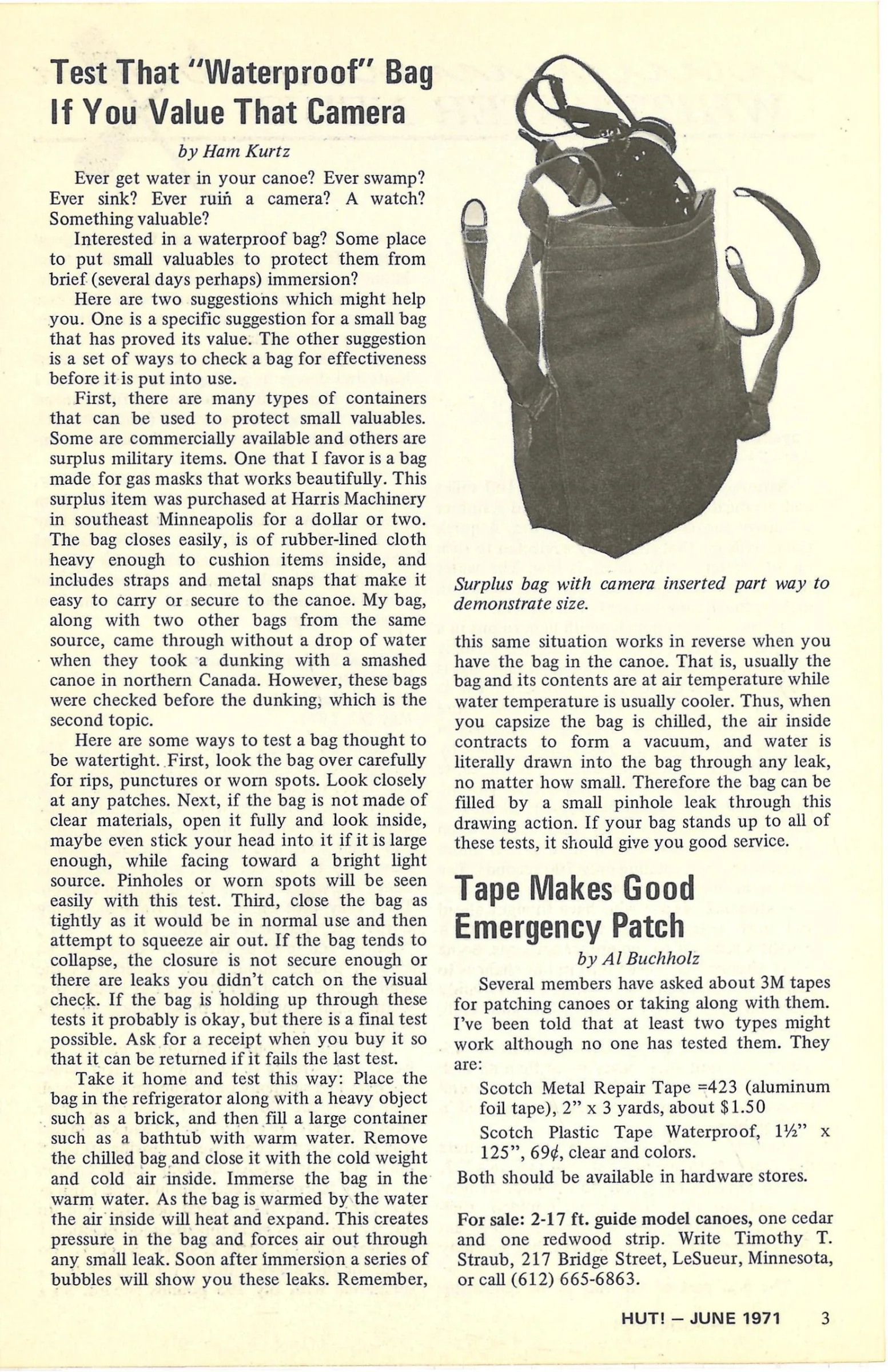
surplus military items. One that I favor is a bag
made for gas masks that works beautifully. This
surplus item was purchased at Harris Machinery
in southeast Minneapolis for a dollar or two.
The bag closes easily, is of rubber-lined cloth
heavy enough to cushion items inside, and
includes straps and metal snaps that make it syrplus bag with camera inserted part way to
easy to carry or secure to the canoe. My bag, demonstrate size.
along with two other bags from the same
source, came through without a drop of water this same situation works in reverse when you
- when they took a dunking with a smashed have the bag in the canoe. That is, usually the
canoe in northern Canada. However, these bags _ bag and its contents are at air temperature while
were checked before the dunking, which is the water temperature is usually cooler. Thus, when
second topic. you capsize the bag is chilled, the air inside
Here are some ways to testa bag thought to contracts to form a vacuum, and water is
be watertight. First, look the bag over carefully literally drawn into the bag through any leak,
for rips, punctures or worn spots. Look closely no matter how small. Therefore the bag can be
at any patches. Next, if the bag is not made of filled by a small pinhole leak through this
clear materials, open it fully and look inside, drawing action. If your bag stands up to all of
maybe even stick your head into it ifitislarge these tests, it should give you good service.
enough, while facing toward a bright light
source. Pinholes or worn spots will be seen Tape Makes G ood
easily with this test. Third, close the bag as
tightly as it would be in normal use and then
attempt to squeeze air out. If the bag tends to Emergency Patch
collapse, the closure is not secure enough or by Al Buchholz
there are leaks you didn’t catch on the visual Several members have asked about 3M tapes
check. If the bag is holding up through these for patching canoes or taking along with them.
tests it probably is okay, but there isa final test J>ye been told that at least two types might
possible. Ask for a receipt when you buy it so work although no one has tested them. They
that it can be returned if it fails the last test. are:
Take it home and test this way: Place the m1 rs :
bag in the refrigerator along with a heavy object ce rat ee pee nel phe gatas
such as a brick, and then fill a large container culitape)s a yates; gout . iA
such as a bathtub with warm water. Remove Scotch Plastic Tape Waterproof, 1%” x
the chilled bag and close it with the cold weight 125”, 69¢, clear and colors.
and cold air inside. Immerse the bag in the’ Both should be available in hardware stores.
warm water. As the bag is warmed bythe water
the air inside will heat and expand. This creates _ For sale: 2-17 ft. guide model canoes, one cedar
pressure in the bag and forces air out through and one redwood strip. Write Timothy T.
any small leak. Soon after immersion a series of Straub, 217 Bridge Street, LeSueur, Minnesota,
bubbles will show you these leaks. Remember, or call (612) 665-6863.
HUT! — JUNE 1971 3
Article contents & approved summaries (0)
No article summaries are available for this view.