
July 1971 · Vol. 5 No. 8
July 1971 Magazine (Vol. 5 No. 8)
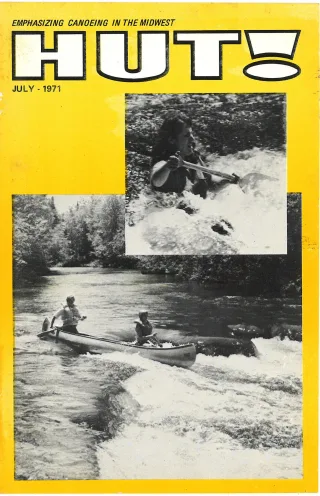
Magazine · 24 pages
Search this issue
July 1971 Magazine (Vol. 5 No. 8)
Captured text — scan page 18
Automatically captured text may contain recognition errors. Compare it with the original scan.
Answers to “Quiz on River Current”
on Page 8.
1. (b). Always lean downstream! The
only exception is when turning into a
back eddy. (Then lean upstream
slightly because the current is moving
upstream.) In other words, always
lean in the direction in which the
current is going. The reason for lean-
ing downstream is that the current
moving under the boat wants to twist
it upstream.
2. (a). Always lean outside when
making gradual turns! Note that this
outside lean is also downstream, since
the boat is veering toward the outside
and is pointed upstream. The lean
lifts the ends of the boat out of the
water and allows the current to slip
under the boat.
3. (b). Lean inside on most abrupt
turns! This situation (eddy turn) is
the only time you lean upstream.
4. (b). Lean inside (downstream, turn-
ing out of the eddy), unless you want
to do a “half Eskimo-roll”’.
5. (c). Facing upstream 45 degrees.
(You want to paddle against the
current, not with it.) And, of course,
lean downstream! A canoe held care-
fully in this position can be “ferried”
without losing ground across quite a
fast-moving current.
6. It all depends. In the event of being
spun around, one should be able to
do all three, as the situation de-
mands. Trying to turn around 180
degrees in a rapid can be dangerous if
there are lots of rocks. This is one
reason for learning to go backward.
7. (a). Lean into the rock (down-
stream). Otherwise the upstream gun-
nel of the canoe may dip under water
— if that happens, scratch one canoe!
8. (a) and (b). Smooth pillows and
upstream-pointing Vs almost always
indicate rocks. The “smooth pillow”
is the best all-around indicator —
learn to look for it hidden inside
other waves. (Does an otherwise
“choppy” wave have a “goose-bump”
somewhere? If so, avoid that spot.)
Downstream-pointing Vs are usually
in deep channels, and rollers and
haystacks are caused by the “hy-
draulic bounce” of water recoiling
from an abrupt drop. Incidentally,
the regular haystack varieties are
much less likely to fill up a canoe
than the mean-looking back-curlers
(rollers).
9. (a). Straight ahead is best. Otherwise,
you know the answer: lean down-
stream.. ,
10. (b). The edge of the haystacks is
generaliy safest. Heading at high
speed into back eddies (c) is danger-
ous — the boat is likely to spin
around and turn over.
11. It all depends. Never stay down-
stream of the canoe. You might get
pinned against a rock. Generally, (b)
— try to hold onto the canoe from
the upstream end, but in rare situa-
tions (terribly high water) you may
want to abandon it and go for shore.
If you must swim alone down a
rapid, go down feet first, on your
back, to hit off the rocks with your
feet and posterior. The only excep-
tion might be through terribly high
waves, where you turn your back to
the waves in order to breathe more
easily.
12. You're right.
As a bonus, here’s one more situation
which very often occurs. You’ve gotten
off course in a rapid and have to make a
sharp “‘cut” around a large rock. You first
lean outside (the sternman gradually turn-
ing with sweep and/or rudder strokes as
the bowman draws. Your canoe just grazes
the rock, and now you lean inside, making
an abrupt pivot about the rock. Notice
that in each situation you’re leaning down-
stream.
current
\
pa
Y
path of
canoe
14 HUT! — JULY 1971
Article contents & approved summaries (0)
No article summaries are available for this view.