Articles (19) · Summaries (19)
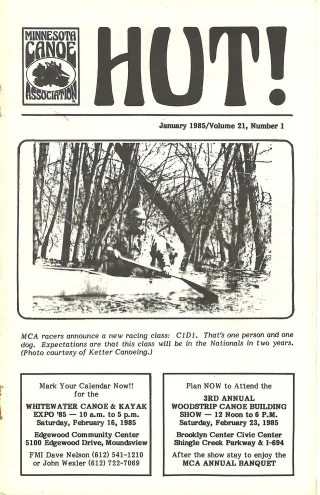
Generated issue overview: January 1985 issue of HUT!, the monthly newsletter of the Minnesota Canoe Association. The issue contains MCA program information, chapter features, canoeing and conservation articles, canoe-building guidance, and member news. It also includes advertisements, event listings, classifieds, board information, and a membership/order form; these non-article items are not listed as articles.
Generated summaries are descriptions, not original captured text. Page-range text shows complete scan pages and may include neighboring material.
UPCOMING MCA PROGRAMS
Title transcribed from original publication
Generated summary: Previews MCA programs scheduled for January through March 1985, including a Prepare to Paddle show, the Whitewater Expo, the canoe-building show, and a Boundary Waters workshop.
Open scan page 3
Read captured page 3 →
FROM THE BOW
Title transcribed from original publication
Generated summary: MCA President Al Gustaveson thanks outgoing president Venice Barsness and encourages members to support MCA programs and help the association grow.
Open scan page 4
Read captured page 4 →
BWCAW TESTS
Title transcribed from original publication
Generated summary: Reports on proposals to educate Boundary Waters Canoe Area Wilderness visitors, including a leader-training curriculum and a possible skills certificate or test.
Open scan page 5
Read captured page 5 →
Helpful Hints
Title transcribed from original publication
Generated summary: Offers a cold-weather paddling tip: use tall kitchen trash-can liners over socks and under shoes as makeshift waterproof coverings.
Open scan page 5
Read captured page 5 →
PUBLISHER'S NOTES
Title transcribed from original publication
Generated summary: Discusses the issue's new-old compact format, requests reader contributions and volunteer help, welcomes new staff, and announces a change to the Trading Post advertising policy.
Open scan page 6
Read captured page 6 →
ASK MCA!!!
Title transcribed from original publication
Generated summary: Introduces a reader question-and-answer feature inviting questions about canoeing, paddling, equipment, and trip planning for possible publication with answers from MCA members.
Open scan page 7
Read captured page 7 →
CHAPTERS IN THE MCA—WHAT THEY'RE ALL ABOUT
Title transcribed from original publication
Generated summary: Explains the MCA's regional and special-interest chapters, describing their activities and purposes, including Rapid Riders, regional chapters, Voyageurs, and Long Distance Racing.
Open scan page 8
Read captured pages 8–10 →
GOALS AND OBJECTIVES OF LONG DISTANCE RACING CHAPTER
Title transcribed from original publication
Generated summary: Sets out goals for building a stronger Minnesota canoe-racing circuit, including expanded race participation, prize-supported events, solo championships, and junior racing.
Open scan page 11
Read captured page 11 →
THE DULUTH TRAVELER
Title transcribed from original publication
Generated summary: A Twin Ports Chapter newsletter report describing recent Duluth paddling and rescue activities and sharing chapter updates and upcoming winter outings and presentations.
Open scan page 12
Read captured page 12 →
RAPID RIDERS WHITEWATER EXPO '85
Title transcribed from original publication
Generated summary: Describes the Whitewater Expo program, including films, seminars, demonstrations, equipment vendors, and a boat swap, with instructions for registering equipment for the swap.
Open scan page 14
Read captured page 14 →
CONSERVATION
Title transcribed from original publication
Generated summary: Reports on planned lake reclamation and fishery projects, Clean Lakes Program work, river protection legislation, and the Minnesota Nongame Wildlife Checkoff.
Open scan page 19
Read captured page 19 →
THE ECOLOGIST'S NICHE
Title transcribed from original publication
Generated summary: Explains how winterkill occurs when ice and snow limit oxygen replenishment in lakes, and describes conditions that make lakes more vulnerable to fish losses.
Open scan page 20
Read captured page 20 →
Lessons Learned in 1984
Title transcribed from original publication
Generated summary: A humorous list of canoeing and racing lessons, including observations about equipment, weather, cruises, and year-round paddling in Minnesota.
Open scan page 21
Read captured page 21 →
RAMBLINGS FROM SAFETY "ED" — CLASSES OF '85
Title transcribed from original publication
Generated summary: Previews the MCA's planned 1985 education and safety classes, including paddling fundamentals, rolling, river rescue, repair, poling, wilderness tripping, and solo paddling.
Open scan page 23
Read captured page 23 →
STRONGBACKS
Title transcribed from original publication
Generated summary: Gives step-by-step instructions for building and aligning a canoe-building strongback and forms, including construction, leveling, centering, and fairing.
Open scan page 24
Read captured pages 24–25 →
SANDING SEALER
Title transcribed from original publication
Generated summary: Warns canoe builders not to apply polyester resin over paint or sanding sealer, citing advice from resin and canoe-supply representatives.
Open scan page 25
Read captured page 25 →
WAX AND RESIN
Title transcribed from original publication
Generated summary: Explains that polyester resin needs a wax additive for its final surface cure and cautions that wax may not mix properly at temperatures below 50°F.
Open scan page 25
Read captured page 25 →
WHAT CAN YOU DO WITH 138 T-SHIRTS?
Title transcribed from original publication
Generated summary: A humorous account of how racing and other sports left the author with a large collection of race T-shirts, along with reflections on their uses and the difficulty of giving them away.
Open scan page 26
Read captured pages 26–27 →
EATIN' CROW!
Title transcribed from original publication
Generated summary: Revisits the author's changed opinions about canoe strokes, bent-shaft paddles, knives, and carrying fresh food on canoe trips.
Open scan page 28
Read captured pages 28–29 →