
January 1985 · Vol. 21 No. 1
January 1985 Magazine (Vol. 21 No. 1)
Magazine · 32 pages
Search this issue
January 1985 Magazine (Vol. 21 No. 1)
Captured text — scan page 20
Automatically captured text may contain recognition errors. Compare it with the original scan.
THE ECOLOGIST'S NICHE
Last month we talked about how a lake freezes. Now that the lakes
are frozen we can discuss another winter occurrence, winterkill. Winterkill
is said to occur whenever all or most of the fish, and sometimes other
organisms, die due to the severe conditions that winter presents. This is
sometimes not evident until spring when a large number of fish float to the
surface. How does winterkill occur?
Fish, like all organisms, need oxygen to survive. We all know that fish
get their oxygen from the water through their gills, but oxygen is not always
in constant supply in water as it is in the atmosphere. Lakes obtain their
oxygen in two main ways: through exchange with the air at the water's
surface, and through the photosynthesis of aquatic plants and algae. But in
the winter there is a covering of ice that prevents the exchange with air at
the surface, and photosynthesis may not occur at all. Aquatic plants and
algae, very few of which live under the ice, still need light to survive. Ice,
and the layer of snow that may be on top of it, may reduce light levels to
the point where no photosynthesis can occur. So once ice forms on a lake it
may not receive any additional oxygen input until the ice breaks up in the
spring. Whatever oxygen is present must last a long time. Unfortunately,
not only fish use up the oxygen. Other aquatic organisms use up some.
Decaying vegetation on the bottom uses up a lot more. Eventually, the
oxygen gets used up to the point where there simply is not enough to support
the fish life, and they perish.
Fortunately this does not occur in all our lakes. Where the water is
deep enough there may be sufficient oxygen in the water to last the whole
winter. Some lakes have open water all winter long, others have flow from
streams or rivers that carry oxygen to them. But lakes that have soft muddy
bottoms, are shallow, and have no flow or open water are in danger of
winterkill. Winterkill may not occur every winter, but it occurs often
enough in some waters so that the fish may not fully recover, and the
population will be small in size and low in numbers. Very often, in an
attempt to prevent winterkill, large aerators will be installed in lakes to
keep them oxygenated. Chances are that you know of some of these lakes in
your area.
Winter is a severe time of year for the fish and wildlife of the north
country. Winterkill is just one of the hazards of being a fish in Minnesota in
the winter. Folks who ice fish are another! — John Nosek
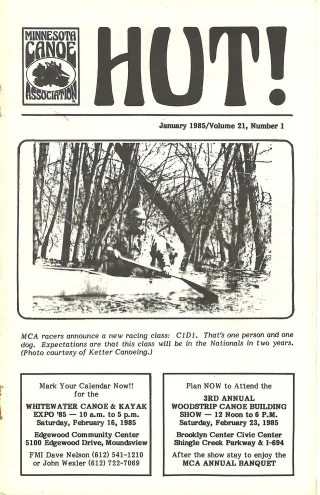
Sometimes racers don't always race. These secret photos show the truth
about those infamous "Rum River training runs." (Photo courtesy of Ketter
Canoeing.)
HUT! 20
Article contents & approved summaries (0)
No article summaries are available for this view.