← Back to The HUT

March 1985 · Vol. 21 No. 3

March 1985 Magazine (Vol. 21 No. 3)

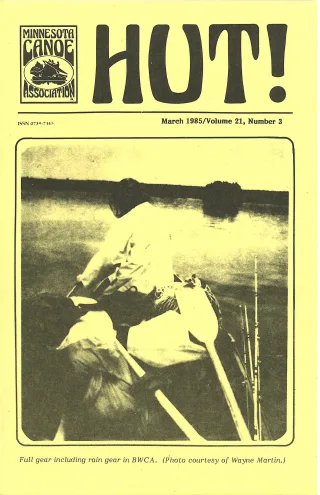
Issue first-page cover

Magazine · 40 pages

March 1985 Magazine (Vol. 21 No. 3)

Captured text — scan page 30

Automatically captured text may contain recognition errors. Compare it with the original scan.

This shows the complete scan page, including any other material on it.

CANOE LICENSE MONEY

Canoe license money — Over the dam? Under the bridge? Down the
drain? What happens to canoe license money, and how much is there,
anyhow? HUT! Editor John Wexler wanted to know, and he thought you'd
probably like to know too. SoI hied me off to the DNR to find out.

Kim Elverum, head of the DNR's Water Safety Section, said that as of
December 31, 1984, there were 128,361 canoes licensed in Minnesota:
86,000 aluminum canoes; 26,000 fiberglass canoes; 5,000 or more wood
canoes; and the rest are made of this, that, and Kevlar.

Since a license costs $7.00 for three years, one can compute annual
license income to the state to be $299,509. For easy recall that's $300,000.

From Steve Kirch (pronounced Kirk), River Recreation Supervisor, I
learned there is no correlation between revenues derived from licensing and
DNR programs related to canoeing, because it simply goes into the state's
general fund. Licensing was probably begun simply to tap a fresh source of
revenue for Minnesota, and not as a means of financing perceived needs in
canoeing recreation.

But wait! That does not mean there is no formal program for canoeing
or that other DNR programs do not touch or affect the sport.

The Canoe and Boating Routes Program was created by the state
legislature to serve canoeing (Minn. Statute 83.52). It provides six full-time
field people (one in each of the six DNR regions of the state) to monitor and
maintain nineteen rivers totalling more than 2,800 miles of recreational
waterways. Those six people form the Trails and Waterways crew and are
assisted by other DNR staff as projects and tasks require. Four program
functions are specified in the statute: to acquire sites, to develop and
maintain the sites, to remove obstructions, and to mark hazards.

Site acquisition is going forward in a manner financially painless to the
state, due in large measure to the cooperation of power and mining
companies. Kirch says that good cooperation with interdepartmental people,
as well as with other levels of government—county and municipal—has also
made site acquisition much easier than might be expected.

There are presently over 500 sites on nineteen rivers, with more being
added each year. A site may provide river access, a portage trail, picnic
facilities, camping facilities, or a combination of any or all of the above.

Developing and maintaining these sites is the second function of the
program, and might include keeping sites clean and trash-free, and maybe
even mowing grass.

The third job of the Trails and Waterways crew, to remove river
obstructions such as trees, refrigerators and automobiles, requires consider-
able time and effort, according to Steve Kirch. In this last, he says the DNR
regions are particularly helpful in providing staff and equipment to assist the
Trails and Waterways personnel.

The fourth and final responsibility is to mark hazards. Signs which are
aesthetically acceptable (you know how sensitive paddlers are) and yet are
resistant to the elements and vandals must effectively warn of lowhead
dams and dangerous rapids. Because five of the twenty-four drownings in
1984 involved lowhead dams, a lowhead dam warning sign program is starting
this spring.

HUT! 30

Articles (12) · Summaries (12)

Generated issue overview: March 1985 issue of HUT!, the Minnesota Canoe Association newsletter (Volume 21, Number 3). The issue includes association columns and club news, canoe racing and training information, conservation coverage of the BWCAW, canoe-building and paddling features, and practical information for canoeists.

Generated summaries are descriptions, not original captured text. Page-range text shows complete scan pages and may include neighboring material.

From the Bow

Title transcribed from original publication

Generated summary: The MCA president discusses the upcoming BWCA wilderness program, the association’s river-inventory reporting form, and canoeing safety, including Minnesota water-accident fatalities and the importance of taking safety courses.

Open scan page 3

Read captured page 3 →

About the Bow

Title transcribed from original publication

Generated summary: A brief note explains the history of the “From the Bow” column and its use by successive MCA presidents.

Open scan page 3

Read captured page 3 →

Publisher's Canoe Sense

Title transcribed from original publication

Generated summary: The publisher discusses the proposed BWCAW canoeing education program, invites reader responses, and solicits volunteer help, club news, and submissions for HUT!.

Open scan page 4

Read captured page 4 →

Long Slow Days—1985 Spring Training

Title transcribed from original publication

Generated summary: An overview of spring endurance training for canoe racers, describing the long river workouts, likely routes, required gear, and the need for drivers and vans.

Open scan page 9

Read captured page 9 →

MUCK Arises from the Mighty Muddy

Title transcribed from original publication

Generated summary: A short report describes the growth of the Mankato-area canoe and kayak club MUCK and its aim to paddle canoes and kayaks in many places.

Open scan page 7

Read captured page 7 →

MUCK Pool Slalom

Title transcribed from original publication

Generated summary: A report on MUCK’s first pool slalom, held at Mankato State University, describing its participation and the event’s goals and race classes.

Open scan page 7

Read captured page 7 →

Why the Rapid Riders Are Always Smiling

Title transcribed from original publication

Generated summary: A humorous explanation attributes paddlers’ cheerfulness near waterfalls to negative ions and their reported effects on serotonin.

Open scan page 11

Read captured page 11 →

Conservation

Title transcribed from original publication

Generated summary: The article describes the environmental impacts of canoe use in the BWCAW and the development of a user certification program focused on wilderness knowledge, low-impact practices, trip planning, and safety.

Open scan page 25

Read captured page 25 →

The Ecologist's Niche

Title transcribed from original publication

Generated summary: The column explains how animal body size and extremity size vary with climate, illustrating Bergmann’s Rule and Allen’s Rule with examples of Minnesota and Texas wildlife.

Open scan page 26

Read captured page 26 →

A Brief Planning Guide to the BWCA

Title transcribed from original publication

Generated summary: A practical guide to BWCA trip reservations, permits, ranger-station contacts, group and equipment rules, and timing a visit to avoid the busiest periods.

Open scan page 27

Read captured page 27 →

Anyone Can Build a Canoe (But You Have to Have More Faith Than Your Neighbors)

Title transcribed from original publication

Generated summary: A personal account of rebuilding a badly damaged wood-strip canoe, including problems with mismatched forms and fitting replacement strips, and the satisfaction of getting the canoe back on the water.

Open scan page 28

Read captured pages 28–29 →

Canoe License Money

Title transcribed from original publication

Generated summary: The article estimates Minnesota canoe-license revenue and explains that it goes to the state general fund, then describes the state Canoe and Boating Routes Program and its work on river sites, obstructions, and hazard signs.

Open scan page 30

Read captured pages 30–31 →