Articles (19) · Summaries (19)
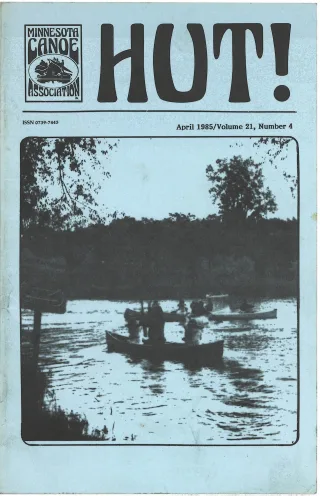
Generated issue overview: April 1985 issue of HUT!, the monthly newsletter of the Minnesota Canoe Association. The issue contains association news, canoeing and conservation articles, chapter updates, letters, class information, calendars, advertisements, and member services.
Generated summaries are descriptions, not original captured text. Page-range text shows complete scan pages and may include neighboring material.
FROM THE BOW
Title transcribed from original publication
Generated summary: The MCA president discusses spring river conditions, requests river-level reports, promotes upcoming events and the new canoe convention, and describes the association's courses and activities for the year.
Open scan page 4
Read captured page 4 →
ROOKIES '85
Title transcribed from original publication
Generated summary: Describes the Long Distance Canoe Racers' weekly rookie training sessions on the Mississippi River, explaining how newcomers learn racing skills by paddling with experienced racers.
Open scan page 6
Read captured page 6 →
RACING CANOE AVAILABILITY
Title transcribed from original publication
Generated summary: Introduces North American racing-canoe manufacturers, offers advice for choosing a racing hull, and lists manufacturers, designs, materials, and local builders.
Open scan page 7
Read captured pages 7–8 →
EASTERN WHITEWATER TRIP SETS OUT
Title transcribed from original publication
Generated summary: Brief chapter-news report naming paddlers departing for a ten-day trip to the Nantahala Outdoor Center, with hopes of returning with new skills.
Open scan page 9
Read captured page 9 →
RAPID RIDERS SET GUIDELINES FOR SCHOLARSHIPS
Title transcribed from original publication
Generated summary: Reports the Rapid Riders' criteria for selecting class scholarship recipients, including paddling and teaching ability, chapter commitment, financial need, joint review, and a repayment arrangement after course completion.
Open scan page 9
Read captured page 9 →
TWIN PORTS NEWS
Title transcribed from original publication
Generated summary: Reports on spring runoff and paddling opportunities around the Twin Ports, outlines planned spring trips and the MCA convention, and announces a canoe-building opportunity with Greg Furtman.
Open scan page 10
Read captured page 10 →
"FAS BACK"
Title transcribed from original publication
Generated summary: A humorous fictional piece imagines a canoe fitted with solar-powered bow thrusters that can propel its paddler out of rapids.
Open scan page 11
Read captured page 11 →
NORTH COUNTRY CANOE CONVENTION
Title transcribed from original publication
Generated summary: Announces the Duluth Chapter's first annual canoe convention near the Bois Brule River, describing the YMCA camp venue and planned paddling, instruction, recreation, and family activities.
Open scan page 14
Read captured page 14 →
A CUT ABOVE THE REST
Title transcribed from original publication
Generated summary: Discusses the history and uses of the hand-axe, argues that it is best used for splitting kindling and related camp tasks rather than chopping large wood, and gives safety guidance for its use.
Open scan page 17
Read captured pages 17–19 →
CRUISIN' ALONG: WHERE WERE YOU?
Title transcribed from original publication
Generated summary: Explains how MCA cruises are organized, what participants and leaders are responsible for, how to contact cruise leaders, and how members can become involved in leading trips or submitting reports.
Open scan page 27
Read captured page 27 →
THE ECOLOGIST'S NICHE
Title transcribed from original publication
Generated summary: Explains ecological succession using the progression of a Minnesota lake through marsh, pond, and terrestrial stages, and describes how human actions can speed up or slow down the process.
Open scan page 28
Read captured page 28 →
CONSERVATION NOTES
Title transcribed from original publication
Generated summary: Notes Minnesota watercraft-registration figures and advises boaters to register early. It also discusses proposed Iowa legislation affecting public access to waterways and urges recreationists to respect landowners' property.
Open scan page 29
Read captured page 29 →
BUILDER'S CORNER
Title transcribed from original publication
Generated summary: Describes a builder's mistake with the West System epoxy hardener pump, explains the pump's five-to-one resin-to-hardener ratio, and recommends following the priming and measuring instructions.
Open scan page 33
Read captured page 33 →
DEAR MCA: Letter on canoe-license funding
Title transcribed from original publication
Generated summary: Clarifies how canoe-license revenue, state appropriations, land-acquisition funds, and development funds support Minnesota's Canoe and Boating Route Program.
Open scan page 38
Read captured pages 38–39 →
DEAR MCA
Title transcribed from original publication
Generated summary: Argues that canoe racers are an important part of the MCA and that the association should recognize and encourage its different canoeing specialties.
Open scan page 39
Read captured page 39 →
DEAR MCA: Invitation to the Mississippi River Canoe Classic
Title transcribed from original publication
Generated summary: Invites MCA members to participate in the Mississippi River Canoe Classic and Junior Classics and requests volunteers, spectator outreach, and financial support.
Open scan page 39
Read captured page 39 →
DEAR MCA
Title transcribed from original publication
Generated summary: Criticizes the MCA's low public profile and recommends stronger publicity, media outreach, and board support for promoting the association and its activities.
Open scan page 39
Read captured pages 39–41 →
THE EVILS OF THE "IN" GROUP
Title transcribed from original publication
Generated summary: Uses humor and personal anecdotes to describe how a newcomer can become involved in the MCA, arguing that the association needs more active members to share its work.
Open scan page 42
Read captured pages 42–44 →
ASK MCA!!!
Title transcribed from original publication
Generated summary: Answers reader questions about estimating whether BWCAW streams are canoeable at low water and how to assess water levels on Minnehaha Creek.
Open scan page 45
Read captured page 45 →