← Back to The HUT

June 1985 · Vol. 21 No. 6

June 1985 Magazine (Vol. 21 No. 6)

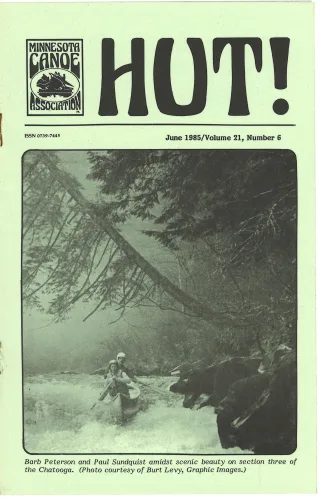
Issue first-page cover

Magazine · 40 pages

June 1985 Magazine (Vol. 21 No. 6)

Captured text — scan page 35

Automatically captured text may contain recognition errors. Compare it with the original scan.

The issue of brightly colored camping gear is minor, but I agree that

earth tones are nicer. All one has to do is go to a popular BWCAW lake in

- July or August to see the hillsides splashed with every color of tent in the

rainbow. Bright colors do no long-lasting damage to the wilderness.

However, I will say that if you are dependent on your blazing orange tent to
guide you back to your campsite, you're in big trouble!

It was unfair of Cliff to characterize the people working on the
BWCAW User Education Program as incompetent. This effort enjoys broad
support from many outdoor educators who are dedicated, competent, and
have a concern for our natural resources. This effort should never be
dismissed as a group of elitists who are arbitrarily trying to impose
restraints on wilderness users.

I also think it was irresponsible to tacitly suggest disregarding laws you
don't agree with, as he did in the second article. Some people disagree with
the restrictions on motorboats and snowmobiles in the BWCAW, and for that
matter with the ban on cans and bottles. Should these laws simply be
disregarded if we disagree with them? I hope not. There is no law banning
the use of hand axes in the BWCAS. Hopefully, there will never be one.

Before I finish let me say that I respect Cliff Jacobson and I know he is
a dedicated outdoor educator who shares the goal of protecting our natural
resources. I ask him, and you, to consider the following:

When we talk of an environmental ethic, there is an implied under-
standing that our natural resources are finite. The BWCAW is in fact a tiny
remnant of the virgin forests that dominated Minnesota a mere 120 years
ago. This remnant is a priceless part of our heritage that must be
protected—NOT JUST FOR TOMORROW BUT FOR ALL TIME. At current
usage, the BWCAW doesn't have time right now to properly recouperate
from its annual summer thrashing. What will the BWCAW look like in 2020,
or 2285, or for that matter 5985? The BWCAW has existed since the last ice
age in roughly its present form. What will Ogishkemuncie Lake look like in
5,000 years? I shudder to think about it.

The major emphasis of the BWCAW User Education Program is
environmental awareness to reduce the problem of user impact on the
resource. It is a far sighted effort to head off problems and reduce the need
for regulations such as the can and bottle laws. Our alternatives are to put
a tight limit on BWCAW use through use permit restrictions (the mechanism
for this exists today), accept a diminished resource, or educate people on
camping practices that minimize their impact on the environment. The
Forest Service has wisely chosen the option of education over regulation,
and they are asking for our help in pulling it off.

Everyone agrees that the improper use of the hand axe is a major
factor in camper abuse of the wilderness. Since it's basically an unnecessary
tool, let's discourage it in the BWCAW-—just as we've discouraged the use of
bough beds, guns, and soaping up in the lakes. What do you think, Cliff?
Would you be willing to risk taking a trip without your hand axe or your
orange tent? I know several hundred outdoor people who would gladly show
you how. — Greg Lais

(Ed. note: Greg Lais is the director of Wilderness Inquiry II, a non-profit,
Minneapolis-based program that conducts wilderness canoe and dogsled trips
for integrated.groups of physically disabled and non-disabled persons.)

HUT! — 35

Articles (12) · Summaries (12)

Generated issue overview: June 1985 issue of HUT!, the monthly newsletter of the Minnesota Canoe Association. The issue includes canoeing trip reports, MCA columns, wilderness-use commentary, chapter news, and convention information.

Generated summaries are descriptions, not original captured text. Page-range text shows complete scan pages and may include neighboring material.

From the Bow

Title transcribed from original publication

Generated summary: A column on canoe-building tools and filler, followed by advice about axes and brightly colored equipment in the Boundary Waters Canoe Area. The author argues that most BWCA visitors can leave hand axes at home and rely on a small saw.

Open scan page 4

Read captured page 4 →

From the Stern

Title transcribed from original publication

Generated summary: The editor explains why recent letters and differing opinions about wilderness practices were published, and asks members to help with HUT! writing, planning, and production.

Open scan page 5

Read captured page 5 →

St. Cloud Canoe Club

Title transcribed from original publication

Generated summary: A first-person account of the St. Cloud club's first official 1985 trip, from Little Rock Lake through a channel to the Mississippi River, including the wind, boats, lunch stop, and challenging current near Sartell dam.

Open scan page 9

Read captured page 9 →

Down South

Title transcribed from original publication

Generated summary: A Rapid Riders group's ten-day whitewater trip in the southeastern United States, describing runs on rivers including the Nantahala, Ocoee, French Broad, Chattooga, and Nolichucky, along with the group's experiences and mishaps.

Open scan page 11

Read captured pages 11–12 →

The Duluth Traveler

Title transcribed from original publication

Generated summary: A Twin Ports chapter newsletter report on recent spring paddling trips and the chapter's upcoming canoe convention at Lake Nebagamon.

Open scan page 13

Read captured page 13 →

Who Are We?

Title transcribed from original publication

Generated summary: An introduction to the Twin Ports Chapter: its history, organization, trip program, range of paddling activities, welcome for beginners, and relationship with the MCA.

Open scan page 14

Read captured page 14 →

Cruising Etiquette

Title transcribed from original publication

Generated summary: Guidance for cruise leaders and participants on contacting the leader, honestly assessing skill and equipment, organizing shuttles, preparing before launch, and keeping groups together on the river.

Open scan page 16

Read captured page 16 →

1st Annual MCA Canoe Convention to Be Held June 7, 8 and 9

Title transcribed from original publication

Generated summary: An invitation and overview of the first annual MCA Canoe Convention at the Superior-Douglas County YMCA camp on Lake Nebagamon, describing lodging, meals, paddling, classes, and other activities.

Open scan page 24

Read captured page 24 →

BWCA User Education Program

Title transcribed from original publication

Generated summary: Forest Service staff explain the BWCA user education program's aims of reducing campsite damage and promoting considerate wilderness use. They discuss axes, trip preparation, clothing, equipment colors, and map-and-compass skills in response to prior HUT! commentary.

Open scan page 32

Read captured pages 32–33 →

Grinding Cliff's Axe

Title transcribed from original publication

Generated summary: A response to Cliff Jacobson's views on hand axes and camping gear. The author argues that axes are unnecessary and can contribute to wilderness damage, supports discouraging their use, and calls for education to reduce human impact on the BWCAW.

Open scan page 34

Read captured pages 34–35 →

Conservation Notes

Title transcribed from original publication

Generated summary: A reflection on differing opinions about wilderness practices, arguing that people should use equipment responsibly and remain aware of their impact on wilderness areas.

Open scan page 36

Read captured page 36 →

The Ecologist's Niche: Wildlife Profiles

Title transcribed from original publication

Generated summary: A wildlife profile of the common loon, covering its appearance, calls, adaptations, nesting, diet, and the importance of observing nesting birds without disturbing them.

Open scan page 37

Read captured page 37 →