Articles (12) · Summaries (12)
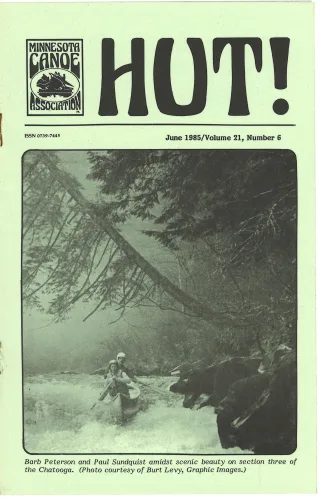
Generated issue overview: June 1985 issue of HUT!, the monthly newsletter of the Minnesota Canoe Association. The issue includes canoeing trip reports, MCA columns, wilderness-use commentary, chapter news, and convention information.
Generated summaries are descriptions, not original captured text. Page-range text shows complete scan pages and may include neighboring material.
From the Bow
Title transcribed from original publication
Generated summary: A column on canoe-building tools and filler, followed by advice about axes and brightly colored equipment in the Boundary Waters Canoe Area. The author argues that most BWCA visitors can leave hand axes at home and rely on a small saw.
Open scan page 4
Read captured page 4 →
From the Stern
Title transcribed from original publication
Generated summary: The editor explains why recent letters and differing opinions about wilderness practices were published, and asks members to help with HUT! writing, planning, and production.
Open scan page 5
Read captured page 5 →
St. Cloud Canoe Club
Title transcribed from original publication
Generated summary: A first-person account of the St. Cloud club's first official 1985 trip, from Little Rock Lake through a channel to the Mississippi River, including the wind, boats, lunch stop, and challenging current near Sartell dam.
Open scan page 9
Read captured page 9 →
Down South
Title transcribed from original publication
Generated summary: A Rapid Riders group's ten-day whitewater trip in the southeastern United States, describing runs on rivers including the Nantahala, Ocoee, French Broad, Chattooga, and Nolichucky, along with the group's experiences and mishaps.
Open scan page 11
Read captured pages 11–12 →
The Duluth Traveler
Title transcribed from original publication
Generated summary: A Twin Ports chapter newsletter report on recent spring paddling trips and the chapter's upcoming canoe convention at Lake Nebagamon.
Open scan page 13
Read captured page 13 →
Who Are We?
Title transcribed from original publication
Generated summary: An introduction to the Twin Ports Chapter: its history, organization, trip program, range of paddling activities, welcome for beginners, and relationship with the MCA.
Open scan page 14
Read captured page 14 →
Cruising Etiquette
Title transcribed from original publication
Generated summary: Guidance for cruise leaders and participants on contacting the leader, honestly assessing skill and equipment, organizing shuttles, preparing before launch, and keeping groups together on the river.
Open scan page 16
Read captured page 16 →
1st Annual MCA Canoe Convention to Be Held June 7, 8 and 9
Title transcribed from original publication
Generated summary: An invitation and overview of the first annual MCA Canoe Convention at the Superior-Douglas County YMCA camp on Lake Nebagamon, describing lodging, meals, paddling, classes, and other activities.
Open scan page 24
Read captured page 24 →
BWCA User Education Program
Title transcribed from original publication
Generated summary: Forest Service staff explain the BWCA user education program's aims of reducing campsite damage and promoting considerate wilderness use. They discuss axes, trip preparation, clothing, equipment colors, and map-and-compass skills in response to prior HUT! commentary.
Open scan page 32
Read captured pages 32–33 →
Grinding Cliff's Axe
Title transcribed from original publication
Generated summary: A response to Cliff Jacobson's views on hand axes and camping gear. The author argues that axes are unnecessary and can contribute to wilderness damage, supports discouraging their use, and calls for education to reduce human impact on the BWCAW.
Open scan page 34
Read captured pages 34–35 →
Conservation Notes
Title transcribed from original publication
Generated summary: A reflection on differing opinions about wilderness practices, arguing that people should use equipment responsibly and remain aware of their impact on wilderness areas.
Open scan page 36
Read captured page 36 →
The Ecologist's Niche: Wildlife Profiles
Title transcribed from original publication
Generated summary: A wildlife profile of the common loon, covering its appearance, calls, adaptations, nesting, diet, and the importance of observing nesting birds without disturbing them.
Open scan page 37
Read captured page 37 →