Articles (16) · Summaries (16)
Generated issue overview: The July 1985 issue of HUT!, the Minnesota Canoe Association's monthly newsletter, featuring association and chapter news, canoeing instruction, conservation material, letters, and member-submitted content alongside schedules, forms, advertisements, and other non-article material.
Generated summaries are descriptions, not original captured text. Page-range text shows complete scan pages and may include neighboring material.
FROM THE BOW
Title transcribed from original publication
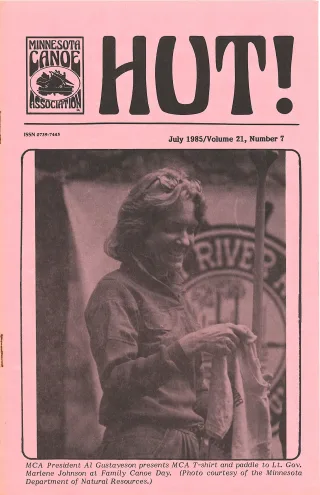
Generated summary: The MCA president reflects on recent canoe events, including Family Canoe Day and the canoe convention, and encourages readers to join future paddling activities.
Open scan page 4
Read captured page 4 →
FROM THE STERN
Title transcribed from original publication
Generated summary: The editor recounts the canoe convention, invites readers to a planned Quebec trip, requests article submissions and an editor volunteer, and comments on HUT! contributions.
Open scan page 5
Read captured page 5 →
MANNERS AND SPORTSMANSHIP
Title transcribed from original publication
Generated summary: The author urges club members to avoid insulting criticism and labels, and argues for fair treatment of partners when boats or equipment are damaged or lost.
Open scan page 10
Read captured page 10 →
AI-supplied descriptive title: Report on the First MCA Canoe Convention
AI-supplied descriptive title
Generated summary: A report describes the first MCA annual convention at Lake Nebagamon, including attendance, classes, recreational activities, contributors, and thanks to organizers.
Open scan page 11
Read captured page 11 →
BUG ZAPP
Title transcribed from original publication
Generated summary: A humorous fictional advertisement describes an invented solar-powered sound barrier said to keep insects away from canoeists.
Open scan page 12
Read captured page 12 →
DEAR MCA
Title transcribed from original publication
Generated summary: A letter thanks Tom Nicodemus and the convention volunteers for organizing the first MCA Canoe Convention, noting the event's inclusive activities and childcare.
Open scan page 12
Read captured page 12 →
DEAR MCA
Title transcribed from original publication
Generated summary: A letter congratulates the Twin Ports Chapter on the first annual convention, praising its instruction, activities, setting, and hospitality.
Open scan page 12
Read captured page 12 →
OFFSIDE LEAN
Title transcribed from original publication
Generated summary: A canoeing technique article explains how leaning opposite the turn helps the stern swing and can improve sharp turns and control in side winds.
Open scan page 16
Read captured page 16 →
Efficient Canoeing
Title transcribed from original publication
Generated summary: A report describes a canoe school class in which students practiced paddling techniques on backwaters and the St. Croix River.
Open scan page 24
Read captured page 24 →
Beginning Whitewater
Title transcribed from original publication
Generated summary: A student recounts MCA beginning-whitewater instruction and trips, describing basic strokes, river conditions, safety practices, and the challenges of paddling rapids.
Open scan page 24
Read captured pages 24–25 →
CONSERVATION NOTES
Title transcribed from original publication
Generated summary: A conservation update shares information on walleye eggs, reporting damaged public boat launches, lake-access maps, and required nighttime boating lights.
Open scan page 26
Read captured page 26 →
THE ECOLOGIST'S NICHE
Title transcribed from original publication
Generated summary: A guide describes edible uses for several aquatic plants and cautions readers to respect protected areas and wildlife when gathering wild foods.
Open scan page 26
Read captured page 26 →
QUICKIE CRUISING
Title transcribed from original publication
Generated summary: An invitation describes weekly practice sessions for paddlers interested in faster cruising, including where participants meet and what equipment to bring.
Open scan page 27
Read captured page 27 →
STOP AND SMELL THE ROSES CRUISE
Title transcribed from original publication
Generated summary: The author describes a leisurely Mississippi River cruise focused on wildlife and natural history, with meeting and shuttle details for participants.
Open scan page 27
Read captured page 27 →
BOUNDARY WATERS CANOE AREA WILDERNESS (BWCA) USER EDUCATION PROGRAM
Title transcribed from original publication
Generated summary: The article explains the BWCA user education program and the development of leader training to teach wilderness ethics, minimum-impact camping, and responsible visitor practices.
Open scan page 28
Read captured pages 28–29 →
PALM BEACH BROWNIES
Title transcribed from original publication
Generated summary: A recipe gives ingredients and instructions for chocolate brownies, with a note that the batch was eaten by the Efficient Paddling Class.
Open scan page 33
Read captured page 33 →