
September 1985 · Vol. 21 No. 9
September 1985 Magazine (Vol. 21 No. 9)
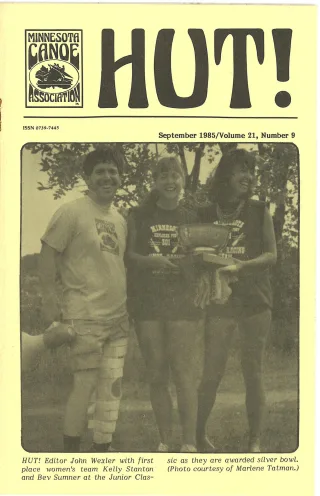
Magazine · 32 pages
Search this issue
September 1985 Magazine (Vol. 21 No. 9)
Captured text — scan page 14
Automatically captured text may contain recognition errors. Compare it with the original scan.
CHAPTER NEWS (Continued)
The rookies desire and expect to get examples and information on the
following topics:
RACING ETIQUETTE: Learn rookie's name. Don't intentionally bump
(gunnel contact) other canoes. Never ram (bow contact) another canoe.
Paddle as close to other canoes as possible and make efforts to avoid
contact. If contact occurs, separate canoes with the least loss of
momentum to both. When gaining on a stern, warn the other canoe's
sternman about his paddle blade. When canoes are very close, paddle in
unison with the other canoe to avoid paddle dueling. Be polite when
addressing partners or other teams. Explain to a rookie if your anger is
directed elsewhere. Thank the rookie for paddling with you. Invite all
rookies to paddle again. Talk to and get names and addresses of all new
people as soon as they arrive at the parking lot.
FORMAT: At or before 6:00, each racer should ask one of the rookies
to paddle. Try to pick a new one each week. Since rookies and racers differ
in potential and experience, teams should be adjusted to avoid very slow or
very fast combinations. The racer should supply his racing canoe and a
paddle for the rookie, who should have his own PFD. If a racer is without a
eanoe, HE should request to borrow an "extra" one from its OWNER. Do not
paddle C-1's unless no one else is available.
As soon as a partner is chosen, launch, paddle upstream to the 35W
bridge and wait. Use that 10 minute paddle to teach your rookie the basics
of stroke, hut, and upstream steering.
When most teams have arrived at 35W (adjust any mismatched teams),
turn downstream and paddle slowly in a group to the starting beach; stop
paddling to regroup and get straggling teams from shore. Paddle in a pack
to the I-94 bridge and pause to take up gaps.
Paddle to the Lake Street Bridge and wait for all canoes to arrive.
The slower canoes that arrive last should cruise to the front of the pack at
each rest stop.
Paddle in a pack to the Ford Bridge and wait.
Paddle upstream to the Lake Street Bridge and wait.
Paddle to the take out point and portage to ears. (Have the rookie
help tie the canoe down, especially if it's a borrowed boat.)
Sprint to the restaurant chosen by a vote of the survivors. (Avoid
consecutive weeks at the same restaurant.) Be sure to invite your rookie
and others who may have been overlooked. Check that all teams finished
and check for any equipment left by parking lot.
THE HUT: Call hut at the beginning of a stroke and complete the
entire stroke; 8 to 10 strokes per side. This is a steering technique that
eliminates energy absorbing paddle dragging. Invented in early '40s in 10-
day Minneapolis Aquatennial Derby. "Hut" phrase coined by Gene Jensen
about 1948.
THE STROKE: Use rotation of the shoulders around the spine rather
than arm motion to carry the load. Reach forward with the tip of the
paddle, not with body or top shoulders. Top hand low and is weighted ("push
down"). Top elbow may flex but bottom elbow never flexes. Avoid "locking"
elbows. The stroke has rhythm in that the "pull" takes longer than the
"recovery". 60 strokes per minute is normal and easy if the canoe is up to
speed. Explain when and why the stroke rate is varied. The stroke can be
adjusted for rate ("quicker, slower"), speed, depth, length, forward reach,
rear reach, and power ("harder, easier"). The rookie should watch a racer in
a nearby canoe as an example, but tell the rookie what part of the racer's
HUT! 14
Article contents & approved summaries (0)
No article summaries are available for this view.