
January 1987 · Vol. 23 No. 1
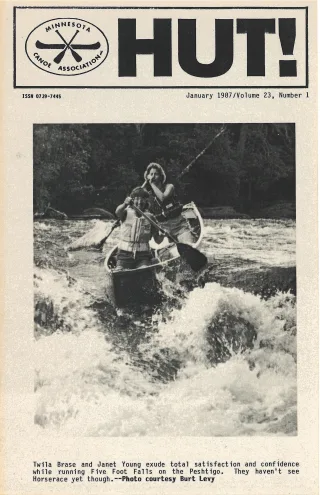
January 1987 Magazine (Vol. 23 No. 1)
Magazine · 36 pages
Search this issue
For the full-resolution original, use Open PDF above. Your browser handles PDF zoom and navigation.
Searchable text for scan page 8
THROUGH THE DROWNING MACHINE - CONTINUED FROM PAGE 7
2. If you should ever round a bend and find yourself careening
over a dam not shown on your map, put steering on hold and paddle
furiously to try to clear the recirculating wave below the dam.
3. If, despite your efforts, you are caught in this
recirculating froth (or if you become trapped in a hole while running
whitewater), be aware that the way out is down, not up. You can dive
even in a PFD, or you can extend a paddle below (if you have one),
but the object is to catch the current that is being propelled away
from the dam near the bottom of the river. I was lucky enough to be
sucked to that depth by accident. Judging from the way I emerged
(and, incidentally, my boat, too), that current is very powerful and
will literally eject you downstream, clear of the dam or hole.
4. If you are in a water accident and inhale water, do as I did
and go as soon as possible to a hospital emergency room for a chest
x-ray and blood gases analysis. Far too many people have survived
near drownings only to die as much as 48 hours later from pneumonia
or other respiratory complications.
5. Finally, if this isn't already obvious, realize that dams of
any size and type, but expecially dams on rivers at flood stage are
dangerous. STEER CLEAR OF DAMS, from the top or bottom, regardless
of your confidence in yourself, your partner, your boat, or your
rescue equipment. Sometimes it takes days to recover bodies after
accidents at low-head dams.
All I actually lost as a result of my accident were my hat and
some pride, but that day of illusions was an expensive one for me.
To its credit, my boat, designed brilliantly by Bob Brown and crafted
expertly by Martin Van, sustained relatively little damage. (Nothing
like the one on the cover of the October '86 HUT!) It's insured, but
it will still cost me the $100 deductible to have the boat restored
to its original condition. I have medical insurance, too, but I'11
be paying 20% of my $225 ER and doctor bill. The significance of the
dollar signs fade, however, when I realize that I could have paid for
this experience with ultimate currency; my life.--Sue Hix
MORE ON LOW-HEAD DAMS
I am very familiar with the Berning Mill dam, having led trips on
the Crow river for several years. There have been many drownings at
this dam in the past few years. (Fortunately, no MCA members.) Sue
was extremely fortunate to have survived to tell of her experience.
The mill has been out of operation for many years and the dam no
longer serves any useful purpose. The dam is already starting to
deteriorate on the left half. This may have contributed to Sue's
being spit out by the current. Perhaps the MCA as a group should
seek the removal of this dangerous hazard. Let us hope that
something can be done before any more deaths occur.
One point that Sue did not mention that is extremely important is
rescue attempts for anyone caught by a low-head dam. DO NOT GO INTO
THE CURRENTS PRODUCED BY THE DAM. Rescue attempts by boat will only
produce more victims. Rescue by rope is the only way that can be
used with safety. The Minnesota Department of Natural Resources has
a pamphlet entitled "The Drowning Machine" which tells of the hazards
of low-head dams and should be required reading for all canoeists and
boaters. Burt Levy has informed me that the "Drowning Machine"
pamphlet will be available at the Whitewater Expo. There is also a
movie by the same title available from the DNR film library. This
film shows the proper rescue techniques to be used at low-head dams.
Even though the graphic scenes of actual drownings may be upsetting,
it is well worth seeing and will educate the viewers to the dangers
posed by these dams.--James Robinson
8 HUT!
Article contents & approved summaries (0)
No article summaries are available for this view.