
August 1987 · Vol. 23 No. 8
August 1987 Magazine (Vol. 23 No. 8)
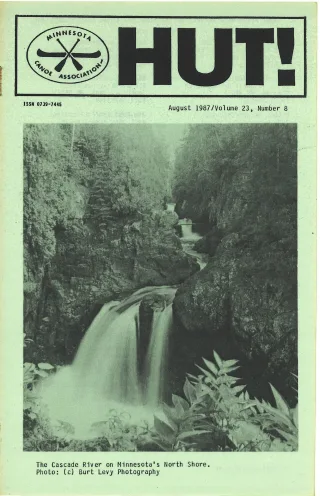
Magazine · 28 pages
Search this issue
For the full-resolution original, use Open PDF above. Your browser handles PDF zoom and navigation.
Searchable text for scan page 6
CLIFF'S CORNER--BEGINNINGS
It's easy to forget our beginnings. Easy
to overlook the difficulties we all faced when
learning to canoe. Now, as experts, we shake
our heads wonderingly at those who “still
don't understand." For us, the strokes and
Maneuvers seem so easy: Backferry, peel-out,
eddy-turn, sweeps, prys, post, hook. Was
there ever a time when these procedures were
‘not self-evident? You bet!
Case in point: In early May, I taught a
one day class in Basic River Canoeing through
the Science Museum of Minnesota. Participants
arrived bright-eyed and eager, anxious to
learn the way of canoe and paddle. But most
were beginners, or at best, advanced
beginners. The course is as it says--"Basic
River Paddling." No technical whitewater
maneuvers, ala bow-first eddy turns and heavy-
water ferries, at least not at this point. The “How to Paddle"
basics would have to come first.
Back in my Neanderthal college days, my old forestry professor
Charlie Miller frequently admonished: "Trouble with most teachers,"
he said, "is that they teach too much too fast."
Yep. Prof Miller was right. Practice makes perfect. Again and
again. And so to my philosophy of teaching the ways of the river.
In the past, my day long river classes were split between four
hour quiet water sessions on Lake Rebecca in Hastings, and an
afternoon of rock dodging in the ordinarily high spring freshets of
the Kinnikinnic River in Wisconsin. The shallow Kinni is a maze of
twists and turns. It's a wonderful "learning" stream, as it
continually reinforces correct paddle procedures.
Surprisingly, upsets are common. About 30 percent will tip once.
One crew flipped six times! But the river is safe, and by day's end,
draws, cross-draws, prys, sweeps and ferries are burned vividly into
the mind.
Now, in absurdly low water, it was necessary to make some
compromises. Rebecca was algae choked; the Kinni was walkable. The
obvious choice was Taylor's Falls. So, off we went, 14 enthusiastic
students, a gaggle of canoes, and a slightly pessimistic teacher. I
had no intent of using the Class II waters of the dalles with this
crowd. It would simply be too intimidating (or so I thought).
Prof Miller's philosophy was keyed into four basic strokes: The
draw and cross-draw at the bow, and draw and pry in the stern. Yes,
I'm aware of the heavy water advantages of the bow pry, but I also
recognize the danger of using this stroke in rock-strewn shallows.
And, the abuse to which the paddle shafts and gunnel are subjected.
The cross-draw would suffice.
Within minutes, partners had learned the basic turning strokes.
The fun came when emphasis was placed on coordination. Right and
left pivots, right and left side-slips! "No communication with your
partner, Just do ‘em folks!"
A mind set develops as each partner discovers how a given stroke
affects each end of the canoe. Change paddle sides, and pandemonium.
Change canoe ends--and paddle sides--and utter confusion. Getting it
"right" takes around two hours. By two p.m. the fog was penetrated!
Now comes the fun--learning to paddle backwards in a straight
line (via conventional backstrokes, back draws, and reverse J's at
the bow). It's pointless to work in current until you've mastered
the art of straight line backing--a procedure still unfamiliar to
some who claim to be “experts."
6 HUT!-August 1987
Article contents & approved summaries (0)
No article summaries are available for this view.