
October 1987 · Vol. 23 No. 10
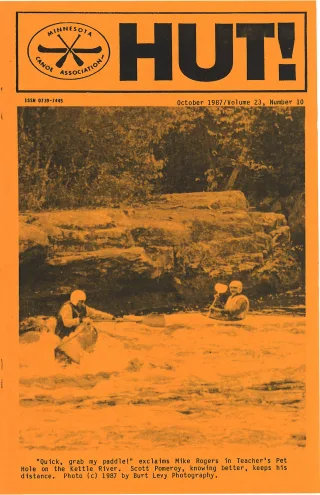
October 1987 Magazine (Vol. 23 No. 10)
Magazine · 32 pages
Search this issue
For the full-resolution original, use Open PDF above. Your browser handles PDF zoom and navigation.
Searchable text for scan page 6
CLIFF’S CORNER--A MATTER OF "PROPER TEACHING"
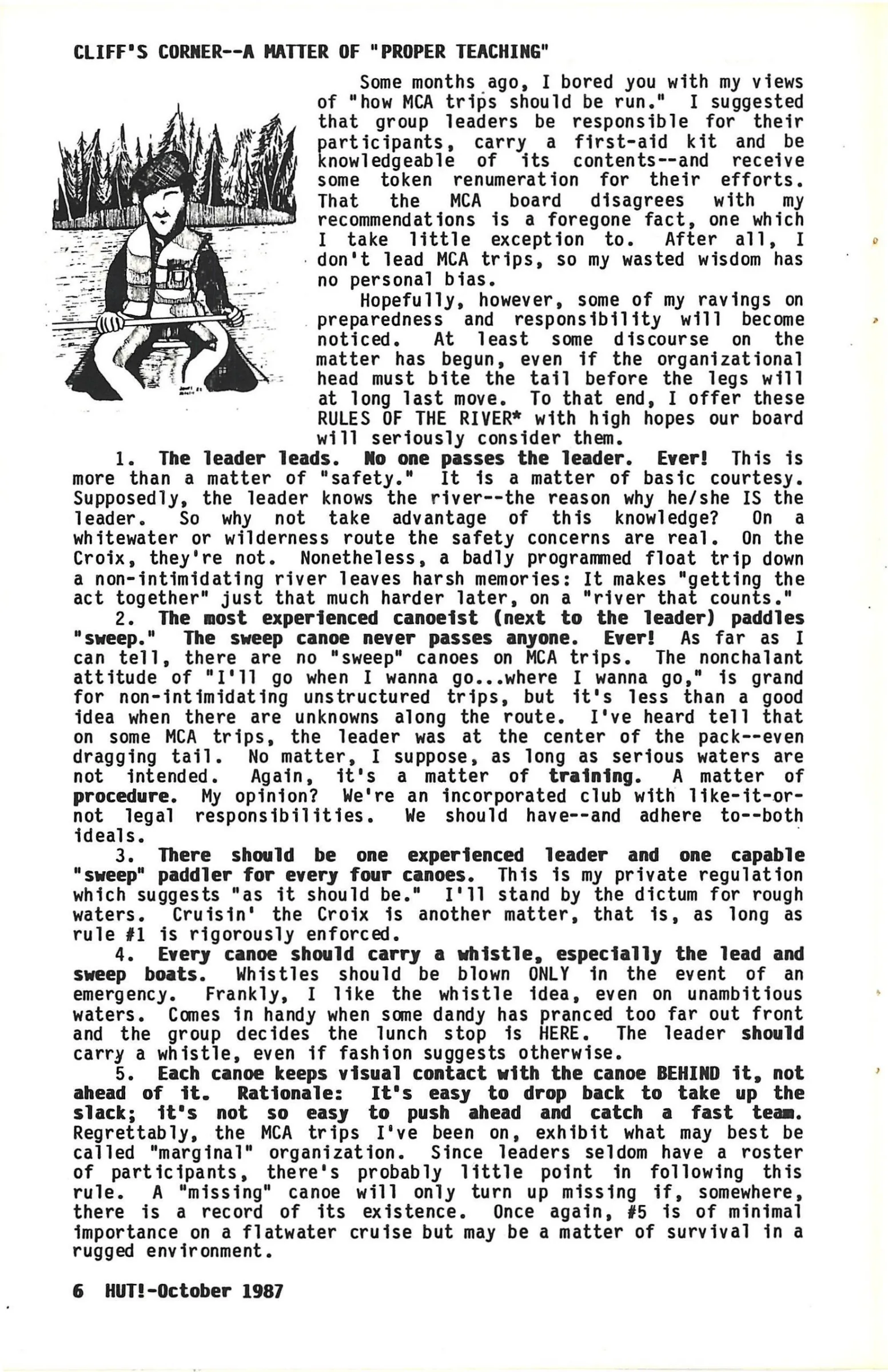
Some months ago, I bored you with my views
of “how MCA trips should be run." I suggested
that group leaders be responsible for their
participants, carry a first-aid kit and be
knowledgeable of its contents--and receive
some token renumeration for their efforts.
That the MCA board disagrees with my
recommendations is a foregone fact, one which
I take little exception to. After all, I
- don't lead MCA trips, so my wasted wisdom has
no personal bias.
Hopefully, however, some of my ravings on
preparedness and responsibility will become
noticed. At least some discourse on the
matter has begun, even if the organizational
head must bite the tail before the legs will
at long last move. To that end, I offer these
RULES OF THE RIVER* with high hopes our board
will seriously consider them.
1. The leader leads. Wo one passes the leader. Ever! This is
more than a matter of "safety." It is a matter of basic courtesy.
Supposedly, the leader knows the river--the reason why he/she IS the
leader. So why not take advantage of this knowledge? On a
whitewater or wilderness route the safety concerns are real. On the
Croix, they're not. Nonetheless, a badly programmed float trip down
a non-intimidating river leaves harsh memories: It makes “getting the
act together" just that much harder later, on a “river that counts."
2. The most experienced canoeist (next to the leader) paddles
"sweep." The sweep canoe never passes anyone. Ever! As far as I
can tell, there are no “sweep" canoes on MCA trips. The nonchalant
attitude of "I'll go when I wanna go...where I wanna go,” is grand
for non-intimidating unstructured trips, but it's less than a good
idea when there are unknowns along the route. I've heard tell that
on some MCA trips, the leader was at the center of the pack--even
dragging tail. No matter, I suppose, as long as serious waters are
not intended. Again, it's a matter of training. A matter of
procedure. My opinion? We're an incorporated club with like-it-or-
not legal responsibilities. We should have--and adhere to--both
ideals. ,
3. There should be one experfenced leader and one capable
"sweep" paddler for every four canoes. This is my private regulation
which suggests “as it should be." I'11 stand by the dictum for rough
waters. Cruisin’ the Croix is another matter, that is, as long as
rule #1 is rigorously enforced.
4. Every canoe should carry a whistle, especially the lead and
sweep boats. Whistles should be blown ONLY in the event of an
emergency. Frankly, I like the whistle idea, even on unambitious
waters. Comes in handy when some dandy has pranced too far out front
and the group decides the lunch stop is HERE. The leader should
carry a whistle, even if fashion suggests otherwise.
5. Each canoe keeps visual contact with the canoe BEHIND it, not
ahead of it. Rationale: It’s easy to drop back to take up the
slack; it’s not so easy to push ahead and catch a fast team.
Regrettably, the MCA trips I've been on, exhibit what may best be
called “marginal" organization. Since leaders seldom have a roster
of participants, there's probably little point in following this
rule. A “missing" canoe will only turn up missing if, somewhere,
there is a record of its existence. Once again, #5 is of minimal
importance on a flatwater cruise but may be a matter of survival in a
rugged environment.
6 HUT!-October 1987
Article contents & approved summaries (0)
No article summaries are available for this view.