
From the Bow
Title transcribed from original publication
Generated summary: A brief humorous editorial explains that the president's monthly message was missing because of computer trouble.
Open scan page 4September 1987 · Vol. 23 No. 9
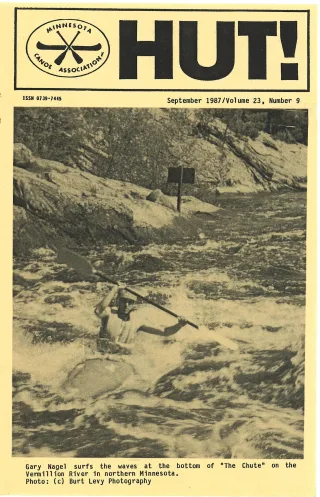
Magazine · 36 pages
September 1987 Magazine (Vol. 23 No. 9)
Automatically captured text may contain recognition errors. Compare it with the original scan.
This shows the complete scan page, including any other material on it.
SAFETY AND EDUCATION--LIGHTNING STORMS
At the July Rapids Riders meeting, questions regarding lightning
storms and how best to deal with them were raised. They were brought
up during a comparison of on-the-river-behavior witnessed by club
members on different occasions.
The background information on lightning and safe practices was
found in: "Mountaineering-the Freedom of the Hills" by the Seattle
Mountaineers; "Summit March '84" article by Bill March; "The Whole
Hikers Handbook" from "Backpacker", article by Geoffrey Childs; and
"Manual for Ski Mountaineering" by the Sierra Club. /
There seem to be four ways people are affected by lightning. Up
strokes, down strokes, ground currents and induced currents.
Sometimes the bolt will leave the ground and be drawn upwards.
Here the victim gets the full power of the bolt with generally fatal
results.
More people survive downstrokes. Here bolts are made of several
strokes, each following a random path. The victim doesn't get the
full effect and 70% of them recover entirely.
Induced currents are small and come about in metal objects on
your person. They add to ground currents and so you should set aside
metal objects.
By far and away, the biggest but least obvious danger is due to
ground currents. Here people are injured or die because they lack
knowledge of hazards and protective measures.
After a strike, the charge spreads out like ripples in a pond
growing weaker with distance. Wet surfaces allow current to retain
its strength. These ground currents are enough to stop the heart or
breathing. Victims may need mouth to mouth resuscitation or CPR.
Victims without serious injury may still go into shock or be
disoriented for some length of time.
Here are some recommended behaviors:
1. Get off the river! Even if you aren't burnt to a crisp, you
could be disoriented and drown.
2. Don't be near the tallest objects. 15% of the fatalities are
found under large trees. Standing out in a meadow isn't much better.
Being in a group of the smaller trees is safer. Make sure they won't
blow down on you.
3. Crevices and gullies will be wet and dangerous.
4. Spread out. If people stay 30' apart, help will be available
for any victims.
5. Span as small a distance as possible (mimimum contact area
with the ground). Even at night, don't lie down, Sit or crouch with
your feet together and hands off the ground.
6. Insulate yourself by crouching on foam pads, ropes, clothes.
The drier the better.
7. Stay out of caves and overhanging rock recesses. Current
often jumps from roof to floor using the victim as a bridge for the
gap.
8. Cliff faces are current paths, so stay 50'-80' away.
9. Communicate with each other. Lots of folks need TLC in these
storms. At night in your tents, it is important to call out to the
other tents after those close ones, “Are you okay?" Don't kid
yourself, they aren't sleeping either. .
So be aware of your environment. Always remember that nature is
far bigger than you. Accept that you may have to change your plans.
--George Skinner, Education and Safety Director
14 HUT!-September 1987
Generated issue overview: September 1987 issue of HUT!, the monthly publication of the Minnesota Canoe Association (Volume 23, Number 9). The issue contains canoe-trip reports, safety and canoeing features, association updates, event information, advertisements, and classified material.
Generated summaries are descriptions, not original captured text. Page-range text shows complete scan pages and may include neighboring material.
Title transcribed from original publication
Generated summary: A brief humorous editorial explains that the president's monthly message was missing because of computer trouble.
Open scan page 4Title transcribed from original publication
Generated summary: A first-person account of a relaxed two-day Namekagon River outing, describing the paddling, swimming, campsite, playful activities, and friendships made on the trip.
Open scan page 4Title transcribed from original publication
Generated summary: The author describes finding scattered garbage and heavy motorboat use during a visit to Voyageurs National Park, while also noting its wildlife and potential as a canoeing destination.
Open scan page 7Title transcribed from original publication
Generated summary: A letter updates the progress of a canoe journey across the St. Croix and Brule rivers to Lake Superior, recounting low-water travel, portages, rapids, and a wind-bound stay near Ontonagon.
Open scan page 10Title transcribed from original publication
Generated summary: Bob Brown recounts paddling a hundred-mile stretch of the Mississippi in Iowa and joining the MADRAC group paddle, describing the welcoming towns, fellow participants, and memorable stops.
Open scan page 12Title transcribed from original publication
Generated summary: An educational article explains lightning hazards and recommends safety practices for paddlers, including leaving the river, spacing out, crouching with minimal ground contact, and checking on others.
Open scan page 14Title transcribed from original publication
Generated summary: An essay describes how a powerboat's attempt to be considerate by slowing down can create a hazardous wake for canoeists, and argues for better communication and an MCA policy on the issue.
Open scan page 16Title transcribed from original publication
Generated summary: The editor reports on HUT! archive donations and bound volumes, notes that the president is not seeking reelection, and encourages members to consider serving on the MCA board.
Open scan page 17Title transcribed from original publication
Generated summary: A Twin Ports Chapter newsletter update recalls a moonlight paddle, mentions a delayed wilderness trip and an upcoming club election, and directs readers to contact a chapter leader about an Apostle Islands trip.
Open scan page 20Title transcribed from original publication
Generated summary: A report describes new Forest Service procedures that may allow some lightning-caused fires to burn under monitored conditions in the Boundary Waters Canoe Area Wilderness, while retaining strict protection for public safety and high-value areas.
Open scan page 24Title transcribed from original publication
Generated summary: The author recounts a group paddle through the St. Anthony Falls locks, a brunch at St. Anthony Main, and a return trip to the river, inviting readers to a future outing.
Open scan page 25Title transcribed from original publication
Generated summary: The second part of a canoe-building comparison discusses the application, curing, safety, and shelf life of polyester and epoxy resins, concluding that epoxy produces a better finished product while polyester can be easier and more flexible to apply.
Open scan page 26Title transcribed from original publication
Generated summary: Cliff Jacobson critiques magazine gear evaluations, arguing that short testing periods, advertising pressures, and simplified ratings can mislead readers; he urges consumers to assess equipment through personal use and experienced advice.
Open scan page 28Title transcribed from original publication
Generated summary: Sheila Huber describes an alarming first kayaking trip on the Brule River, including repeated capsizes and fear, and concludes by recommending that beginners take instruction from trained professionals.
Open scan page 30Title transcribed from original publication
Generated summary: A brief editorial note clarifies that the group in Sheila Huber's account was not affiliated with the MCA or Rapids Riders Chapter and warns about outfitters renting equipment to unqualified customers.
Open scan page 31