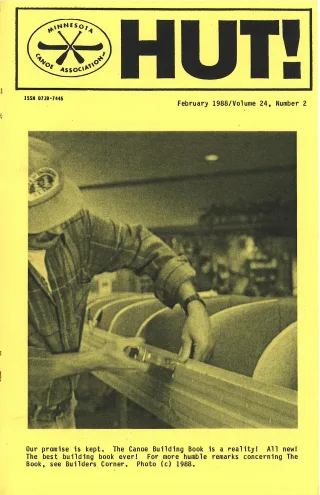
Automatically captured text may contain recognition errors. Compare it with the original scan.
This shows the complete scan page, including any other material on it.
BOOK REVIEWS
A great deal of my "canoeing" time is spent in a recliner,
Jistening to the stereo, and reading. If I can't be on the water, at
least I can escape in my mind. There are three books some of you
might be interested in.
THE GPEN CANOE by Bill Riviere
Published by Little, Brown and Company
This is an informative, unbiased look at open canoes. It deals
with canoes that are short and stable enough to stand on the seat and
fly fish from, to high tech kevlar racing canoes and everything in
between.
The book examines the general aspects of design, types of
construction, tandem and solo canoes, paddles, paddling and other
aspects of canoeing. ;
The book would be a good overview for someone who is just getting
into the sport, hasn't defined their needs, and really doesn't know
what questions to ask. It is also for someone who has been confined
to one aspect of the sport and wants to examine other facets of it.
BAIDARKA by George Dyson
Published by Alaska Northwest Publishing Company
Baidarka is the Russian word for Kayak. The book is a
fascinating look at the history and development of the Kayak in
Alaska fron the history just as Europeans came in contact with the
native people on up to the authors' present efforts to build kayaks
using 6061 aluminum tubing and modern skin coverings. It affords a
look at the sociology of different cultures interacting, how the
kayak evolved to meet different needs, and skills of the people who
used them. It covers the authors’ present day construction
technique, design and off-sets for one kayak and an address for
information on other designs.
ULTRALIGHT BOGAT CUILDING by Thomas J. Hill
Published by International Marine Publishing Company
This book is subtitled "How you can build light, elegant, and
simple boats and canoes using plywood and epoxy."
This is a straight-forward, clearly written and wel] illustrated
book on how to build lapstrake boats and canoes using marine plywood
and epoxy. Lapstrake is a century-old technique of planking a hull
by slightly over-lapping each plank with its neighbor. The book
covers tools, lofting, jigbuilding and al} of the techniques needed
to construct a flat-bottom skiff and a solo canoe,
Given that it deals with wider boards than are used in building a
strip canoe, the hul? wouldn't be quite as round. I think it would
be cifficult to put the strakes through complex convex and concave
curves such as the Kootenay has, but it might work wel! on something
like the Guide. The author states it would cost about $250.00 to
build his 11-1/2 foot solo canoe, so it is a bit more expensive than
stripping a canoe. It requires more woodworking skills than a strip
built canoe, I counted 38 C-clamps in use in one picture, so it would
require a considerable investment in clamps, although it might be
possible to substitute staples, I'm not sure. Weight seems roughly
comparable between the two technigues.
Building a canoe, beside the objective of getting a boat on the
water, is a method of expressing oneself. Lapstrake lines have a
traditional elegance to them. Many people would enjoy’ the
woodworking skills challenge. The greater complexity isn't
necessarily bad. This book might be a good place to start if you
have ever wanted to build something like a whitehall pulling boat or
24 HUT!-February 1988