
March 1988 · Vol. 24 No. 3
March 1988 Magazine (Vol. 24 No. 3)
Magazine · 40 pages
Search this issue
For the full-resolution original, use Open PDF above. Your browser handles PDF zoom and navigation.
Searchable text for scan page 7
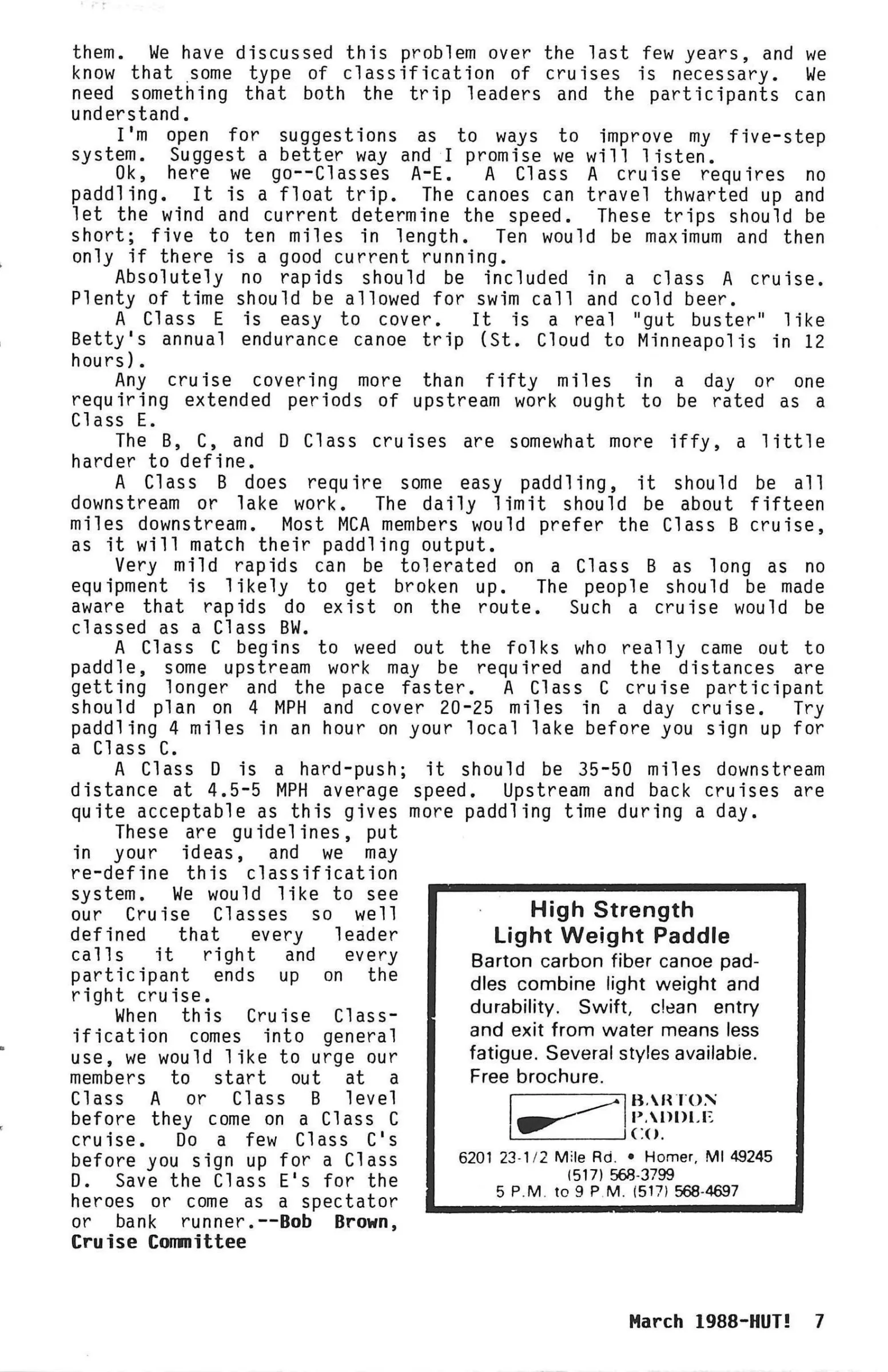
them. We have discussed this problem over the last few years, and we
know that some type of classification of cruises is necessary. We
need something that both the trip leaders and the participants can
understand.
I'm open for suggestions as to ways to improve my five-step
system. Suggest a better way and I promise we will listen.
Ok, here we go--Classes A-E. A Class A cruise requires no
paddling. It is a float trip. The canoes can travel thwarted up and
Jet the wind and current determine the speed. These trips should be
short; five to ten miles in length. Ten would be maximum and then
only if there is a good current running.
Absolutely no rapids should be included in a class A cruise.
Plenty of time should be allowed for swim call and cold beer.
A Class E is easy to cover. It is a real “gut buster" like
Betty's annual endurance canoe trip (St. Cloud to Minneapolis in 12
hours).
Any cruise covering more than fifty miles in a day or one
requiring extended periods of upstream work ought to be rated as a
Class E.
The B, C, and D Class cruises are somewhat more iffy, a little
harder to define.
A Class B does require some easy paddling, it should be all
downstream or lake work. The daily limit should be about fifteen
miles downstream. Most MCA members would prefer the Class B cruise,
as it will match their paddling output.
Very mild rapids can be tolerated on a Class B as Jong as no
equipment is likely to get broken up. The people should be made
aware that rapids do exist on the route. Such a cruise would be
classed as a Class BW.
A Class C begins to weed out the folks who really came out to
paddle, some upstream work may be required and the distances are
getting longer and the pace faster. A Class C cruise participant
should plan on 4 MPH and cover 20-25 miles in a day cruise. Try
paddling 4 miles in an hour on your local Jake before you sign up for
a Class C.
A Class D is a hard-push; it should be 35-50 miles downstream
distance at 4.5-5 MPH average speed. Upstream and back cruises are
quite acceptable as this gives more paddling time during a day.
These are guidelines, put
in your ideas, and we may
re-define this classification
system. We would like to see
nf Cruise Classes so well High Strength
defined that every leader Light Weight Paddle
calls it right and every Barton carbon fiber canoe pad-
participant ends up on the dles combine light weight and
right cruise. se .
When this Cruise Class- durability. Swift, clean entry
ification comes into general and exit from water means less
use, we would like to urge our fatigue. Several styles available.
members to start out at a Free brochure.
Class A or Class B_tlevel BARTON
before they come on a Class C er” PADDLE
cruise. Do a few Class C's co.
before you sign up for a Class 6201 23-1/2 Mile Rd. © Homer, MI 49245
D. Save the Class E's for the (517) 568-3799
5 P.M. to 9 P.M. (517) 568-4697
heroes or come as a spectator
or bank runner.--Bob- Brown,
Cruise Committee
March 1988-HUT! 7
Article contents & approved summaries (0)
No article summaries are available for this view.