
FROM THE BOW
Title transcribed from original publication
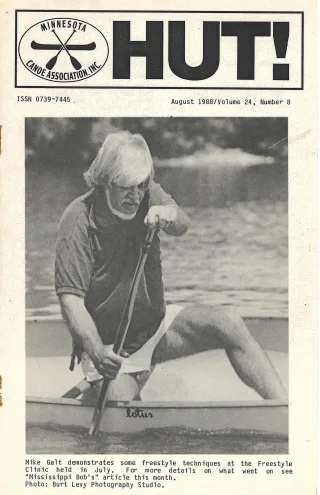
Generated summary: The MCA president discusses summer paddling, a freestyle clinic, member involvement, and the association’s financial stability.
Open scan page 4August 1988 · Vol. 24 No. 8
Magazine · 48 pages
August 1988 Magazine (Vol. 24 No. 8)
Automatically captured text may contain recognition errors. Compare it with the original scan.
TRIP REPORT ON THE ELK AND THELON RIVERS
The Elk and Thelon Rivers begin just at the edge of treeline in
Canada's Northwest Territories. Though inhabited for thousands of
years by Inland Inuit, who followed the caribou migrations, this vast
drainage area is now completely uninhabited. Except for the few
groups of canoeists that go through each year in summer and very few
solitary trappers in winter, the entire area, excluding the last 120
miles where there are a few isolated cabins, is devoid of any sign of
modern man. There are no roads, no villages, no people. The stone
rings used to hold down caribou skin tents, left by the Eskimos of
Jong ago, are the only evidence of human habitation.
On the evening of July 3, 1987 my partner, Jason Peterson, and I
were dropped off on the isolated shores of Damant Lake in the
Mackenzie district of the Northwest Territories, by a chartered
Cessna 185 float plane. We had flown a crowded 180 miles north from
Stoney Rapids, Saskatchewan with 750 pounds of gear, including
ourselves, a month's supply of food, and an 18 foot collapsible skin-
over-frame canoe, crammed into the cabin of the plane. We followed
the Elk and Thelon Rivers for approximately 580 miles through the
heart of the Thelon Game Preserve, which was established in 1927
primarily to protect the dwindling numbers of muskox, across three
Jarge lakes Beverly, Aberdeen, and Schults, and then down the final
stretch of river into Baker Lake, the only remaining community of
Inland Inuit. We started at an elevation of 1251 feet in Damant Lake
and ended at 8 feet above sea level in Baker Lake. Our route took 24
days to complete. Wolves, muskox, caribou, and innumerable species
of birds were our only companions until the 23rd day. The route is
extremely varied from a _ canoeist's perspective. It features
everything from flatwater on the large lakes to Class I, II and III
rapids to huge canyons with crashing waterfalls.
Here is my journal. It is not at all intended as a route
description or a natural history, those are available from other
sources, nor has it been embellished or developed into any kind of
narrative. It appears just as it was written, usually while very
tired and with sore and swollen hands. I intend it simply to give an
idea of what a canoe trip in this area is like.
A THELON JOURNAL
July 2. Welcome to Stoney Rapids. Our bags all ‘came through
except one of the large red waterproofs with most of the food and one
sleeping bag and clothing in it. The air charter man, Brian, has put
us up for the night in a vacant house and so we wait. Bacon and eggs
and Jason's first bannock for dinner. It is warm and the rapids look
intimidating. I am very tired and a bit depressed haveing to just
sit and wait for our bag, but after being waved through customs and
being allowed to put all that overweight luggage on the plane with no
extra charge, it's no surprise that something would screw up. We are
putting magnetic declination lines on our maps and putting them in
ziplocks. Better luck tomorrow. Warm and not many bugs. Sullen
Indians at the Bay store and the usual trash of the north scattered
everywhere.
July 3. After a quick overnight trip to Vancouver, our bag
arrived. Beautiful flight in over miles and miles of nothing but
Jakes and rivers and small trees. Eventually we set down near the
point the map indicated was the last group of trees and surprise!
Total tundra. We unloaded our gear and I began to assemble the canoe
while Jason and our pilot, Fred took a walk to the top of the hill.
They spotted two wolves frolicking out on the point. Howling wind
and 45 degrees F. We set up camp after the plane gave us a final
30 HUT! -August 1988
Generated issue overview: August 1988 issue of HUT!, the monthly Minnesota Canoe Association publication. The issue includes canoeing reports and commentary, trip accounts, organizational material, event information, race results, advertisements, and member services.
Generated summaries are descriptions, not original captured text. Page-range text shows complete scan pages and may include neighboring material.
Title transcribed from original publication
Generated summary: The MCA president discusses summer paddling, a freestyle clinic, member involvement, and the association’s financial stability.
Open scan page 4Title transcribed from original publication
Generated summary: The report recounts MCA members’ participation in dragon boat festivals in Taipei and Hong Kong, describing the race formats and the U.S. women's team’s fourth-place finish in Hong Kong.
Open scan page 4Title transcribed from original publication
Generated summary: A brief account of the annual canoe day describes attendance, visiting officials, the St. Croix cruise, and windy conditions near the takeout.
Open scan page 5Title transcribed from original publication
Generated summary: A local canoeing column covers river cleanup, urban paddling and races, Mike Galt’s clinic, freestyle practice, and the author's views on qualifying cruises and paddling standards.
Open scan page 6Title transcribed from original publication
Generated summary: The author describes a family outing on Gun Club Lake, including access and portage conditions, fishing, wildlife, wind, and the practical challenges of canoeing with young children.
Open scan page 8Title transcribed from original publication
Generated summary: The letter urges readers to consider other members’ perspectives, value different forms of canoeing, and respect differing opinions within the MCA.
Open scan page 9Title transcribed from original publication
Generated summary: A product-review column praises the Grey Owl C-1 whitewater paddle, describing its weight, construction, balance, and suitability for whitewater and touring.
Open scan page 10Title transcribed from original publication
Generated summary: The author responds critically to claims that a particular solo canoe is perfect or faster than other models, comparing the Traveler III and other canoes with the Merlin and Traveler I.
Open scan page 11Title transcribed from original publication
Generated summary: The author recounts an MCA group trip on Great Slave Lake, visiting sites associated with explorers George Back and John Hornby and describing the Hoarfrost, Lockhart, and Pike's Portage areas.
Open scan page 12Title transcribed from original publication
Generated summary: The editor argues that the MCA benefits from supporting varied interests in canoe sport, including recreational canoeing, canoe camping, northern trips, building, racing, and whitewater.
Open scan page 14Title transcribed from original publication
Generated summary: The membership director explains that a questionnaire included with renewal notices is optional and is intended to help the MCA understand members’ interests and willingness to volunteer.
Open scan page 14Title transcribed from original publication
Generated summary: The review recommends Rivers Running Free: Stories of Adventurous Women, praising its selected writings and its presentation of women's long-standing participation in canoeing and outdoor adventure.
Open scan page 21Title transcribed from original publication
Generated summary: The author reflects on decades of canoeing in Grumman aluminum canoes, recounting their durability, repairs, limitations, and service on rivers and lakes while defending their place in canoeing.
Open scan page 30Title transcribed from original publication
Generated summary: A first-person journal recounts a 24-day, roughly 580-mile canoe journey from Damant Lake through the Elk and Thelon rivers and lakes to Baker Lake. It describes rapids, portages, weather, wildlife, ice delays, equipment, and the trip's conclusion.
Open scan page 34