
March 1973 · Volume/issue not printed or unknown
March 1973 Magazine
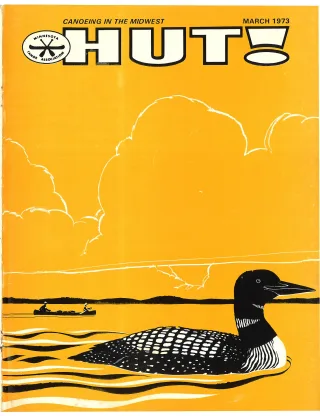
Magazine · 20 pages
Search this issue
March 1973 Magazine
Captured text — scan page 10
Automatically captured text may contain recognition errors. Compare it with the original scan.
Gavia Immer — The Common Loon
Judy McIntyre is a Zoologist at the April. They winter off all North American Pair with two-day old chick. The
University of Minnesota and will be coasts, with the heaviest eastern concen- aduit in front is giving a tremelo, or
doing her doctoral dissertation on tration from the mid-Atlantic states to threat, call, in defense of its young.
certain aspects of the Loon’s be- Florida, and along the coasts of Washing-
havior. Stapled in this issue of HUT! ton and British Columbia on the west. served: males give the territorial call,
you'll find the Project Loon Watch Although they form large concentrations males are on top during copulation, and
Questionnaire which is one of Judy’s Lake Michigan during fall migrations, females lay the eggs.
research tools. We're very happy to records from Illinois northward indicate Incubation lasts from 27 to 31 days,
distribute the form to MCA mem- that they make their spring migration and the young usually hatch one or two
bers and trust that anyone sighting %O0n-stop to their summer range. Large days apart. Chicks are fed by the parents
loons will use it. concentrations do sometimes occur on for up to 10 weeks. For the first two
northern rivers which have open water be- weeks they are frequently carried on the
by Judy McIntyre fore the neighboring lakes do. But within adults’ backs. They can’t crawl under the
It is three o’clock in the morning. 4 day or two following ice break-up on adult to be brooded like terrestrial birds,
Echoing across a lake and penetrating the _ the nesting lakes, the loons fly to them. such as chickens, do. Back-riding is really
sleep of a weary canoeist comes the wail of Nesting begins in Minnesota in early form of brooding, or warming, of the
a loon. This vocalization more than any May. Should a nest be destroyed, loons Young.
other sound of the north expresses the es- may re-nest, and may make up to four. The results of 87 successful hatchings
sence of the wilderness. Yet its meaningis _nestingattempts. Hatching dates vary from in 1972 showed that half of the broods
just one of the many questions still unan- early June through July. had two young, and half had one. Two
swered about our State Bird, the Common Experiments we have made indicate Palrs were reported to have had three
Loon. Similar vocalizations are used to that the raccoonis the primary mammalian Yung each. The average young per brood
summon mate or young, but until we are predator. Islands are chosen as nesting WaS 1.62; in 1971, the average for 107
able to set up some nocturnalexperiments, sites if they are available, and these are broods was 1.52. There were 132 lakes on
this call will remain another mystery. safe from raccoons. However, should hu- which known production of young was
Other calls are beginning to be under- mans interfere, as for example, a fishing ‘ecorded. Fifty to sixty percent of the
stood. The yodel is territorial, given by boat anchored near a nest, or camperson lakes under 200 acres had pairs with
the male on its own lake, and may be a nesting island, the loon slides into the young. All lakes from 400 to 750 acres
termed the “‘song of the loon”. The trem- _ water and leaves its eggs. The nest is then that were reported had at least one pair
elo, frequently referred to as the laughing left open to avian predators, primarily With young. It would appear that the
call, is actually a threat vocalization, used crows and gulls. If the eggs are not de- larger lakes produce more young; however,
both in defense of territory and of the — stroyed, desertion is likely to result if se. 86.8% of all Minnesota lakes are smaller
young. The flight call is a variety of the veral hours pass before the loon canreturn. than 200 acres. Therefore, smaller lakes
tremelo, although it has a rhythm differ- Both sexes incubate the eggs and care may furnish the greater number of poten-
ent from the latter. There are several for the young. Adult plumage is the same tial territories. Extremely large lakes of
“talking calls”, most of which are soft for both sexes. In measuring over 100 several thousand acres, if they contain a
and brief and serve as contact calls to link specimens, I have found males to average complex of bays, also provide habitat for
members of a pair, or parents and young. larger than females, but there is much numbers of loons. A census of pairs. on
Altogether there are four basic calls with overlap. It is impossible to be certain 116 lakes shows that on those up to 500
nearly a dozen variations. which sex is which in a given pair unless acres, most (69% to 80%) accommodate
Loons arrive in Minnesota in early one of three behavior patterns can be ob- Only a single pair of loons.
8 HUT! MARCH 1973
Article contents & approved summaries (0)
No article summaries are available for this view.