
July 1973 · Volume/issue not printed or unknown
July 1973 Magazine

Magazine · 20 pages
Search this issue
For the full-resolution original, use Open PDF above. Your browser handles PDF zoom and navigation.
Searchable text for scan page 10
Those Green
Things
by Bill Sullivan
|
ili
x
| Ki
—— 4 : z -
sa —— = F
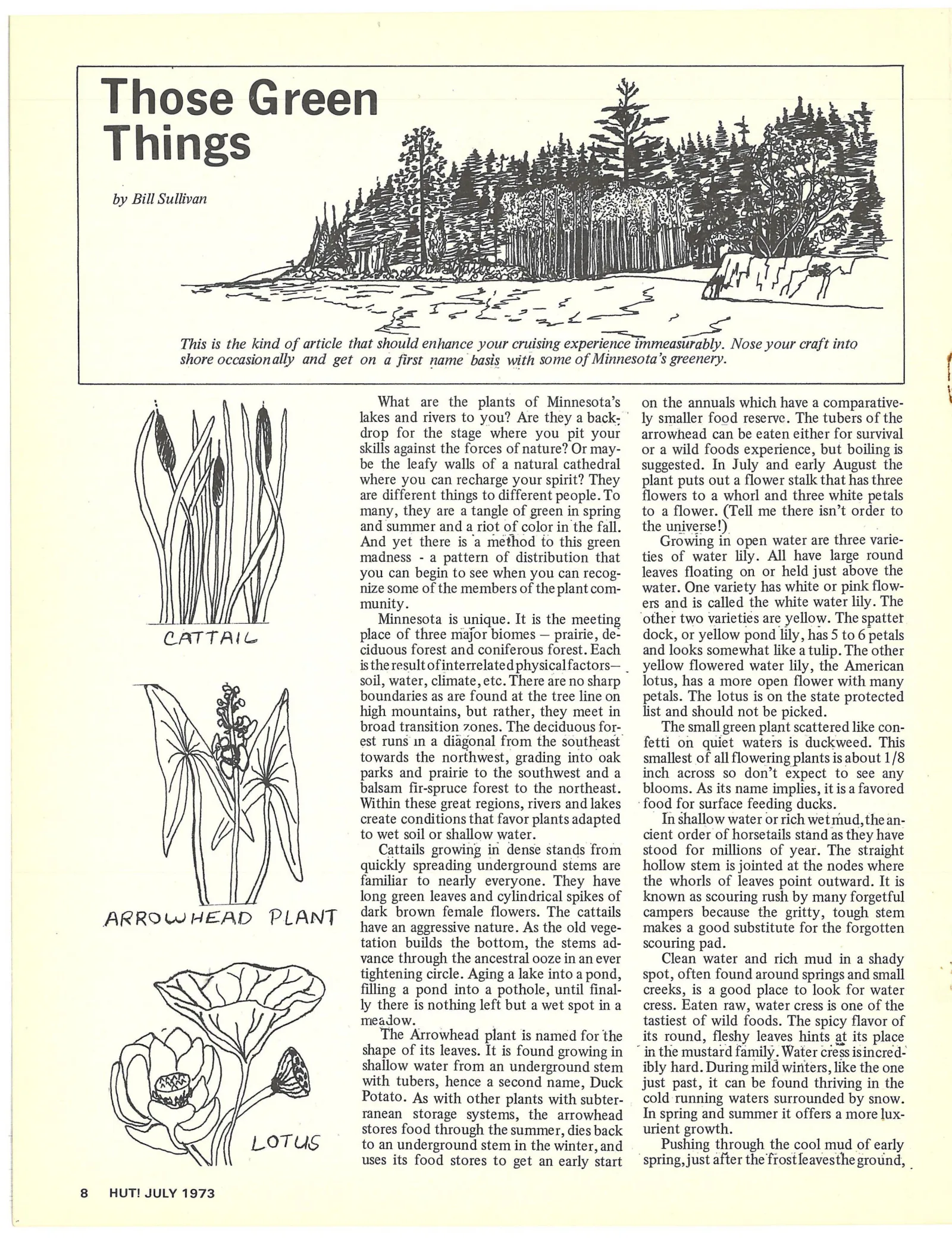
This is the kind of article that should enhance your cruising experience immeasurably. Nose your craft into
shore occasionally and get on a first name basis with some of Minnesota’s greenery.
: : What are the plants of Minnesota’s on the annuals which have a comparative-
lakes and rivers to you? Are they a back: ' ly smaller food reserve. The tubers of the
drop for the stage where you pit your arrowhead can be eaten either for survival
skills against the forces of nature? Or may- or a wild foods experience, but boiling is
be the leafy walls of a natural cathedral suggested. In July and early August the
where you can recharge your spirit? They _ plant puts out a flower stalk that has three
are different things to different people.To flowers to a whorl and three white petals
many, they are a tangle of green in spring _ to a flower. (Tell me there isn’t order to
and summer and a riot of color in the fall. _ the universe!) ;
And yet there is a method to this green Growing in open water are three varie-
madness - a pattern of distribution that ties of water lily. All have large round
you can begin to see when you can recog- _leaves floating on or held just above the
nize some of the members of the plantcom- water. One variety has white or pink flow-
munity. ers and is called the white water lily. The
Minnesota is unique. It is the meeting other two varieties are yellow. The spattet
CATTAIL place of three major biomes — prairie, de- dock, or yellow pond lily, has 5 to 6 petals
ciduous forest and coniferous forest.Each and looks somewhat like a tulip. The other
isthe result ofinterrelatedphysicalfactors—_ yellow flowered water lily, the American
soil, water, climate,etc. There arenosharp _ lotus, has a more open flower with many
boundaries as are found at the tree lineon _ petals. The lotus is on the state protected
high mountains, but rather, they meet in list and should not be picked.
broad transition zones. The deciduous for- The small green plant scattered like con-
est runs in a diagonal from the southeast _fetti on quiet waters is duckweed. This
towards the northwest, grading into oak smallest of all flowering plants is about 1/8
parks and prairie to the southwest anda inch across so don’t expect to see any
balsam fir-spruce forest to the northeast. blooms. As its name implies, it is a favored
Within these great regions, rivers andlakes food for surface feeding ducks.
create conditions that favor plants adapted In shallow water or rich wet mud, the an-
to wet soil or shallow water. cient order of horsetails stand as they have
Cattails growing in dense stands from stood for millions of year. The straight
quickly spreading underground stems are _ hollow stem is jointed at the nodes where
familiar to nearly everyone. They have the whorls of leaves point outward. It is
long green leaves and cylindrical spikes of | known as scouring rush by many forgetful
dark brown female flowers. The cattails campers because the gritty, tough stem
have an aggressive nature. As the old vege- makes a good substitute for the forgotten
tation builds the bottom, the stems ad- scouring pad.
vance through the ancestral ooze in an ever Clean water and rich mud in a shady
tightening circle. Aging a lake intoapond, spot, often found around springs and small
filling a pond into a pothole, until final- creeks, is a good place to look for water
ly there is nothing left but a wet spot ina cress. Eaten raw, water cress is one of the
meadow. tastiest of wild foods. The spicy flavor of
The Arrowhead plant is named for the its round, fleshy leaves hints at its place
shape of its leaves. It is found growing in ~ in the mustard family. Water cress isincred-
shallow water from an underground stem __ibly hard. During mild winters, like the one
with tubers, hence a second name, Duck just past, it can be found thriving in the
Potato. As with other plants with subter- cold running waters surrounded by snow.
ranean storage systems, the arrowhead In spring and summer it offers a more lux-
stores food through the summer, dies back urient growth.
to an underground stem in the winter, and Pushing through the cool mud of early
uses its food stores to get an early start spring, just after the frostleavesthe ground, |
HUT! JULY 1973
Article contents & approved summaries (0)
No article summaries are available for this view.