
July 1973 · Volume/issue not printed or unknown
July 1973 Magazine
Magazine · 20 pages
Search this issue
For the full-resolution original, use Open PDF above. Your browser handles PDF zoom and navigation.
Searchable text for scan page 6
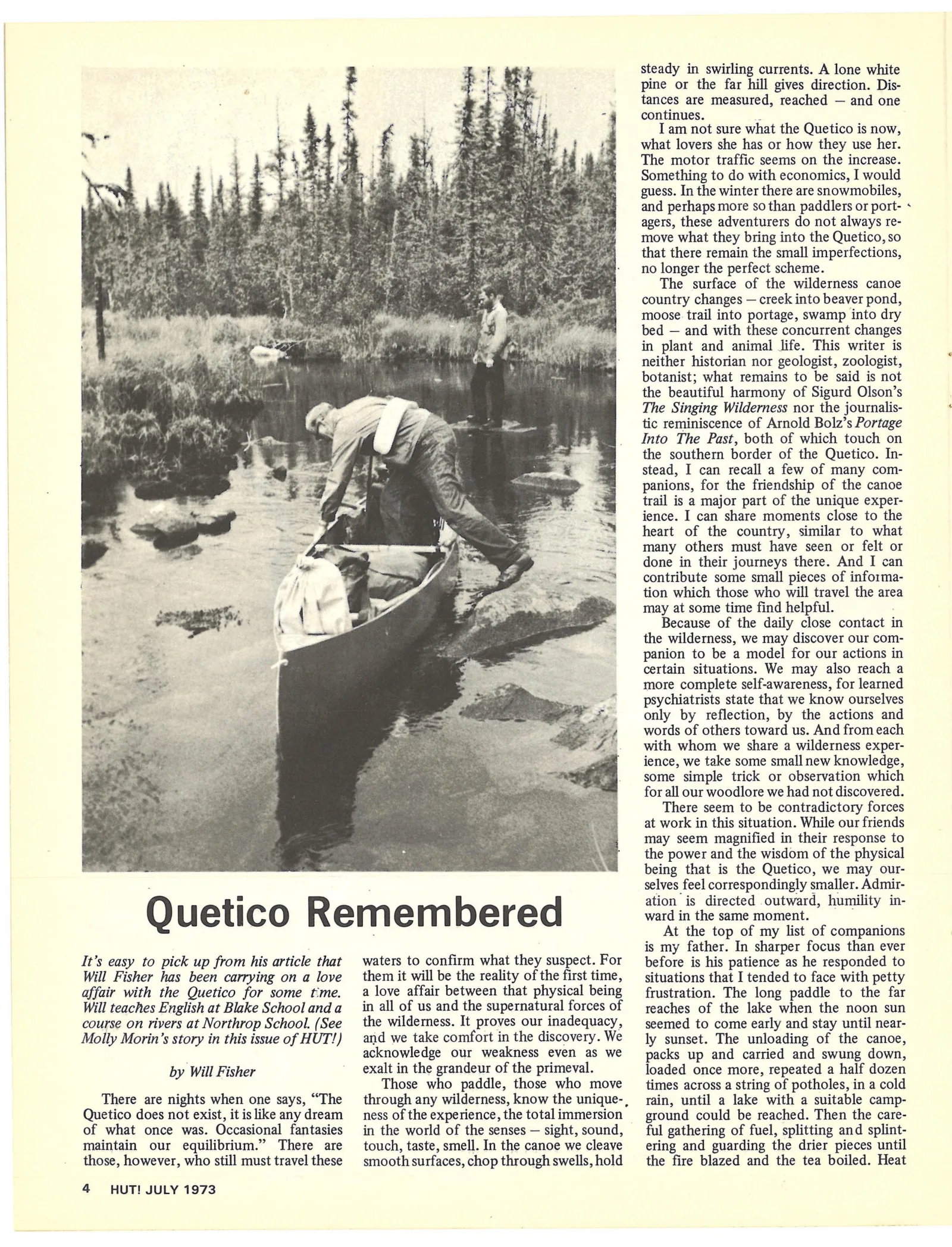
Quetico Remembered
It’s easy to pick up from his article that
Will Fisher has been carrying on a love
affair with the Quetico for some tme.
Will teaches English at Blake School and a
course on rivers at Northrop School. (See
Molly Morin’s story in this issue of HUT!)
by Will Fisher
There are nights when one says, “The
Quetico does not exist, it is like any dream
of what once was. Occasional fantasies
maintain our equilibrium.” There are
those, however, who still must travel these
4 HUT! JULY 1973
waters to confirm what they suspect. For
them it will be the reality of the first time,
a love affair between that physical being
in all of us and the supernatural forces of
the wilderness. It proves our inadequacy,
and we take comfort in the discovery. We
acknowledge our weakness even as we
exalt in the grandeur of the primeval.
Those who paddle, those who move
through any wilderness, know the unique- ,
ness of the experience, the total immersion
in the world of the senses — sight, sound,
touch, taste, smell. In the canoe we cleave
smooth surfaces, chop through swells, hold
steady in swirling currents. A lone white
pine or the far hill gives direction. Dis-
tances are measured, reached — and one
continues. =
I am not sure what the Quetico is now,
what lovers she has or how they use her.
The motor traffic seems on the increase.
Something to do with economics, I would
guess. In the winter there are snowmobiles,
and perhaps more so than paddlers or port-
agers, these adventurers do not always re-
move what they bring into the Quetico, so
that there remain the small imperfections,
no longer the perfect scheme.
The surface of the wilderness canoe
country changes — creek into beaver pond,
moose trail into portage, swamp into dry
bed — and with these concurrent changes
in plant and animal life. This writer is
neither historian nor geologist, zoologist,
botanist; what remains to be said is not
the beautiful harmony of Sigurd Olson’s
The Singing Wilderness nor the journalis-
tic reminiscence of Arnold Bolz’s Portage
Into The Past, both of which touch on
the southern border of the Quetico. In-
stead, I can recall a few of many com-
panions, for the friendship of the canoe
trail is a major part of the unique exper-
ience. I can share moments close to the
heart of the country, similar to what
many others must have seen or felt or
done in their journeys there. And I can
contribute some small pieces of informa-
tion which those who will travel the area
may at some time find helpful.
Because of the daily close contact in
the wilderness, we may discover our com-
panion to be a model for our actions in
certain situations. We may also reach a
more complete self-awareness, for learned
psychiatrists state that we know ourselves
only by reflection, by the actions and
words of others toward us. And from each
with whom we share a wilderness exper-
ience, we take some small new knowledge,
some simple trick or observation which
for all our woodlore we had not discovered.
There seem to be contradictory forces
at work in this situation. While our friends
may seem magnified in their response to
the power and the wisdom of the physical
being that is the Quetico, we may our-
selves feel correspondingly smaller. Admir-
ation is directed outward, humility in-
ward in the same moment. ,
At the top of my list of companions
is my father. In sharper focus than ever
before is his patience as he responded to
situations that I tended to face with petty
frustration. The long paddle to the far
reaches of the lake when the noon sun
seemed to come early and stay until near-
ly sunset. The unloading of the canoe,
packs up and carried and swung down,
loaded once more, repeated a half dozen
times across a string of potholes, in a cold
rain, until a lake with a suitable camp-
ground could be reached. Then the care-
ful gathering of fuel, splitting and splint-
ering and guarding the drier pieces until
the fire blazed and the tea boiled. Heat
Article contents & approved summaries (0)
No article summaries are available for this view.