
April 1974 · No. 7
April 1974 Magazine (No. 7)
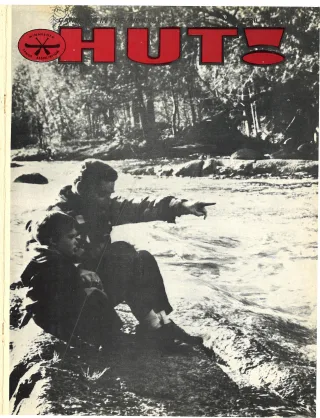
Magazine · 36 pages
Search this issue
April 1974 Magazine (No. 7)
Captured text — scan page 27
Automatically captured text may contain recognition errors. Compare it with the original scan.
a
CANOE
by Ian Richards
As most everyone knows, “HUT” is
canoe jargon for “Paddle on the other side,
please.” In prehistoric times people said
“Switch”; but one day two Minnesota
racers were battling against a headwind,
and one of them said “Son of (something
‘that rhymes with switch)”, and the other
thought he meant “change sides” and did
and then they were both paddling on the
same side tipped over. Thus the word
“HUT” was born.
Some recreational canoeists, and almost
all long-distance racers use a style that
involves switching sides every few strokes
(it’s described in the article). The following
anecdote may illustrate the power of this
technique. A few years ago, there was a
canoe race from Ely, Minnesota to Atiko-
ken, Ontario—a hundred miles through
the Quetico Wilderness. It was assumed
that professional -guides would take the
top places. But two Minneapolis “pros”
(meaning racers who take prize money—
nobody makes a living at this sport) came
up and entered the contest. These men
had won races all over the United States
and Canada; but here they had a slight
disadvantage—they didn’t know the route.
So all they could do was to follow the
fastest of the other canoes intending to
pass it at the finish line. The Minneapolis
pros won, but that is not the thing which
made the biggest impression on their op-
ponents. For, during the course of the race,
the pros got tired of following the other
it!
It is commonplace for the authors of
“how to do it” articles to state their
qualifications. This article is based on
more than twenty years of canoeing ex-
perience—but, as the following anecdote
will illustrate, that shouldn’t be taken
too seriously. I made my first trip into
boat and started paddling in circles around
the Superior-Quetico in the summer of
1952. It really was a wilderness then;
we traveled for a week without seeing
another party. On that trip I mostly pad-
dled in the bow. Finally, becoming bold,
I demanded a chance to steer. So my
buddies let me paddle stern—and we
went all over the lake! The fellows in
the other canoe showed signs of merri-
ment, but my friends defended me, point-
ing out that I was simply following the
tactics developed during World War II
for evading submarines. And in fact we
were not hit by a single torpedo during
the entire day! .
Eventually I learned to steer a canoe
in a straight line on lakes, and in a
crooked line in rapids. Then I got the
racing bug and persuaded Joe Conrad
to give me a few pointers. According to
Joe, I had developed a “lousy” stroke.
Experience is not always the best teacher!
So here [ll pass on bits and pieces which
[ve picked up from other paddlers,
mostly in the MCA.
The Bow Stroke
Learn to do it the right way. Whether
your partner “J-strokes” or you both
.“switch,” there is only one correct stroke
in the bow. The essentials are:
(a) Reach far forward, in front of
your body, but do not lunge.
Flick the paddle into the water at
least two feet in front of your
body by a deft arm motion, using
the lever principle: lower hand
forward, top hand back. There is
only one way to do it if you do
not lunge.
(b) Bend both arms. At the start of
the stroke, the top arm is bent,
the lower arm straight and ex-
tended forward. At the end of
the stroke it’s reversed. (Lever
principle).
(c) Keep the top hand low, not above
the hairline, and push forward
with it. The top hand should go
out somewhat like a boxer’s jab.
Otherwise you’re not making full
use of it.
(d) Use a shorter paddle than you
may be accustomed to (5 feet or
less).
Note: Many experienced paddlers use
a different stroke. They keep one (or
sometimes both) arms straight and swing
from the shoulders. Characteristically,
they dip the paddle in the water at the
Top hand
Lower hand about :
under chin
4 inches above top
of blade
Posterior
on seat
Paddle far forward
Figure la. Start of bow stroke.
body (not in front of it), and pull the”
blade through the water behind them.
This is a weak stroke, although it looks
“sraceful”. The trouble is that the most
powerful muscles are not brought into
play. (Anyone who has ever lifted weights
knows that he can push much more than
he can “‘curl.’’)
The Stern Stroke
Here the racers and many serious pad-
dlers switch sides. That is, they avoid
HUT! APRIL 1974 15
Article contents & approved summaries (0)
No article summaries are available for this view.