
April 1974 · No. 7
April 1974 Magazine (No. 7)
Magazine · 36 pages
Search this issue
For the full-resolution original, use Open PDF above. Your browser handles PDF zoom and navigation.
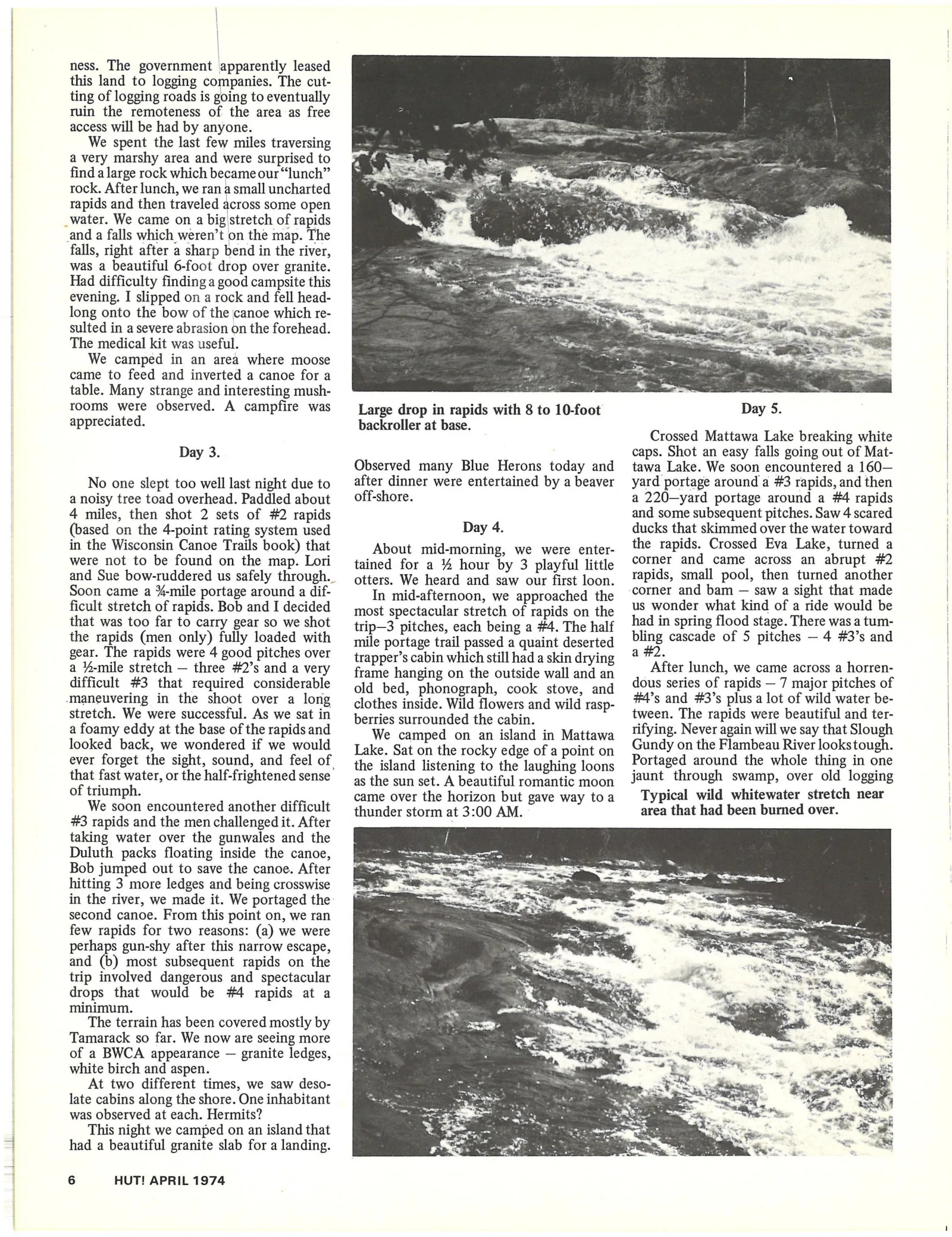
Searchable text for scan page 8
ness. The government apparently leased
this land to logging companies. The cut-
ting of logging roads is going to eventually
ruin the remoteness of the area as free
access will be had by anyone.
We spent the last few miles traversing
a very marshy area and were surprised to
find a large rock which became our “lunch”
rock. After lunch, we ran a small uncharted
rapids and then traveled across some open
_water. We came on a big stretch of rapids
“and a falls which weren’t on the map. The
‘falls, right after a sharp bend in the river,
was a beautiful 6-foot drop over granite.
Had difficulty finding a good campsite this
evening. I slipped on a rock and fell head-
long onto the bow of the canoe which re-
sulted in a severe abrasion on the forehead.
The medical kit was useful.
We camped in an area where moose
came to feed and inverted a canoe for a
table. Many strange and interesting mush-
rooms were observed. A campfire was
appreciated.
Day 3.
No one slept too well last night due to
a noisy tree toad overhead. Paddled about
4 miles, then shot 2 sets of #2 rapids
(based on the 4-point rating system used
in the Wisconsin Canoe Trails book) that
were not to be found on the map. Lori
and Sue bow-ruddered us safely through.
Soon came a %-mile portage around a dif-
ficult stretch of rapids. Bob and I decided
that was too far to carry gear so we shot
the rapids (men only) fully loaded with
gear. The rapids were 4 good pitches over
a %-mile stretch — three #2’s and a very
difficult #3 that required considerable
-maneuvering in the shoot over a long
stretch. We were successful. As we sat in
a foamy eddy at the base of the rapids and
looked back, we wondered if we would
ever forget the sight, sound, and feel of
that fast water, or the half-frightened sense
of triumph.
We soon encountered another difficult
#3 rapids and the men challenged it. After
taking water over the gunwales and the
Duluth packs floating inside the canoe,
Bob jumped out to save the canoe. After
hitting 3 more ledges and being crosswise
in the river, we made it. We portaged the
second canoe. From this point on, we ran
few rapids for two reasons: (a) we were
perhaps gun-shy after this narrow escape,
and (b) most subsequent rapids on the
trip involved dangerous and spectacular
drops that would be #4 rapids at a
minimum.
The terrain has been covered mostly by
Tamarack so far. We now are seeing more
of a BWCA appearance — granite ledges,
white birch and aspen.
At two different times, we saw deso-
late cabins along the shore. One inhabitant
was observed at each. Hermits?
This night we camped on an island that
had a beautiful granite slab for a landing.
6 HUT! APRIL 1974
Large drop in rapids with 8 to 10-foot
backroller at base.
Observed many Blue Herons today and
after dinner were entertained by a beaver
off-shore.
Day 4.
About mid-morning, we were enter-
tained for a % hour by 3 playful little
otters. We heard and saw our first loon.
In mid-afternoon, we approached the
most spectacular stretch of rapids on the
trip—3 pitches, each being a #4. The half
mile portage trail passed a quaint deserted
trapper’s cabin which still had a skin drying
frame hanging on the outside wall and an
old bed, phonograph, cook stove, and
clothes inside. Wild flowers and wild rasp-
berries surrounded the cabin.
We camped on an island in Mattawa
Lake. Sat on the rocky edge of a point on
the island listening to the laughing loons
as the sun set. A beautiful romantic moon
came over the horizon but gave way toa
thunder storm at 3:00 AM.
Day 5.
Crossed Mattawa Lake breaking white
caps. Shot an easy falls going out of Mat-
tawa Lake. We soon encountered a 160—
yard portage around a #3 rapids, and then
a 220—yard portage around a #4 rapids
and some subsequent pitches. Saw 4 scared
ducks that skimmed over the water toward
the rapids. Crossed Eva Lake, turned a
corner and came across an abrupt #2
rapids, small pool, then turned another
corner and bam — saw a sight that made
us wonder what kind of a ride would be
had in spring flood stage. There was a tum-
bling cascade of 5 pitches — 4 #3’s and
a #2.
After lunch, we came across a horren-
dous series of rapids — 7 major pitches of
#4’s and #3’s plus a lot of wild water be-
tween. The rapids were beautiful and ter-
rifying. Never again will we say that Slough
Gundy on the Flambeau River lookstough.
Portaged around the whole thing in one
jaunt through swamp, over old logging
Typical wild whitewater stretch near
area that had been burned over.
Article contents & approved summaries (0)
No article summaries are available for this view.