
September 1977 · Volume/issue not printed or unknown
September 1977 Magazine
Magazine · 12 pages
Search this issue
For the full-resolution original, use Open PDF above. Your browser handles PDF zoom and navigation.
Searchable text for scan page 8
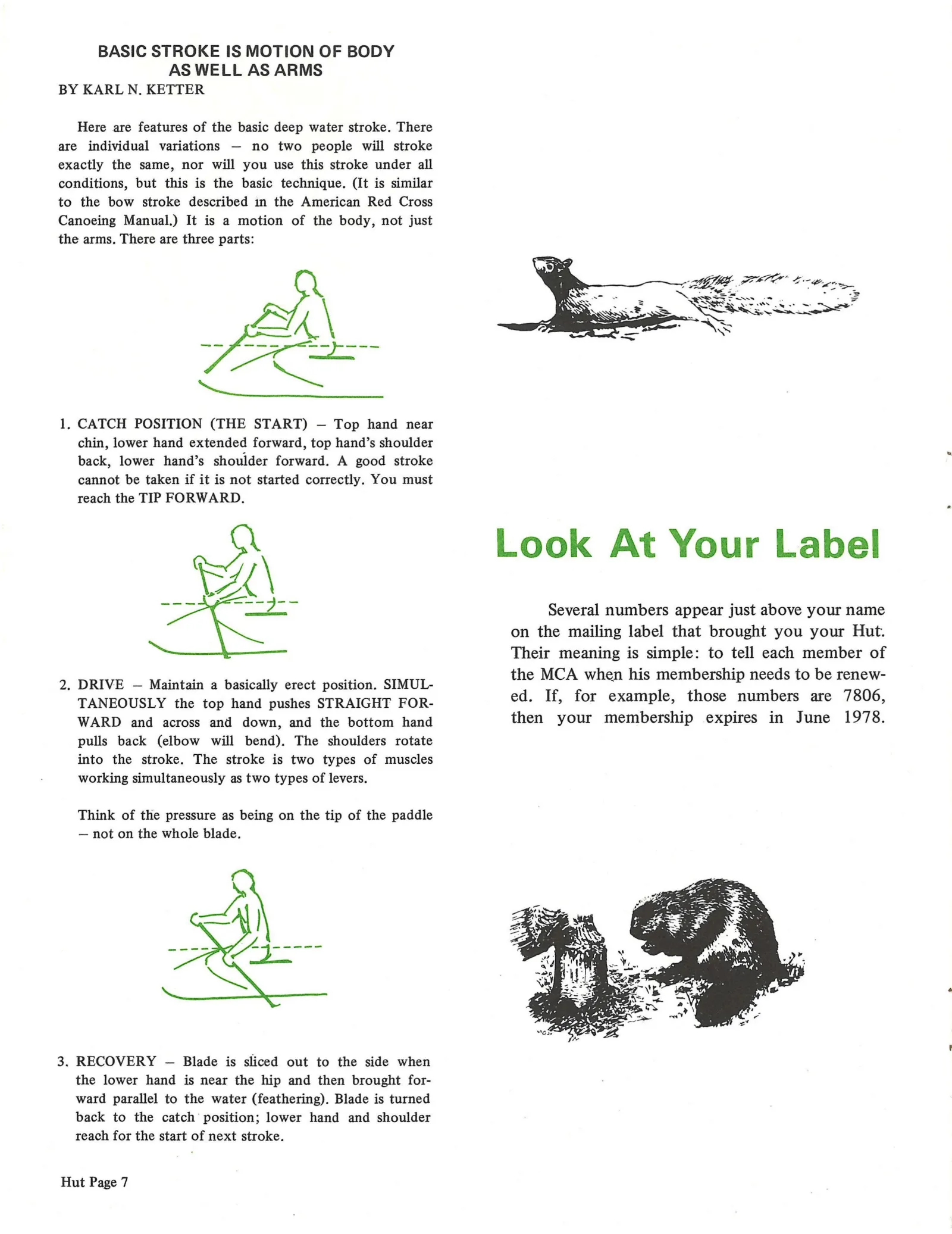
BASIC STROKE IS MOTION OF BODY
AS WELL AS ARMS
BY KARL N. KETTER
Here are features of the basic deep water stroke. There
are individual variations — no two people will stroke
exactly the same, nor will you use this stroke under all
conditions, but this is the basic technique. (It is similar
to the bow stroke described in the American Red Cross
Canoeing Manual.) It is a motion of the body, not just
the arms. There are three parts:
A
1. CATCH POSITION (THE START) — Top hand near
chin, lower hand extended forward, top hand’s shoulder
back, lower hand’s shoulder forward. A good stroke
cannot be taken if it is not started correctly. You must
reach the TIP FORWARD.
Look At Your Label
Several numbers appear just above your name
on the mailing label that brought you your Hut.
Their meaning is simple: to tell each member of
the MCA when his membership needs to be renew-
2. DRIVE — Maintain a basically erect position. SIMUL-
TANEOUSLY the top hand pushes STRAIGHT FOR- ed. If, for example, those numbers are 7806,
WARD and across and down, and the bottom hand then your membership expires in June 1978.
pulls back (elbow will bend). The shoulders rotate
into the stroke. The stroke is two types of muscles
working simultaneously as two types of levers.
Think of the pressure as being on the tip of the paddle
— not on the whole blade.
3. RECOVERY -— Blade is sliced out to the side when
the lower hand is near the hip and then brought for-
ward parallel to the water (feathering). Blade is turned
back to the catch position; lower hand and shoulder
reach for the start of next stroke.
Hut Page 7
Article contents & approved summaries (0)
No article summaries are available for this view.