
June 1978 · Volume/issue not printed or unknown
June 1978 Magazine
Magazine · 12 pages
Search this issue
For the full-resolution original, use Open PDF above. Your browser handles PDF zoom and navigation.
Searchable text for scan page 8
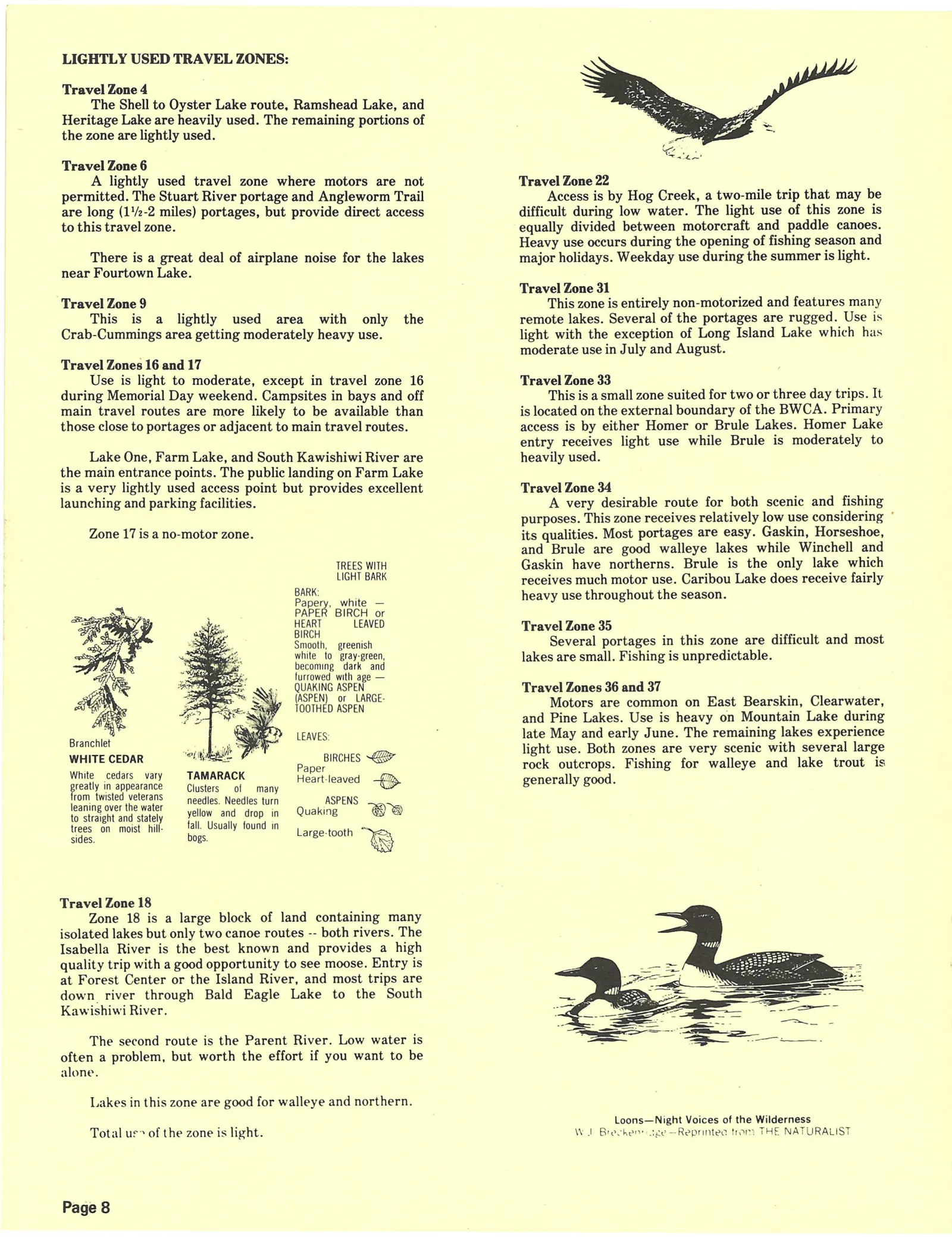
LIGHTLY USED TRAVEL ZONES:
Travel Zone 4
The Shell to Oyster Lake route, Ramshead Lake, and
Heritage Lake are heavily used. The remaining portions of
the zone are lightly used.
Travel Zone 6
A lightly used travel zone where motors are not Travel Zone 22
permitted. The Stuart River portage and Angleworm Trail Access is by Hog Creek, a two-mile trip that may be
are long (11/2-2 miles) portages, but provide direct access difficult during low water. The light use of this zone is
to this travel zone. equally divided between motorcraft and paddle canoes.
Heavy use occurs during the opening of fishing season and
There is a great deal of airplane noise for the lakes major holidays. Weekday use during the summer is light.
near Fourtown Lake.
Travel Zone 31
Travel Zone 9 This zone is entirely non-motorized and features many
This is a lightly used area with only the remote lakes. Several of the portages are rugged. Use is
Crab-Cummings area getting moderately heavy use. light with the exception of Long Island Lake which has
. moderate use in July and August.
Travel Zones 16 and 17
Use is light to moderate, except in travel zone 16 Travel Zone 33
during Memorial Day weekend. Campsites in bays and off This is a small zone suited for two or three day trips. It
main travel routes are more likely to be available than is located on the external boundary of the BWCA. Primary
those close to portages or adjacent to main travel routes. access is by either Homer or Brule Lakes. Homer Lake
entry receives light use while Brule is moderately to
Lake One, Farm Lake, and South Kawishiwi River are heavily used.
the main entrance points. The public landing on Farm Lake
is a very lightly used access point but provides excellent Travel Zone 34
launching and parking facilities. A very desirable route for both scenic and fishing
purposes. This zone receives relatively low use considering °
Zone 17 is a no-motor zone. its qualities. Most portages are easy. Gaskin, Horseshoe,
and Brule are good walleye lakes while Winchell and
TREES WITH Gaskin have northerns. Brule is the only lake which
LIGHT BARK receives much motor use. Caribou Lake does receive fairly
Eee er ee heavy use throughout the season.
oe oe. PAPER BIRCH or
y Ben LEAVED Travel Zone 35
Smooth, greenish Several portages in this zone are difficult and most
white to gray-green, lakes are small. Fishing is unpredictable.
becoming dark and
furrowed with age —
QUAKING ASPEN Travel Zones 36 and 37
ESPEN) or LARGE: Motors are common on East Bearskin, Clearwater,
Atk and Pine Lakes. Use is heavy on Mountain Lake during
Sear LEAVES: ; late May and early June. The remaining lakes experience
Nicene BIRCHES Rr light use. Both zones are very scenic with several large
Paper rock outcrops. Fishing for walleye and lake trout is
White cedars vary Heart-leaved >. generally good.
peal appearance Css al many
: egies. Needles turn
ie
ieee on moist hill- bogs. y Large-tooth eS
Travel Zone 18
Zone 18 is a large block of land containing many
isolated lakes but only two canoe routes -- both rivers. The
Isabella River is the best known and provides a high
quality trip with a good opportunity to see moose. Entry is
at Forest Center or the Island River, and most trips are
down river through Bald Eagle Lake to the South
Kawishiwi River.
The second route is the Parent River. Low water is
often a problem, but worth the effort if you want to be
alone.
Lakes in this zone are good for walleye and northern.
Ww. Loons—Night Voices of the Wilderness
Total us» of the zone is light. Wo Brockenr age —Reprintea tran THE NATURALIST
Page 8
Article contents & approved summaries (0)
No article summaries are available for this view.