
March 1980 · Volume/issue not printed or unknown
March 1980 Magazine
Magazine · 12 pages
Search this issue
For the full-resolution original, use Open PDF above. Your browser handles PDF zoom and navigation.
Searchable text for scan page 7
DESIGN CONCEPT INFLUENCES
MINNESOTA VALLEY STATE TRAIL CONSTRUCTION
Design. is the key element in any trail.
Design, therefore, is a tremendous chal-
lenge to members of the planning team for
the Minnesota Valley State Trail. The
trail has exceptional potential. It's
scenic beauty could be impressive with the
striking variety of natural and historical
features in the area.
The Minnesota Valley Trail will extend more
than 70 miles, from Fort Snelling to LeSueur,
as authorized by state law.
Part of the trail will be built along
abandoned railroads; the*remainder will
wind through the valley, slipping in and
out of view of the river that, in earlier
days, served Indians, voyageurs, and
settlers.
The incredible variety that exists
includes: bluffs, the river, the flood-~
plain marshes, gently-rolling hills,
clear streams and wilderness lakes, woods
carpeted with green nettles, oak-dotted
prairies, plus picturesque historical
buildings and farms.
MASTER PLAN STUDIES OF MISSISSIPPI RIVER
emer
$350 million in master plan studies of the
Upper Mississippi River System (UMRS) are now
underway. The studies include research and
‘analysis of management, navigation/transport-
ation, environmental, dredged material dispo-
sal, computer system feasibility, and public
participation/information activities.
The research represents cooperative efforts
among state governments, federal agencies,
local governments, universities, businesses,
special interest groups and citizens.
The Master Plan purpose is to identify econ-
omic, recreational and environmental objec-
tives for the UMRS, as well as identifying
any authorities needed to meet those objec-
tives.
Several research projects by the Environ-
mental Studies Sub-Work Team have already
begun. These studies include a summary
resource description of the UMRS; identifi-
tion of ways to prevent or reduce damages
/ to. fish and.wildlife resources which may be
related to navigation of the UMRS; and
determination of the effects commercial and
recreational navigation have on fish and
wildlife, wilderness, water quality and
recreation opportunities.
?
OUTDOORS NOT CLOSED FOR THE PHYSICALLY
HANDICAPPED
People with physical handicapped who enjoy
the outdoors will find that the DNR has
taken several measures to make it possible.
In 1977, the Department received more than
$500,000 in federal funds to create or ©
remodel facilities at 40 state parks to
provide accessibility for all persons.
Sanitation buildings, picnic tables, nature
trails and parking areas are examples of
facilities that were modified or built to
permit their use by those with physical
handicapps.
A.trail was built suitable for use by those
in wheel chairs, the blind, and other
physically handicapped persons. Braille
was used to identify the various natural
phenomena along the trail.
In addition, there are various state laws
aimed at making it easier for the physically
handicapped to enjoy hunting.
Local conservation officers can issue
special permits to shoot or hunt from a
standing vehicle to licensed hunters who
are physically unable to walk.
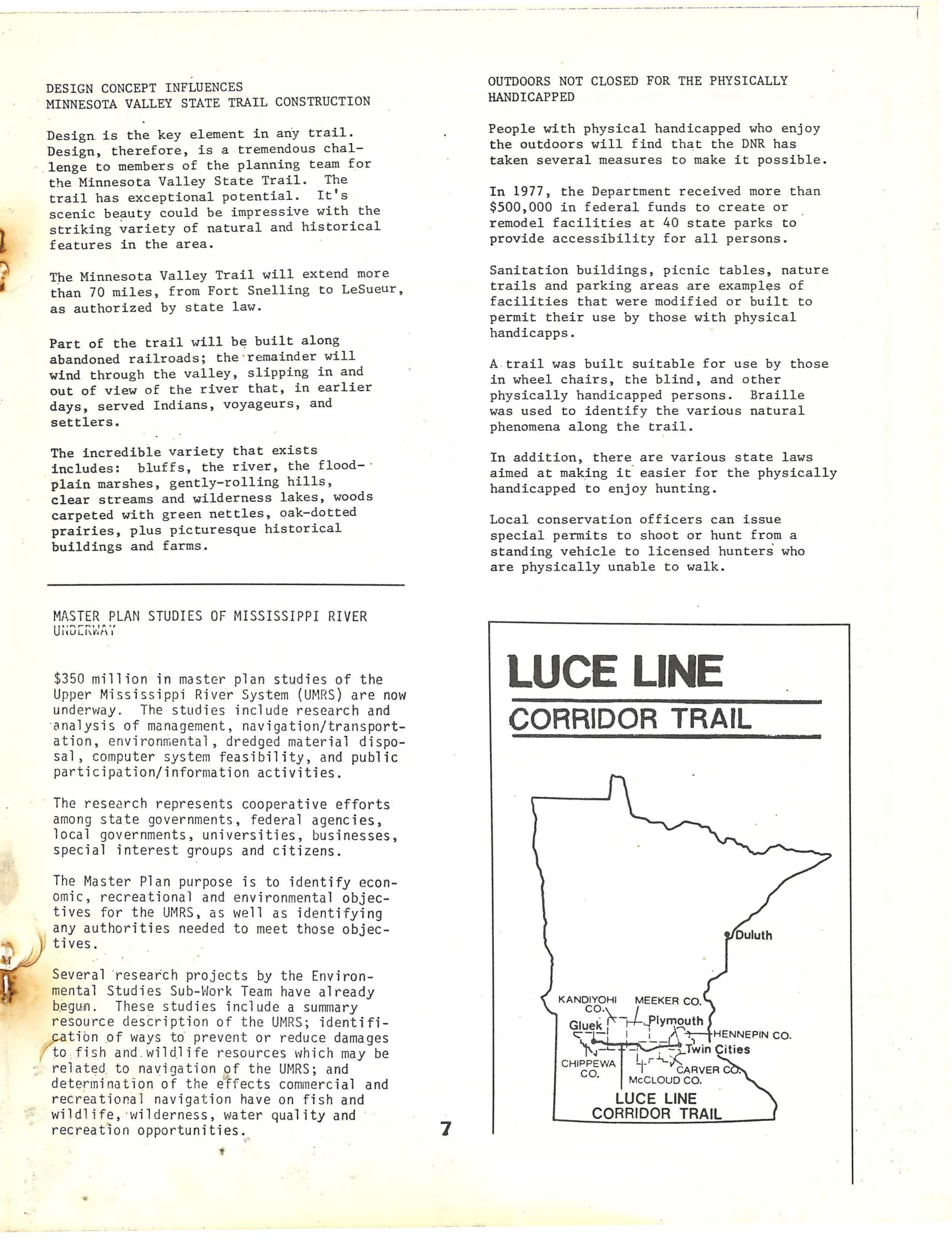
LUCE LINE
CORRIDOR TRAIL
KANDIYOHI MEEKER N
CO. oO
i CARVER
McCLOUD CO.
LUCE LINE
CORRIDOR TRAIL
Article contents & approved summaries (0)
No article summaries are available for this view.