
November 1981 · Volume/issue not printed or unknown
November 1981 Magazine
Magazine · 16 pages
Search this issue
For the full-resolution original, use Open PDF above. Your browser handles PDF zoom and navigation.
Searchable text for scan page 4
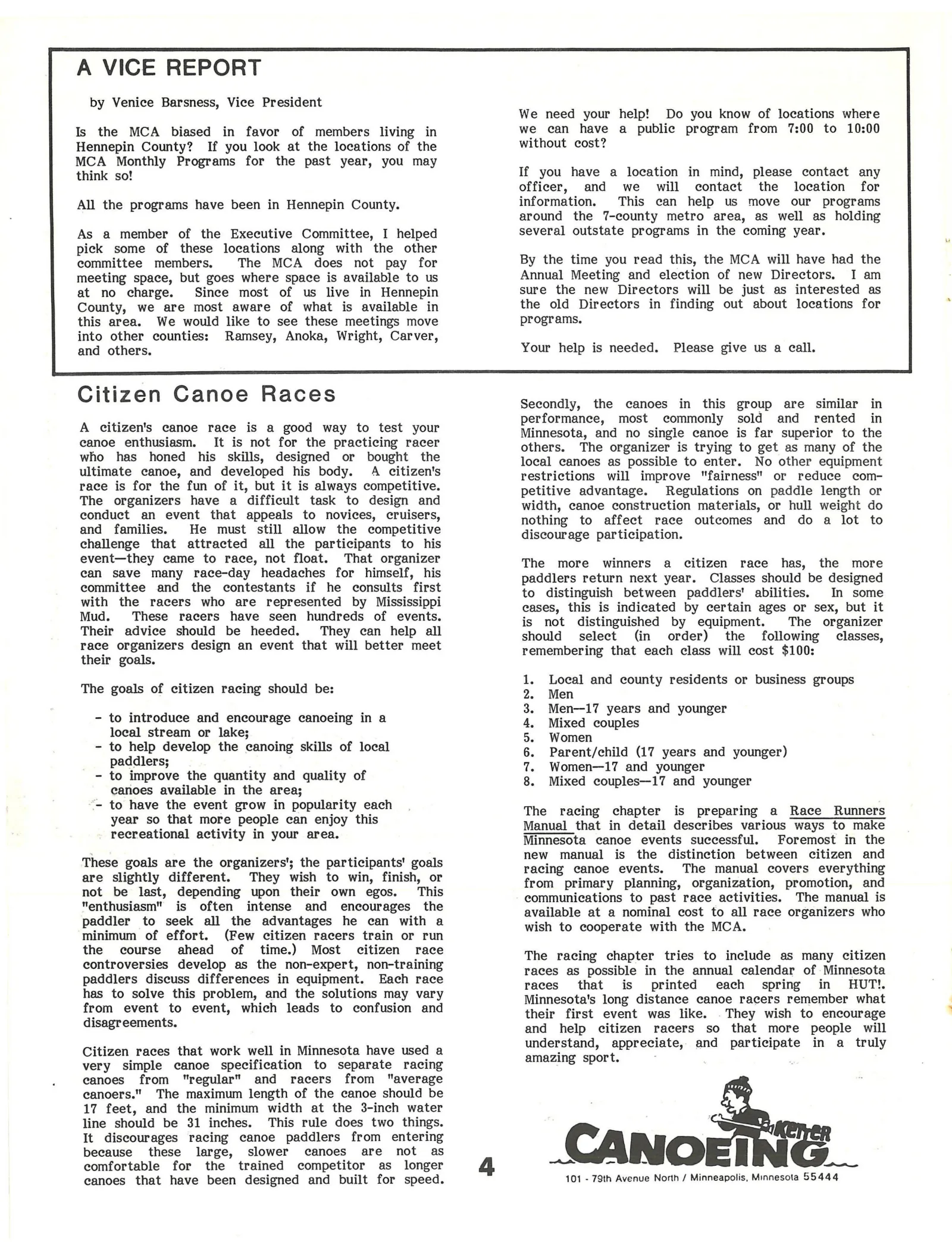
A VICE REPORT
by Venice Barsness, Vice President
We need your help! Do you know of locations where
Is the MCA biased in favor of members living in we can have a public program from 7:00 to 10:00
Hennepin County? If you look at the locations of the without cost?
MCA Monthly Programs for the past year, you may . . .
think so! If you have a location in mind, please contact any
officer, and we will contact the location for
All the programs have been in Hennepin County. information. This can help us move our programs
around the 7-county metro area, as well as holding
As a member of the Executive Committee, I helped several outstate programs in the coming year.
pick some of these locations along with the other . : .
committee members. The MCA does not pay for By the time you read this, the MCA will have had the
meeting space, but goes where space is available to us Annual Meeting and election of new Directors. I am
at no charge. Since most of us live in Hennepin sure the new Directors will be just as interested as
County, we are most aware of what is available in the old Directors in finding out about locations for
this area. We would like to see these meetings move programs.
into other counties: Ramsey, Anoka, Wright, Carver,
and others. Your help is needed. Please give us a call.
Citizen Canoe Races
Secondly, the canoes in this group are similar in
performance, most commonly sold and rented in
iti 1 i . : . .
A citizen's canoe race is a good way to test your Minnesota, and no single canoe is far superior to the
canoe enthusiasm. It is not for the practicing racer others. The organi : P
F 5 : ° ganizer is trying to get as many of the
who has honed his skills, designed or bought a local canoes as possible to enter. No other equipment
ultimate canoe, and developed his body. A citizen's restrictions will improve "fairness" or reduce com-
race is for the fun of it, but it is always competitive.
The organizers have a difficult task to design and
conduct an event that appeals to novices, cruisers,
and families. He must still allow the competitive
challenge that attracted all the participants to his
event—they came to race, not float. That organizer The more winners a citizen race has, the more
can save many race-day headaches for himself, his paddlers return next year. Classes should be designed
committee and the contestants if he consults first to distinguish between paddlers! abilities. In some
with the racers who are represented by Mississippi eases, this is indicated by certain ages or sex, but it
Mud. These racers have seen hundreds of events. is not distinguished by equipment. The organizer
petitive advantage. Regulations on paddle length or
width, canoe construction materials, or hull weight do
nothing to affect race outcomes and do a lot to
discourage participation.
Their advice should be heeded. They can help all should select. (in order) the following classes,
race organizers design an event that will better meet remembering that each class will cost $100:
their goals. .
The goals of citizen racing should be: ata and county residents or business groups
- to introduce and encourage canoeing in a : eed sel aiten and, panes
local stream or lake; 5. Women
- to help develop the canoing skills of local 6. Parent/child (17 years and younger)
paddlers; ; F 7. Women—17 and younger
- to improve the quantity and quality of 8. Mixed couples—17 and younger
canoes available in the area;
- to have the event grow in popularity each
year so that more people can enjoy this
recreational activity in your area.
The racing chapter is preparing a Race Runners
Manual that in detail describes various ways to make
Minnesota canoe events successful. Foremost in the
new manual is the distinction between citizen and
racing canoe events. The manual covers everything
from primary planning, organization, promotion, and
communications to past race activities. The manual is
available at a nominal cost to all race organizers who
wish to cooperate with the MCA.
These goals are the organizers’; the participants' goals
are slightly different. They wish to win, finish, or
not be last, depending upon their own egos. This
"enthusiasm" is often intense and encourages the
paddler to seek all the advantages he can with a
minimum of effort. (Few citizen racers train or run
the course ahead of time.) Most citizen race
controversies develop as the non-expert, non-training
paddlers discuss differences in equipment. Each race
has to solve this problem, and the solutions may vary
from event to event, which leads to confusion and
disagreements.
The racing chapter tries to include as many citizen
races as possible in the annual calendar of Minnesota
races that is printed each spring in HUT!.
Minnesota's long distance canoe racers remember what
their first event was like. They wish to encourage
and help citizen racers so that more people will
understand, appreciate, and participate in a truly
Citizen races that work well in Minnesota have used a amazing sport.
very simple canoe specification to separate racing
eanoes from "regular" and racers from "average
eanoers." The maximum length of the canoe should be
17 feet, and the minimum width at the 3-inch water ;
line should be 31 inches. This rule does two things.
It discourages racing canoe paddlers from entering CA
because these large, slower canoes are not as NO |
4 “~S =- | So
eomfortable for the trained competitor as longer
eanoes that have been designed and built for speed. 101 - 79th Avenue North / Minneapolis, Minnesota 55444
Article contents & approved summaries (0)
No article summaries are available for this view.