
November 1981 · Volume/issue not printed or unknown
November 1981 Magazine
Magazine · 16 pages
Search this issue
For the full-resolution original, use Open PDF above. Your browser handles PDF zoom and navigation.
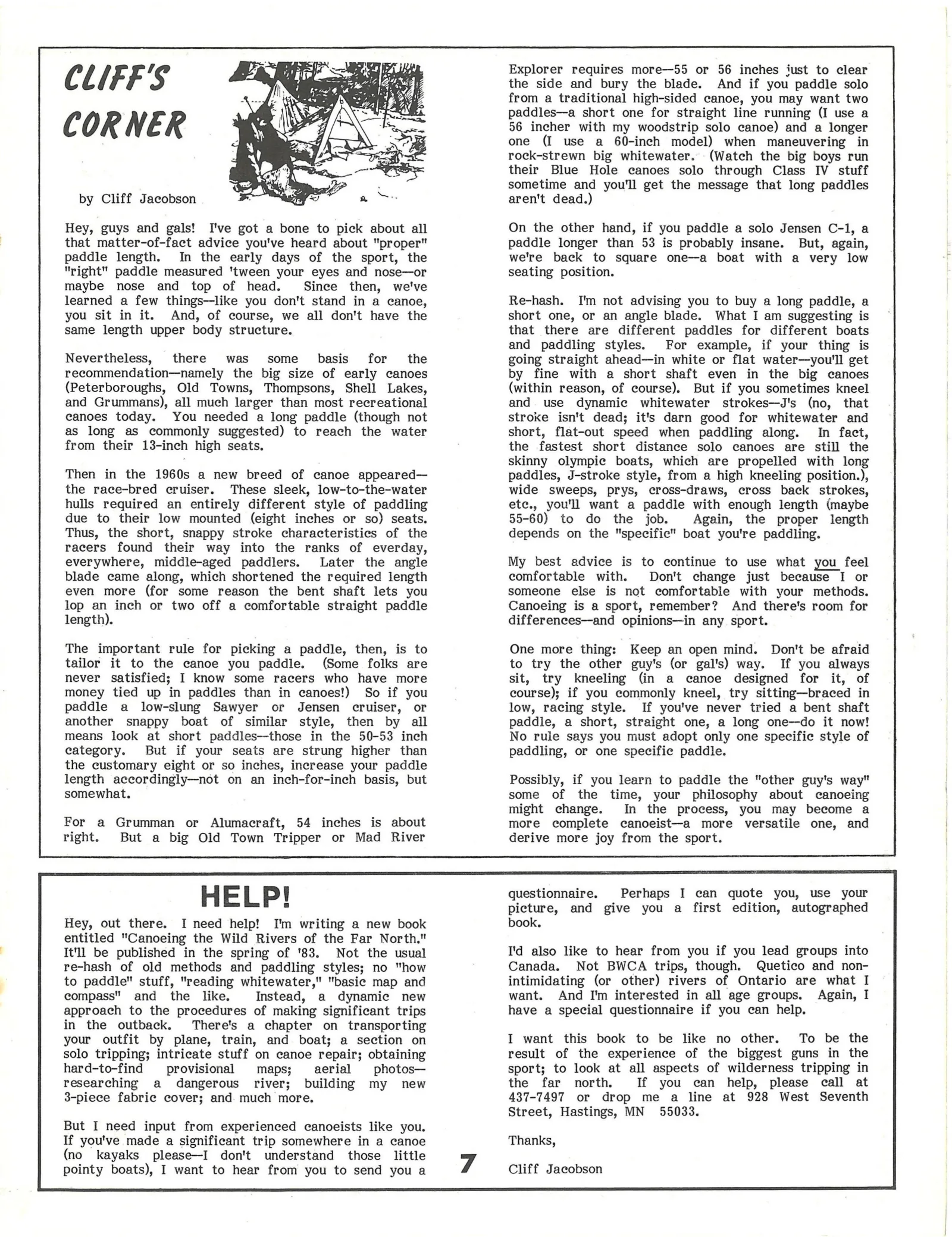
Searchable text for scan page 7
Explorer requires more—55 or 56 inches iust to clear
the side and bury the blade. And if you paddle solo
from a traditional high-sided canoe, you may want two
paddles—a short one for straight line running (I use a
56 incher with my woodstrip solo canoe) and a longer
one (I use a 60-inch model) when maneuvering in
rock-strewn big whitewater. (Watch the big boys run
their Blue Hole canoes solo through Class IV stuff
sometime and you'll get the message that long paddles
aren't dead.)
CLIFFS
CORNER
by Cliff Jacobson
Hey, guys and gals! I've got a bone to pick about all On the other hand, if you paddle a solo Jensen C-1, a
that matter-of-fact advice you've heard about "proper" paddle longer than 53 is probably insane. But, again,
paddle length. In the early days of the sport, the we're back to square one—a boat with a very low
"right" paddle measured 'tween your eyes and nose—or seating position.
maybe nose and top of head. Since then, we've
learned a few things--like you don't stand in a canoe, Re-hash. I'm not advising you to buy a long paddle, a
you sit in it. And, of course, we all don't have the short one, or an angle blade. What I am suggesting is
same length upper body structure. that there are different paddles for different boats
and paddling styles. For example, if your thing is
Nevertheless, there was some basis for the going straight ahead—in white or flat water—you'll get
recommendation—namely the big size of early canoes by fine with a short shaft even in the big canoes
(Peterboroughs, Old Towns, Thompsons, Shell Lakes, (within reason, of course). But if you sometimes kneel
and Grummans), all much larger than most recreational and use dynamic whitewater strokes—J's (no, that
canoes today. You needed a long paddle (though not stroke isn't dead; it's darn good for whitewater and
as long as commonly suggested) to reach the water short, flat-out speed when paddling along. In fact,
from their 13-inch high seats. the fastest short distance solo canoes are still the
; skinny olympic boats, which are propelled with long
Then in the 1960s a new breed of canoe appeared— paddles, J-stroke style, from a high kneeling position.),
the race-bred cruiser. These sleek, low-to-the-water wide sweeps, prys, cross-draws, cross back strokes,
hulls required an entirely different style of paddling ete., you'll want a paddle with enough length (maybe
due to their low mounted (eight inches or so) seats. 55-60) to do the job. Again, the proper length
Thus, the short, snappy stroke characteristics of the depends on the "specific" boat you're paddling.
racers found their way into the ranks of everday,
everywhere, middle-aged paddlers. Later the angle My best advice is to continue to use what you feel
blade came along, which shortened the required length comfortable with. Don't change just because I or
even more (for some reason the bent shaft lets you someone else is not comfortable with your methods.
lop an inch or two off a comfortable straight paddle Canoeing is a sport, remember? And there's room for
length). differences—and opinions—in any sport.
The important rule for picking a paddle, then, is to One more thing: Keep an open mind. Don't be afraid
tailor it to the canoe you paddle. (Some folks are to try the other guy's (or gal's) way. If you always
never satisfied; I know some racers who have more sit, try kneeling (in a canoe designed for it, of
money tied up in paddles than in canoes!) So if you course); if you commonly kneel, try sitting—braced in
paddle a low-slung Sawyer or Jensen cruiser, or low, racing style. If you've never tried a bent shaft
another snappy boat of similar style, then by ail paddie, a short, straight one, a long one—do it now!
means look at short paddles-—those in the 50-53 inch No rule says you must adopt only one specific style of
category. But if your seats are strung higher than paddling, or one specific paddle.
the customary eight or so inches, increase your paddle
length accordingly—-not on an inch-for-inch basis, but Possibly, if you learn to paddle the "other guy's way"
somewhat. some of the time, your philosophy about canoeing
might change. In the process, you may become a
For a Grumman or Alumacraft, 54 inches is about more complete canoeist—a more versatile one, and
right. But a big Old Town Tripper or Mad River derive more joy from the sport.
HELP! questionnaire. Perhaps I can quote you, use your
. picture, and give you a first edition, autographed
Hey, out there. I need help! I'm writing a new book book.
entitled "Canoeing the Wild Rivers of the Far North." .
It'll be published in the spring of '83. Not the usual I'd also like to hear from you if you lead groups into
re-hash of old methods and paddling styles; no "how Canada. Not BWCA trips, though. Quetico and non-
to paddle" stuff, "reading whitewater," "basic map and intimidating (or other) rivers of Ontario are what I
compass" and the like. Instead, a dynamic new want. And I'm interested in all age groups. Again, I
approach to the procedures of making significant trips have a special questionnaire if you can help.
in the outback. There's a chapter on transporting
your outfit by plane, train, and boat; a section on I want this book to be like no other. To be the
solo tripping; intricate stuff on canoe repair; obtaining result of the experience of the biggest guns in the
hard-to-find provisional maps; aerial photos— sport; to look at all aspects of wilderness tripping in
researching a dangerous river; building my new the far north. If you can help, please call at
3-piece fabric cover; and much more. 437-7497 or drop me a line at 928 West Seventh
Street, Hastings, MN 55033.
But I need input from experienced canoeists like you.
If you've made a significant trip somewhere in a canoe Thanks,
(no kayaks please—I don't understand those little 7
pointy boats), I want to hear from you to send you a Cliff Jacobson
Article contents & approved summaries (0)
No article summaries are available for this view.