
March 1982 · Volume/issue not printed or unknown
March 1982 Magazine
Magazine · 16 pages
Search this issue
For the full-resolution original, use Open PDF above. Your browser handles PDF zoom and navigation.
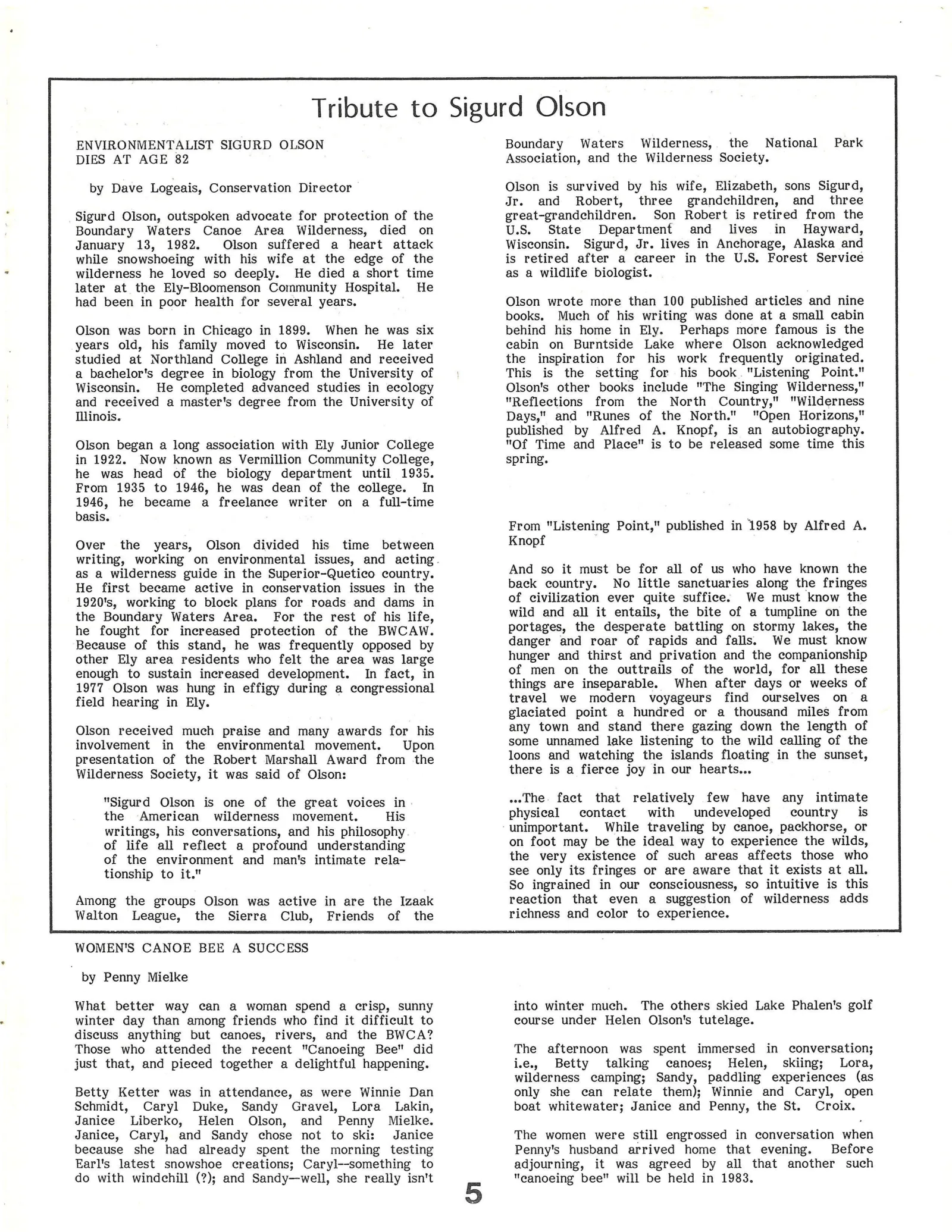
Searchable text for scan page 5
Tribute to Sigurd Olson
ENVIRONMENTALIST SIGURD OLSON Boundary Waters Wilderness, the National Park
DIES AT AGE 82 Association, and the Wilderness Society.
by Dave Logeais, Conservation Director Olson is survived by his wife, Elizabeth, sons Sigurd,
Jr. and Robert, three grandchildren, and three
Sigurd Olson, outspoken advocate for protection of the great-grandchildren. Son Robert is retired from the
Boundary Waters Canoe Area Wilderness, died on U.S. State Department and lives in Hayward,
January 13, 1982. Olson suffered a heart attack Wisconsin. Sigurd, Jr. lives in Anchorage, Alaska and
while snowshoeing with his wife at the edge of the is retired after a career in the U.S. Forest Service
wilderness he loved so deeply. He died a short time as a wildlife biologist.
later at the Ely-Bloomenson Community Hospital. He
had been in poor health for several years. Olson wrote more than 100 published articles and nine
books. Much of his writing was done at a small cabin
Olson was born in Chicago in 1899. When he was six behind his home in Ely. Perhaps more famous is the
years old, his family moved to Wisconsin. He later eabin on Burntside Lake where Olson acknowledged
studied at Northland College in Ashland and received the inspiration for his work frequently originated.
a bachelor's degree in biology from the University of This is the setting for his book. "Listening Point."
Wisconsin. He completed advanced studies in ecology Olson's other books include "The Singing Wilderness,"
and received a master's degree from the University of "Reflections from the North Country," "Wilderness
Minois. Days," and "Runes of the North." "Open Horizons,"
published by Alfred A. Knopf, is an autobiography.
Olson began a long association with Ely Junior College "Of Time and Place" is to be released some time this
in 1922. Now known as Vermillion Community College, spring.
he was head of the biology department until 1935.
From 1935 to 1946, he was dean of the college. In
1946, he became a freelance writer on a full-time
aia From "Listening Point," published in 1958 by Alfred A.
Over the years, Olson divided his time between Knopf
writing, working on environmental issues, and acting. .
as a wilderness guide in the Superior-Quetico country. And so it must be for all of us who have known the
He first became active in conservation issues in the back country. No little sanctuaries along the fringes
1920's, working to block plans for roads and dams in of civilization ever quite suffice. We must know the
the Boundary Waters Area. For the rest of his life, wild and all it entails, the bite of a tumpline on the
he fought for increased protection of the BWCAW. portages, the desperate battling on stormy lakes, the
Because of this stand, he was frequently opposed by danger and roar of rapids and falls. We must know
other Ely area residents who felt the area was large hunger and thirst and privation and the companionship
enough to sustain increased development. In fact, in of men on the outtrails of the world, for all these
1977 Olson was hung in effigy during a congressional things are inseparable. When after days or weeks of
field hearing in Ely. travel we modern voyageurs find ourselves on a
glaciated point a hundred or a thousand miles from
Olson received much praise and many awards for his any town and stand there gazing down the length of
involvement in the environmental movement. Upon some unnamed lake listening to the wild calling of the
presentation of the Robert Marshall Award from the loons and watching the islands floating in the sunset,
Wilderness Society, it was said of Olson: there is a fierce joy in our hearts...
"Sigurd Olson is one of the great voices in The. fact that relatively few have any intimate
the American wilderness movement. His physical contact with undeveloped country is
writings, his conversations, and his philosophy unimportant. While traveling by canoe, packhorse, or
of life all reflect a profound understanding on foot may be the ideal way to experience the wilds,
of the environment and man's intimate rela- the very existence of such areas affects those who
tionship to it." see only its fringes or are aware that it exists at all.
So ingrained in our consciousness, so intuitive is this
Among the groups Olson was active in are the Izaak reaction that even a suggestion of wilderness adds
Walton League, the Sierra Club, Friends of the richness and color to experience.
WOMEN'S CANOE BEE A SUCCESS
by Penny Mielke
What better way can a woman spend a crisp, sunny into winter much. The others skied Lake Phalen's golf
winter day than among friends who find it difficult to course under Helen Olson's tutelage.
discuss anything but canoes, rivers, and the BWCA?
Those who attended the recent "Canoeing Bee" did The afternoon was spent immersed in conversation;
just that, and pieced together a delightful happening. ice, Betty talking canoes; Helen, skiing; Lora,
wilderness camping; Sandy, paddling experiences (as
Betty Ketter was in attendance, as were Winnie Dan only she can relate them); Winnie and Caryl, open
Schmidt, Caryl Duke, Sandy Gravel, Lora Lakin, boat whitewater; Janice and Penny, the St. Croix.
Janice Liberko, Helen Olson, and Penny Mielke. -
Janice, Caryl, and Sandy chose not to ski: Janice The women were still engrossed in conversation when
beeause she had already spent the morning testing Penny's husband arrived home that evening. Before
Earl's latest snowshoe creations; Caryl--something to adjourning, it was agreed by all that another such
do with windchill (?); and Sandy—well, she really isn't "canoeing bee" will be held in 1983.
Article contents & approved summaries (0)
No article summaries are available for this view.