
November 1982 · Volume/issue not printed or unknown
November 1982 Magazine
Magazine · 12 pages
Search this issue
For the full-resolution original, use Open PDF above. Your browser handles PDF zoom and navigation.
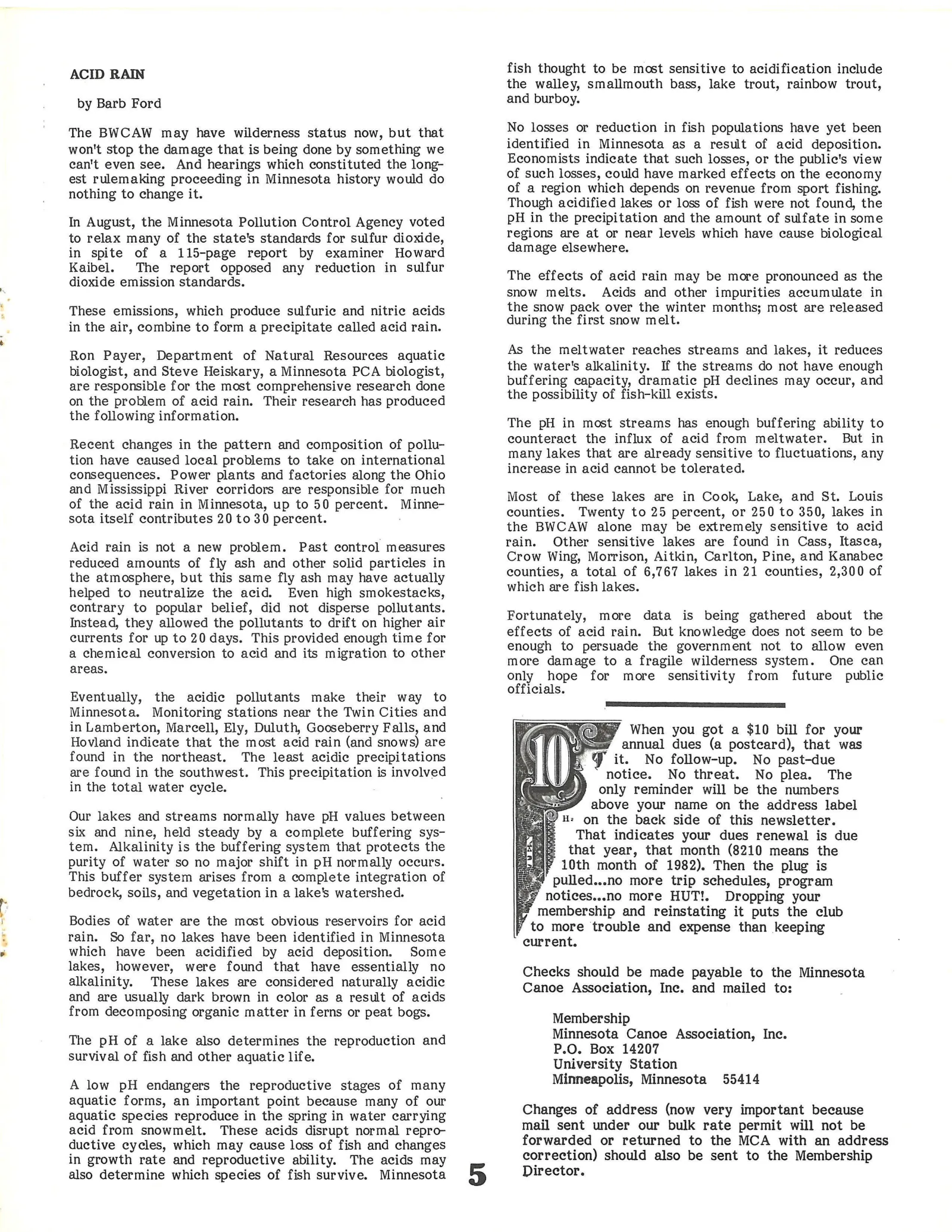
Searchable text for scan page 5
fish thought to be most sensitive to acidification include
ACID RAIN
the walley, smallmouth bass, lake trout, rainbow trout,
by Barb Ford and burboy.
The BWCAW may have wilderness status now, but that No losses or reduction in fish populations have yet been
won't stop the damage that is being done by something we identified in Minnesota as a result of acid deposition.
can't even see. And hearings which constituted the long- Economists indicate that such losses, or the public's view
est rulemaking proceeding in Minnesota history would do of such losses, could have marked effects on the economy
nothing to change it. of a region which depends on revenue from sport fishing.
Though acidified lakes or loss of fish were not found, the
In August, the Minnesota Pollution Control Agency voted pH in the precipitation and the amount of sulfate in some
to relax many of the state's standards for sulfur dioxide, Piers are at or near levels which have cause biological
in spite of a 115-page report by examiner Howard amage elsewhere.
Kaibel. The report opposed any reduction in sulfur
dioxide. enviesion standards. The effects of acid rain may be more pronounced as the
snow melts. Acids and other impurities accumulate in
These emissions, which produce sulfuric and nitric acids wie woot peek ovat the {tater months; most are released
in the air, combine to form a precipitate called acid rain. CES es LE ANE
As the meltwater reaches streams and lakes, it reduces
the water's alkalinity. If the streams do not have enough
buffering capacity, dramatic pH declines may occur, and
the possibility of fish-kill exists.
Ron Payer, Department of Natural Resources aquatic
biologist, and Steve Heiskary, a Minnesota PCA biologist,
are responsible for the most comprehensive research done
on the problem of acid rain. Their research has produced
the following information. The pH in most streams has enough buffering ability to
counteract the influx of acid from meltwater. But in
many lakes that are already sensitive to fluctuations, any
increase in acid cannot be tolerated.
Recent changes in the pattern and composition of pollu-
tion have caused local problems to take on international
consequences. Power plants and factories along the Ohio
and Mississippi River corridors are responsible for much
of the acid rain in Minnesota, up to 50 percent. Minne-
sota itself contributes 20 to 30 percent. :
Most of these lakes are in Cook, Lake, and St. Louis
counties. Twenty to 25 percent, or 250 to 350, lakes in
the BWCAW alone may be extremely sensitive to acid
rain. Other sensitive lakes are found in Cass, Itasca,
Crow Wing, Morrison, Aitkin, Carlton, Pine, and Kanabec
counties, a total of 6,767 lakes in 21 counties, 2,300 of
which are fish lakes.
Acid rain is not a new problem. Past control measures
reduced amounts of fly ash and other solid particles in
the atmosphere, but this same fly ash may have actually
helped to neutralize the acid. Even high smokestacks,
contrary to popular belief, did not disperse pollutants.
Instead, they allowed the pollutants to drift on higher air
currents for up to 20 days. This provided enough time for
a chemical conversion to acid and its migration to other
areas.
Fortunately, more data is being gathered about the
effects of acid rain. But knowledge does not seem to be
enough to persuade the government not to allow even
more damage to a fragile wilderness system. One can
only hope for more sensitivity from future public
Eventually, the acidic pollutants make their way to see.
Minnesota. Monitoring stations near the Twin Cities and
in Lamberton, Marcell, Ely, Duluth, Gooseberry Falls, and
Hovland indicate that the most acid rain (and snows) are
found in the northeast. The least acidic precipitations
are found in the southwest. This precipitation is involved
in the total water cycle.
@ When you got a $10 bill for your
# annual dues (a posteard), that was
WY it. No follow-up. No past-due
notice. No threat. No plea. The
only reminder will be the numbers
above your name on the address label
“/H: on the back side of this newsletter.
That indicates your dues renewal is due
that year, that month (8210 means the
10th month of 1982). Then the plug is
# pulled...no more trip schedules, program
notices...no more HUT!. Dropping your
# membership and reinstating it puts the club
to more trouble and expense than keeping
current.
Our lakes and streams normally have pH values between
six and nine, held steady by a complete buffering sys-
tem. Alkalinity is the buffering system that protects the
purity of water so no major shift in pH normally occurs.
This buffer system arises from a complete integration of
bedrock, soils, and vegetation in a lake's watershed.
Bodies of water are the most obvious reservoirs for acid
rain. So far, no lakes have been identified in Minnesota
which have been acidified by acid deposition. Some
lakes, however, were found that have essentially no
alkalinity. These lakes are considered naturally acidic
and are usually dark brown in color as a result of acids
from decomposing organic matter in ferns or peat bogs.
Cheeks should be made payable to the Minnesota
Canoe Association, Inc. and mailed to:
Membership
Minnesota Canoe Association, Inc.
P.O. Box 14207
University Station
Minneapolis, Minnesota 55414
The pH of a lake also determines the reproduction and
survival of fish and other aquatic life.
A low pH endangers the reproductive stages of many
EQOOL IG DERIES, ampOMEnt Doe Pecaise Mahy Of Ome Changes of address (now very important because
aquatic species reproduce in the spring in water carrying S ¥ imp
acid from snowmelt. These acids disrupt normal repro- mail sent under our bulk rate permit will not be
ductive cycles, which may cause loss of fish and changes forwarded or returned to the MCA with an address
in growth rate and reproductive ability. The acids may correction) should also be sent to the Membership
also determine which species of fish survive. Minnesota 5 Director.
Article contents & approved summaries (0)
No article summaries are available for this view.