
January 1983 · Vol. 19 No. 1
January 1983 Magazine (Vol. 19 No. 1)
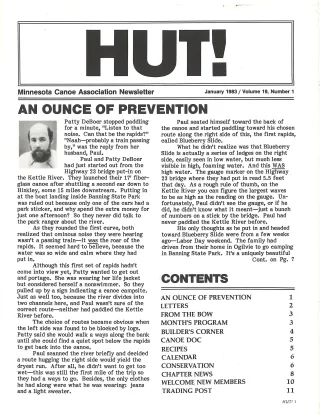
Magazine · 12 pages
Search this issue
For the full-resolution original, use Open PDF above. Your browser handles PDF zoom and navigation.
Searchable text for scan page 4
BUILDER’S CORNER
Fiberglassing a canoe is a major operation that will turn solid with the addition of the
and remains seary to many first time builders. proper chemicals.
A little knowledge of the process removes much Often used is polyester resin. This is
of this scare. relatively cheap and is fairly easy to use.
Fiberglass is glass—very fine fibers of Epoxy resin is much stronger than poly,
glass. These glass fibers can be used to rein- and also more expensive. Epoxys come in a
force a plastic, making a strong composite great variety of hardnesses and cure times.
called FRP. The cost is about three times the price of poly-
The glass in the plastic does the same ester.
thing that reinforcing rods do in a concrete Vinyl esters are newcomers to the market.
structure. The more rebar in concrete the They have a very short shelf life, which is their
stronger it becomes. The same for FRP. The greatest shortcoming. Use fresh resin very
higher the glass to resin ratio, the stronger soon after its purchase (4-6 weeks max.).
the composite. The resin provided by the MCA to its
Rovings are clusters of single strands members is polyester resin. We can also usually
that are bundled together. They can be pur- provide finishing resin. Poly resin is sold either
chased in long rolls. Woven rovings are more as finishing resin with wax or laminating resin
commonly used for building larger boats. This with no wax. Either resin can be used when
is a fabric made of rovings; it looks like cloth building a stripper. My preference is finishing
although the strands of glass are not spun into resin. Be sure you know which you are buying.
threads as in cloth. The rovings are a looser Laminating resin is for layering glass. It
bundle of separate fibers. ean be used for building a stripper, but remem-
Woven rovings are cheaper than cloth. ber that the outer surface will never cure. The
They are made as heavier fabrics and get used outer few thousandths of resin will remain
frequently in laminating when a thicker lami- gummy weeks later. This is a very common
nate is needed. problem that builders have. It is nearly impos-
The fabric that the MCA sells is glass sible to sand off this goo. Fortunately it can
cloth in 72 or 4 ounce weights. The MCA's be washed off with acetone.
material comes in widths that should cover Poly resins require a very small amount of
a canoe from gunnel to gunnel. catalyst to promote a cure. I usually measure
For a woodstrip boat, fiberglass cloth mine with an eye dropper in pint size batches.
makes an excellent covering. A layer of 72 oz. Be sure to read the instructions carefully and
on the outside and a layer of 4 oz. inside works mix your resin accordingly. Follow the direc-
well. This is common in cruising canoes. tions carefully, but remember the cure time is
Fiberglass matt is sometimes used in affected very much by the air and surface tem-
canoe building. Matt is a bunch of short perature. On hot days resin cures fast and less
fibers layed up in a random pattern. These catalyst is required. On cool days much more
fibers are bonded together with a cement that is required. Mix small batches following the
holds them in a unidirectional mass. Matt is instructions, but be ready to adjust the percen-
not nearly as strong as cloth, but it will go tage of catalyst to buy yourself more working
into places that cloth won't. time or a faster cure.
Fiberglass is not the only material that There are many epoxy resin formulas. Be
can be used to reinforce plastic. A quick look sure the dealer knows what you plan to use it
at a state of the art kayak will show a com- for. There are epoxys called Safe—don't believe
posite of many types of fabric laminated it. All epoxys are toxic and should be treated
together. as dangerous. Gas masks, gloves and barrier
Kevlar is the wonder-fiber of the 70's. It creams should be used for your protection. Any
makes a strong, light structure, but it is not resins should be used in well ventilated areas.
without problems. It's greatest place is in com- Solvents should be on hand for cleaning up
posites of Kevlar and glass, or Kevlar and nylon. before any mixing is started. A solution of
Carbon fibers are also used in canoe build- household detergent and ammonia works fairly
ing. These are graphite, very strong, and well on poly resin. Acetone is a good solvent
incredibly expensive. Carbon fibers are dark for clean up but should never come in contact
grey in color. When we get the price down with your skin. Acetone dilutes the resin and
we may all be paddling dark grey boats. on your skin it will cause the resin to soak in.
There are several commonly used resins It is also very volatile and will evaporate very
in these processes. All are syrupy substances quickly when open. Bob Brown
4 HUT!
Article contents & approved summaries (0)
No article summaries are available for this view.