
October 1976 · Volume/issue not printed or unknown
October 1976 Supplement
Supplement · 40 pages
Search this issue
For the full-resolution original, use Open PDF above. Your browser handles PDF zoom and navigation.
Searchable text for scan page 7
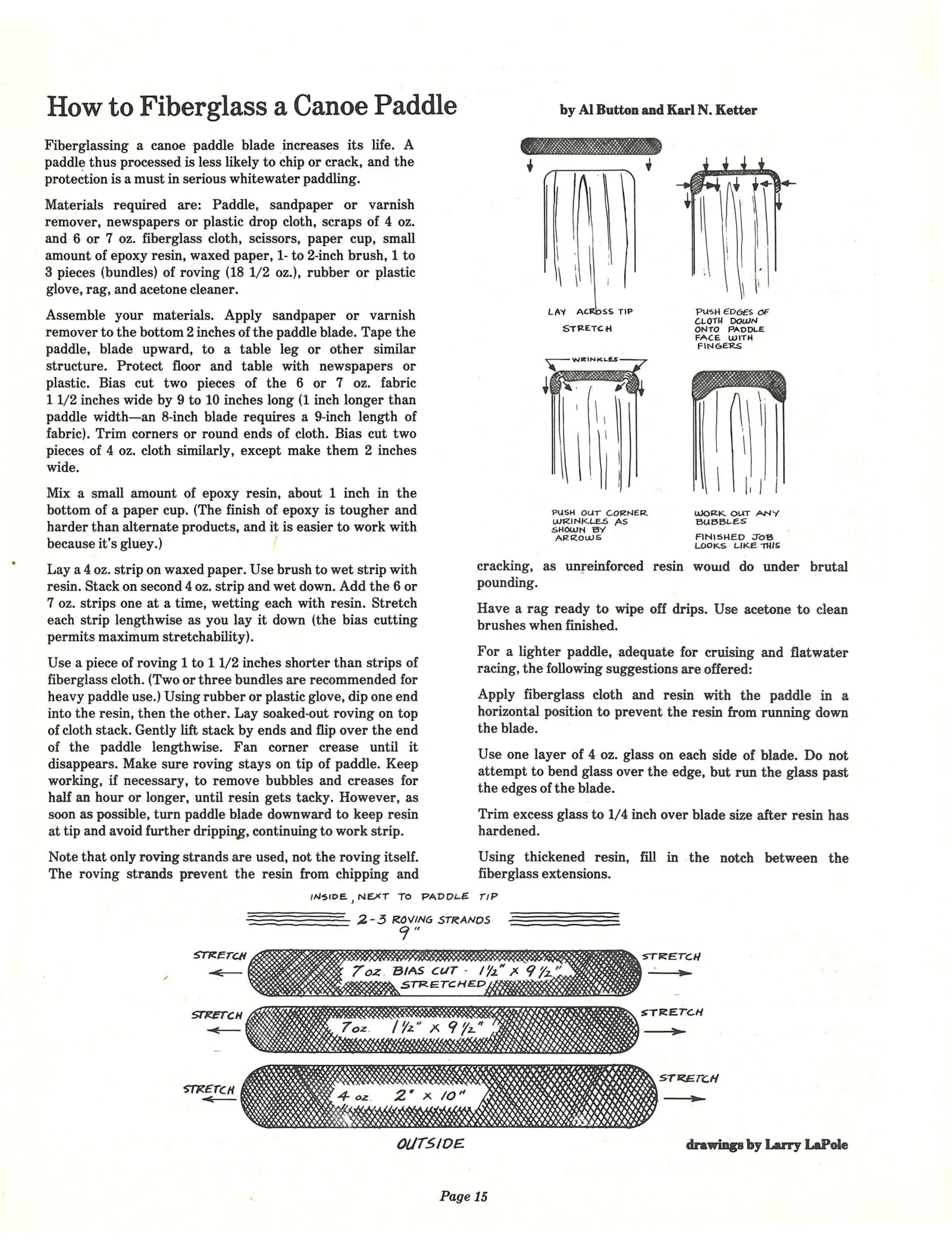
How to Fiberglass a Canoe Paddle by AlButton and Karl N. Ketter
Fiberglassing a canoe paddle blade increases its life. A
paddle thus processed is less likely to chip or crack, and the
protection is a must in serious whitewater paddling.
Materials required are: Paddle, sandpaper or varnish
remover, newspapers or plastic drop cloth, scraps of 4 oz.
and 6 or 7 oz. fiberglass cloth, scissors, paper cup, small
amount of epoxy resin, waxed paper, 1- to 2-inch brush, 1 to
3 pieces (bundles) of roving (18 1/2 oz.), rubber or plastic
glove, rag, and acetone cleaner.
Assemble your materials. Apply sandpaper or varnish HAY eRBSe Tle per cae
remover to the bottom 2 inches of the paddle blade. Tape the STRETCH ae Fee
paddle, blade upward, to a table leg or other similar FINGERS
structure. Protect floor and table with newspapers or
plastic. Bias cut two pieces of the 6 or 7 oz. fabric
1 1/2 inches wide by 9 to 10 inches long (1 inch longer than
paddle width—an 8-inch blade requires a 9-inch length of
fabric). Trim corners or round ends of cloth. Bias cut two
pieces of 4 oz. cloth similarly, except make them 2 inches
wide.
Wi
Mix a small amount of epoxy resin, about 1 inch in the
bottom of a paper cup. (The finish of epoxy is tougher and PUSH OUT CORNER WORK OUT ANY
harder than alternate products, and it is easier to work with Stown ey °° rican
because it’s gluey.) ieee [poke LIKE THIS
Lay a 4 oz. strip on waxed paper. Use brush to wet strip with cracking, as unreinforced resin woud do under brutal
resin. Stack on second 4 oz. strip and wet down. Add the 6 or pounding.
7 oz. strips one at a time, wetting each with resin. Stretch
Have a rag ready to wipe off drips. Use acetone to clean
each strip lengthwise as you lay it down (the bias cutting brushes a Pochod. P f
permits maximum stretchability).
For a lighter paddle, adequate for cruising and flatwater
Use a piece of roving 1 to 1 1/2 inches shorter than strips of racing, the following suggestions are offered:
fiberglass cloth. (Two or three bundles are recommended for
heavy paddle use.) Using rubber or plastic glove, dip one end Apply fiberglass cloth and resin with the paddle in a
into the resin, then the other. Lay soaked-out roving on top horizontal position to prevent the resin from running down
of cloth stack. Gently lift stack by ends and flip over the end the blade.
of the paddle lengthwise. Fan corner crease until it
disappears. Make sure roving stays on tip of paddle. Keep
working, if necessary, to remove bubbles and creases for
Use one layer of 4 oz. glass on each side of blade. Do not
attempt to bend glass over the edge, but run the glass past
half an hour or longer, until resin gets tacky. However, as inaigen OF ene DINEE:
soon as possible, turn paddle blade downward to keep resin Trim excess glass to 1/4 inch over blade size after resin has
at tip and avoid further dripping, continuing to work strip. hardened.
Note that only roving strands are used, not the roving itself. Using thickened resin, fill in the notch between the
The roving strands prevent the resin from chipping and fiberglass extensions.
INSIDE |NEXT TO PADDLE TIP
2-3 ROVING STRANOS
ORR CHE OOK KX
QO OKAY LOA AOQO9
SOO SAO OOOO
HRN) RK
Mie CRIN BOY
SOK OSC Sy
WELK KA RL LAKIN KRACK MAIO ROKK) ree
OO ESAS ESS SSS 5
“ereret
STRETCH
aie bt R 4 oz Z* x fo” —$>
OUTSIDE drawings by Larry LaPole
Page 15
Article contents & approved summaries (0)
No article summaries are available for this view.