
June 1987 · Vol. 23 No. 6
June 1987 Magazine (Vol. 23 No. 6)
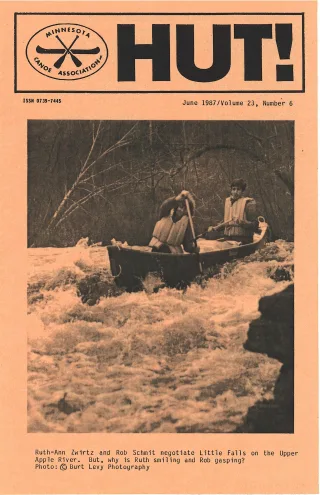
Magazine · 52 pages
Search this issue
For the full-resolution original, use Open PDF above. Your browser handles PDF zoom and navigation.
Searchable text for scan page 8
CLIFF*S CORNER--A BURNING ISSUE
In the April HUT!, a reader expressed
concern at my flippant attitude towards
logging and burning in wilderness areas. In
truth, my rationale is neither flippant nor
incorrect. Any forester will pleasingly extol
the virtues of sensibly sized wildfires and
§. conscionable logging. Indeed, my old forestry
professors (I received my B.S. in forestry in
1962) would thrash me good if I suggested
otherwise.
What follows jis a review of fire/logging
ecology basics for those who would like to
‘better understand.
Fact: Forest fires have burned through
‘northern Minnesota at regular intervals since
the dawn of time. Light surface fires return
to pine stands about every 36 years; heavier
crown fires on the average of 100-300 years.
Northern Minnesota--notably the BWCA--has
learned to survive these fires; indeed this area is dependent on
them. Here's a list of the positive effects of forest fires in the
northern eco-system.
1. Sets back plant succession-~gets rid of the shade~tolerant
spruce and balsam and brings back the intolerant pines and herbaceous
vegetation. Remember, deer and moose don*t eat big trees-~too hard
to reach the leaves! Logging too does the same thing, though because
of the marketability of certain species, man is more selective.
Nonetheless, deer, moose, black bear and other animals invariably
follow a logging operation. Ask any hunter!
2. A surface fire burns up the litter (duff) layer, which
accomplishes two things: a) It returns minerals to the soil for
‘immediate re-use; b) Gets rid of surface debris so young seedlings
can grow better (don*t have to compete against overhead plants).
Minnesota winters are long and cold: Decomposition does not keep pace
with the accumulating leaf/needle fall. Without periodic fires to
destroy the duff layer, build-up would occur on the earth's surface
and minerals would be tied up in the vegetation.
This is a major reason why the destruction of the South American
rain forests is so serious. Virtually all the nutrients in jungle
environments are locked in the vegetative matter. In hot climates,
decomposition does keep pace (even outstrips it) with the falling
litter, so fires are not needed. In Minnesota, fires are critical to
the health of a forest.
3. An occasional (200 year) gullywumper crown fire is often
essential too: Big fires get rid of diseased and insect~ridden trees.
A fire is a far better pest management tool than is the best Geigy
pesticide!
4. On the average, a young healthy forest produces (per acre)
about 1-1/2 tons of oxygen and consumes about one ton of carbon
dioxide annually. Old forests use up as much oxygen as they produce,
and they don*t produce any news wood either. As a forest ages, it
also produces few photosynthetic materials, (leaves and needles) and
nutrients, as mentioned, are tied up in these products and are not
available for re-use.
5. The blackened earth following a fire absorbs heat from the
sun and creates a favorable "incubator" for the growth of new
seedlings.
6. Many trees in northern Minnesota are "fire dependant." The
Jack pine with its serotinous cones (cones are covered with wax which
8 HUT{i-June 1987
Article contents & approved summaries (0)
No article summaries are available for this view.