
June 1987 · Vol. 23 No. 6
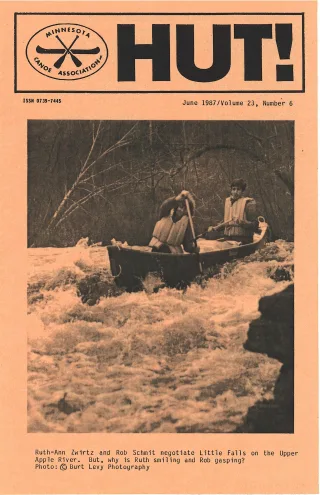
June 1987 Magazine (Vol. 23 No. 6)
Magazine · 52 pages
Search this issue
For the full-resolution original, use Open PDF above. Your browser handles PDF zoom and navigation.
Searchable text for scan page 9
must be melted before seeds can be released) is an example. Some
other species have “semi~serotinous" cones.
7. Most pines have thick, fire-resistant bark and will withstand
a passing fire. Other species, like paper birch and aspen have heat-
resistant root systems which will regenerate (through suckering)
after fire. Want to pick blueberries? These spring back right after
a fire. No fires, no berry crop and a bunch of hopping mad bears!
8. Contrary to popular belief, forest fires usually don't kill
all the trees. So instead of producing a region of even-aged trees,
quite the opposite usually results. Of course, this variety is
healthy for wildlife.
9. After a fire passes, new niches develop in the forest. Sap
weeps from the trees to repair fire wounds. Insects move in, and a
variety of new birds, namely woodpeckers, invade the forest. No
fires, few exotic birds.
Now here's the problem: You can't just let fires burn out of
hand, and you can't "let nature take its course," and put them out
when you've decided too much has been burned. Fire fighting
technology is still pretty primitive. Often, you must get on a new
fire instantly or you may not get it out until it has burned towns
and homes. The forest service has occasionally used controlled
burning to perpetuate fires, and some of this is sorely needed in the
BWCA. But controlled burns, despite precautions, sometimes become
uncontrolled burns, then everyone blames the feds. Besides, most
people still view forest fires as evil--ala the days of Smokey Bear.
And what about logging? Much has been written bout the evils of
clearcutting. And back in the 50's when there were no controls, such
complaints were valid. Today, most pulpwood clearcuts done in
northern Minnesota are quite small. Pulp is not terribly valuable.
Even if you could "selectively cut" aspen and Jack pine, you probably
couldn't make enough money at it to stay in business. A fifteen acre
clearcut--tastefully done, will reforest itself in just a few years,
especially if a checkerboard (strip) method is used, leaving a few
hundred yards between rows.
It's important to realize that aspens and pines are intolerant to
shade--which means they need sunlight. These trees won't grow under
the shade of more mature trees. A selective cut won't work very well
with these species. They need space--an open area to grow. Hence,
methods based on the clearcutting principle are preferred.
Get a piece of paper and think hard. On the left, list all the
animals you can think of which live in the climax forest (typified in
northern Minnesota by balsam fir and spruce). On the right, jot down
those which need pioneer species like aspen, Jack pine, paper birch,
moose maple and blueberries. The left side is pretty short, isn't
it? You bet! Remember, deer don't eat big trees!
It's fashionable today to complain about mis-management of our
natural resources without having adequate information on which to
base decisions. Contrary to popular belief, American foresters and
wildlife managers DO know what they're doing. And they DO care
deeply about the environment. That the selfish interests of some
industries often obscures this fact is the real cause for concern.
Unfortunately, most Americans never learn about forest fire ecology,
about logging or wildlife management. Sure, everyone agonizes over
the loss of the Ivory billed woodpecker and the snail darter. But
schools by and large teach biology, not ecology!
Next time you paddle the favorite haunts of your Boundary Waters
lake, look around. Take a hard look at what's growing...and what's
dying. What? No deer here? No moose? No beaver? No black bear?
Both fires and sensible logging leave scars which are quickly healed.
CLIFF--CONTINUED ON PAGE 10
June 1987-HUT! 9
Article contents & approved summaries (0)
No article summaries are available for this view.