
May 1973 · Volume/issue not printed or unknown
May 1973 Magazine
Magazine · 24 pages
Search this issue
For the full-resolution original, use Open PDF above. Your browser handles PDF zoom and navigation.
Searchable text for scan page 4
The
St. Croix...
A Brief History
Here’s a nicely written and informative
piece that we'll run in two parts — the
second part in the July HUT! Tom Carroll
is a Civil Engineer and MCA member.
Photos courtesy NSP
by Tom Carrell
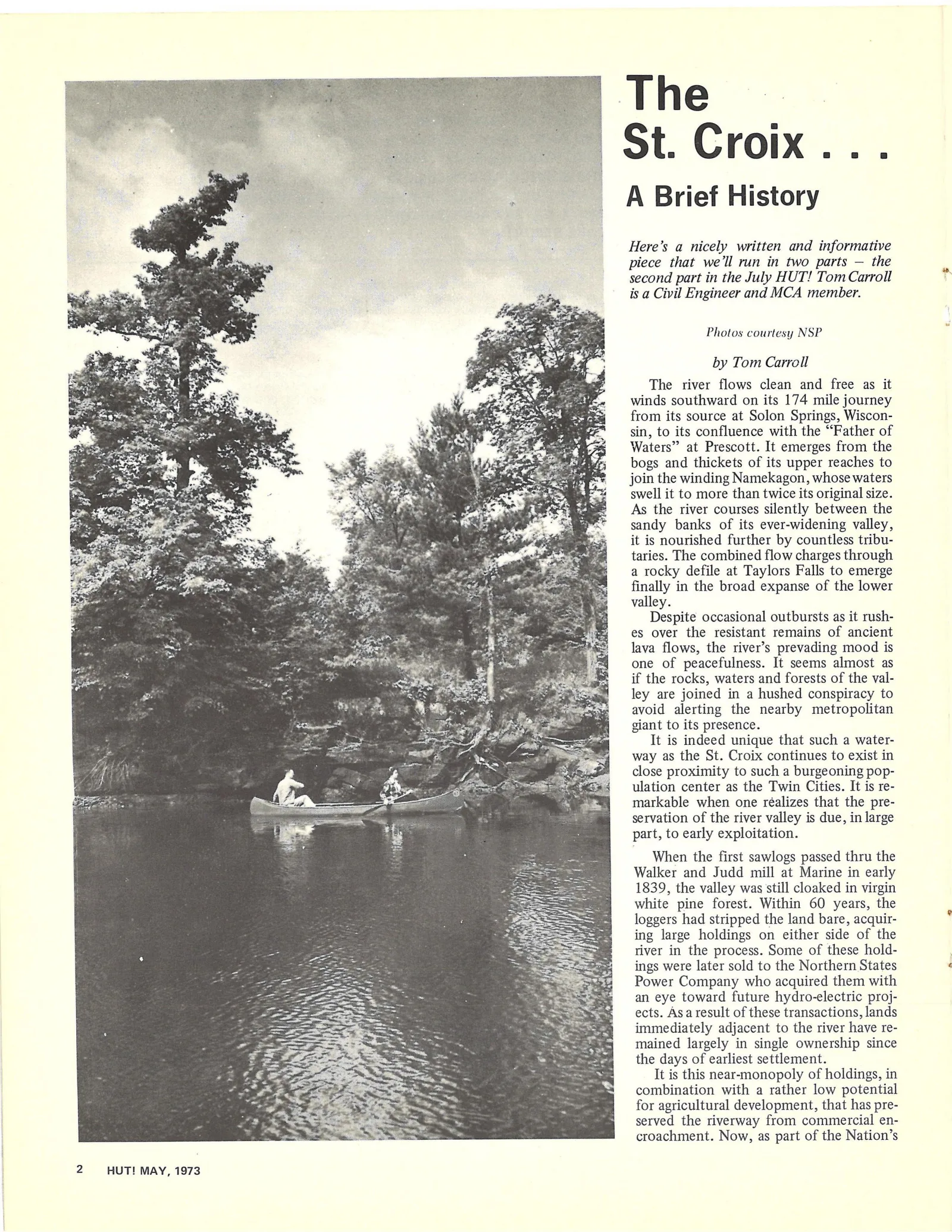
The river flows clean and free as it
winds southward on its 174 mile journey
from its source at Solon Springs, Wiscon-
sin, to its confluence with the “Father of
Waters” at Prescott. It emerges from the
bogs and thickets of its upper reaches to
join the winding Namekagon, whose waters
swell it to more than twice its original size.
As the river courses silently between the
sandy banks of its ever-widening valley,
it is nourished further by countless tribu-
taries. The combined flow charges through
a rocky defile at Taylors Falls to emerge
finally in the broad expanse of the lower
valley.
Despite occasional outbursts as it rush-
es over the resistant remains of ancient
lava flows, the river’s prevading mood is
one of peacefulness. It seems almost as
if the rocks, waters and forests of the val-
ley are joined in a hushed conspiracy to
avoid alerting the nearby metropolitan
giant to its presence.
It is indeed unique that such a water-
way as the St. Croix continues to exist in
close proximity to such a burgeoning pop-
ulation center as the Twin Cities. It is re-
markable when one réalizes that the pre-
servation of the river valley is due, in large
part, to early exploitation.
When the first sawlogs passed thru the
Walker and Judd mill at Marine in early
1839, the valley was still cloaked in virgin
white pine forest. Within 60 years, the
loggers had stripped the land bare, acquir-
ing large holdings on either side of the
river in the process. Some of these hold-
ings were later sold to the Northern States
Power Company who acquired them with
an eye toward future hydro-electric proj-
ects. Asa result of these transactions, lands
immediately adjacent to the river have re-
mained largely in single ownership since
the days of earliest settlement.
It is this near-monopoly of holdings, in
combination with a rather low potential
for agricultural development, that has pre-
served the riverway from commercial en-
croachment. Now, as part of the Nation’s
2 HUT! MAY, 1973
Article contents & approved summaries (0)
No article summaries are available for this view.