
November 1973 · Volume/issue not printed or unknown
November 1973 Magazine
Magazine · 20 pages
Search this issue
For the full-resolution original, use Open PDF above. Your browser handles PDF zoom and navigation.
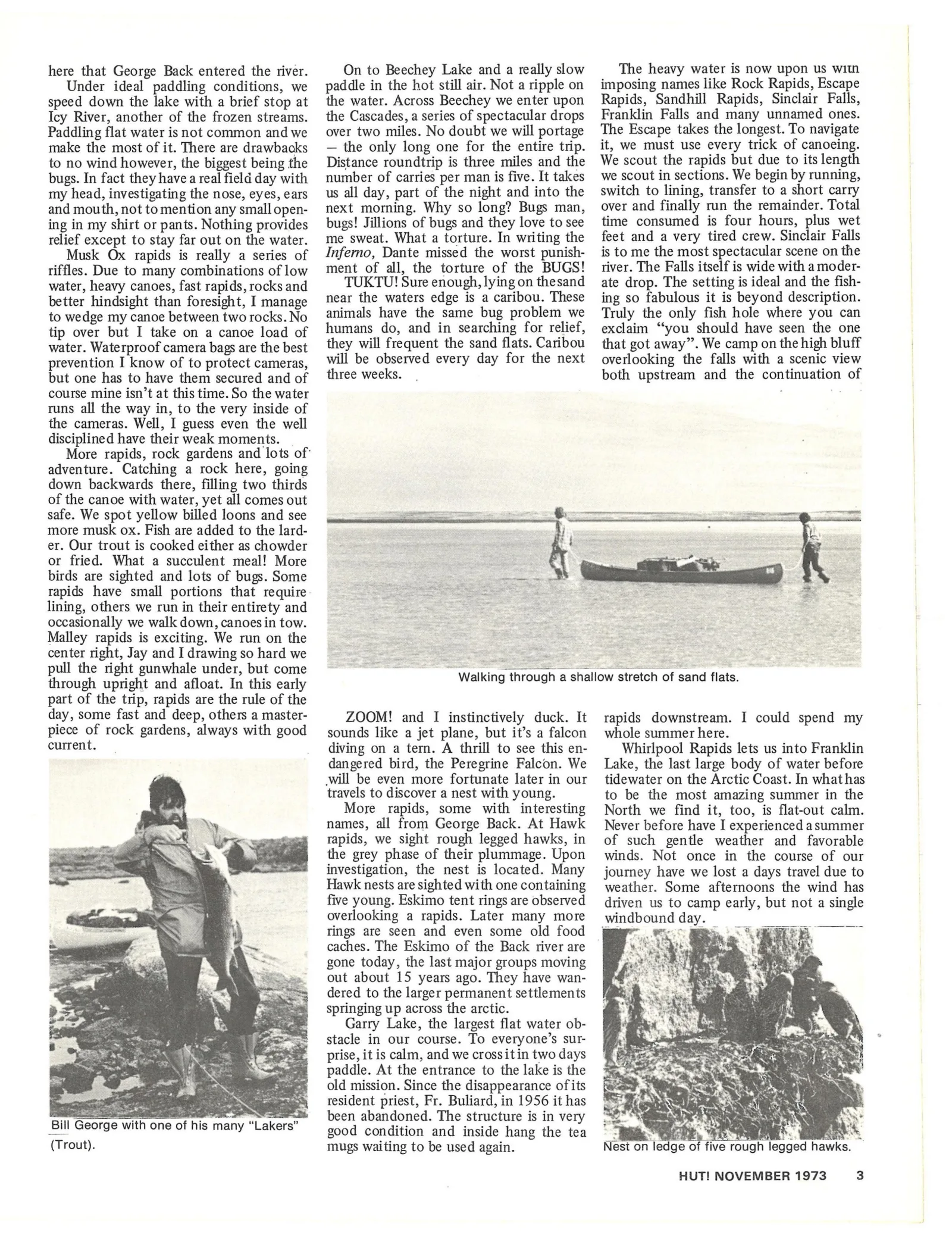
Searchable text for scan page 5
here that George Back entered the river. On to Beechey Lake and a really slow The heavy water is now upon us witn
Under ideal paddling conditions, we paddle in the hot still air. Not a ripple on imposing names like Rock Rapids, Escape
speed down the lake with a brief stop at the water. Across Beechey we enter upon Rapids, Sandhill Rapids, Sinclair Falls,
Icy River, another of the frozen streams. the Cascades, a series of spectacular drops Franklin Falls and many unnamed ones.
Paddling flat water isnot common and we over two miles. No doubt we will portage The Escape takes the longest. To navigate
make the most of it. There are drawbacks — the only long one for the entire trip. it, we must use every trick of canoeing.
to no wind however, the biggest being the Distance roundtrip is three miles and the We scout the rapids but due to its length
bugs. In fact they havea real field day with number of carries per man is five. It takes we scout in sections. We begin by running,
my head, investigating the nose, eyes, ears us all day, part of the night and into the switch to lining, transfer to a short carry
and mouth, not tomention any smallopen- next morning. Why so long? Bugs man, over and finally run the remainder. Total
ing in my shirt or pants. Nothing provides _ bugs! Jillions of bugs and they love to see _ time consumed is four hours, plus wet
relief except to stay far out on the water. me sweat. What a torture. In writing the feet and a very tired crew. Sinclair Falls
Musk Ox rapids is really a series of Inferno, Dante missed the worst punish- is to me the most spectacular scene on the
riffles. Due to many combinations of low ment of all, the torture of the BUGS! _ river. The Falls itself is wide with a moder-
water, heavy canoes, fast rapids, rocks and TUKTU! Sure enough, lyingon thesand ate drop. The setting is ideal and the fish-
better hindsight than foresight, I manage ear the waters edge is a caribou. These ing so fabulous it is beyond description.
to wedge my canoe between tworocks.No animals have the same bug problem we Truly the only fish hole where you can
tip over but I take on a canoe load of humans do, and in searching for relief, exclaim “you should have seen the one
water. Waterproof camera bags are the best _ they will frequent the sand flats. Caribou that got away”. We camp on the high bluff
prevention I know of to protect cameras, Will be observed every day for the next overlooking the falls with a scenic view
but one has to have them secured and of _ three weeks. both upstream and the continuation of
course mine isn’t at this time. So the water
runs all the way in, to the very inside of
the cameras. Well, I guess even the well
disciplined have their weak moments.
More rapids, rock gardens and lots of’
adventure. Catching a rock here, going
down backwards there, filling two thirds
of the canoe with water, yet all comes out
safe. We spot yellow billed loons and see
more musk ox. Fish are added to the lard-
er. Our trout is cooked either as chowder
or fried. What a succulent meal! More
birds are sighted and lots of bugs. Some Per : —,
rapids have small portions that require. ee a a
lining, others we run in their entirety and Set
occasionally we walk down, canoes in tow.
Malley rapids is exciting. We run on the
center right, Jay and I drawing so hard we
pull the right gunwhale under, but come
through upright and afloat. In this early
part of the trip, rapids are the rule of the
Walking through a shallow stretch of sand flats.
day, some fast and deep, others a master- ZOOM! and I instinctively duck. It rapids downstream. I could spend my
piece of rock gardens, always with good sounds like a jet plane, but it’s a falcon whole summer here.
current. diving on a tern. A thrill to see this en- Whirlpool Rapids lets us into Franklin
dangered bird, the Peregrine Falcon. We Lake, the last large body of water before
will be even more fortunate later in our tidewater on the Arctic Coast. In what has
travels to discover a nest with young. to be the most amazing summer in the
More rapids, some with interesting North we find it, too, is flat-out calm.
names, all from George Back. At Hawk Never before have I experienced asummer
rapids, we sight rough legged hawks, in of such gentle weather and favorable
the grey phase of their plummage. Upon winds. Not once in the course of our
investigation, the nest is located. Many journey have we lost a days travel due to
Hawk nests are sighted with one containing weather. Some afternoons the wind has
five young. Eskimo tent rings are observed driven us to camp early, but not a single
overlooking a rapids. Later many more windbound day.
rings are seen and even some old food jig =>
caches. The Eskimo of the Back river are
gone today, the last major groups moving
out about 15 years ago. They have wan-
dered to the larger permanent settlements
springing up across the arctic.
Garry Lake, the largest flat water ob-
stacle in our course. To everyone’s sur-
prise, it is calm, and we crossitin two days
paddle. At the entrance to the lake is the
old mission. Since the disappearance ofits
resident priest, Fr. Buliard, in 1956 it has
been abandoned. The structure is in very
pil good condition and inside hang the tea ~ ° ee
(Trout). mugs waiting to be used again. Nest on ledg
e of five roug
HUT! NOVEMBER 1973 3
Article contents & approved summaries (0)
No article summaries are available for this view.