
November 1973 · Volume/issue not printed or unknown
November 1973 Magazine
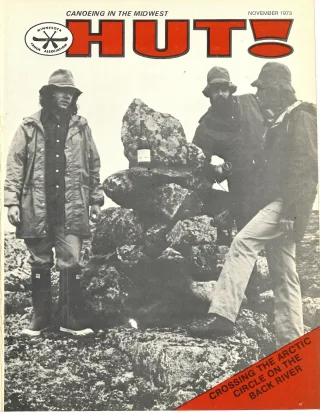
Magazine · 20 pages
Search this issue
For the full-resolution original, use Open PDF above. Your browser handles PDF zoom and navigation.
Searchable text for scan page 6
Beyond Franklin Lake we encounter
the last major Eskimo site. We find a very
nice contrast here. First there is the ancient
site with fish traps of rock, hunting blinds,
old graves and meat caches. Slightly fur-
ther downstream is the summer camp of
modern Eskimos, which was not occupied
this season. In it we find fish spears, hand
carved lures, dogteam sled, old caribou
furs and much bone. Truly a fitting end to
our journey. .
Moving the last few miles to tidewater,
I have to reflect back upon the summer
and its treasures. We observed every arctic
mammal except the arctic fox. Captured
on film are sis-sic or ground squirrels, lem-
mings, wolf, musk ox and caribou. We
caught and consumed three species of fish:
trout, char and grayling. Birds of prey
were numerous and exciting to watch. We
witnessed the flight of eagles, hawks,
gyrfalcons and peregrine falcons. Geese,
ducks and sandhill cranes were equally
numerous not to mention the three species
of loons. It was especially exciting for me
to observe yellow billed and red throated
loons in addition to the familiar common
loon of our own canoe country. Jaegers
of two species, plovers, longspurs, and 9B
snow buntings were with us most of the @AWie
trip. Not to be forgotten is the perennial ; ;
and continuous battle between the terns
and gulls, with the gulls always on the
losing side. It certainly brings one off the ¢ s
cloud of Jonathan Livingston and down
to the reality that the life of a scavenger }
gull is certainly a hard one.
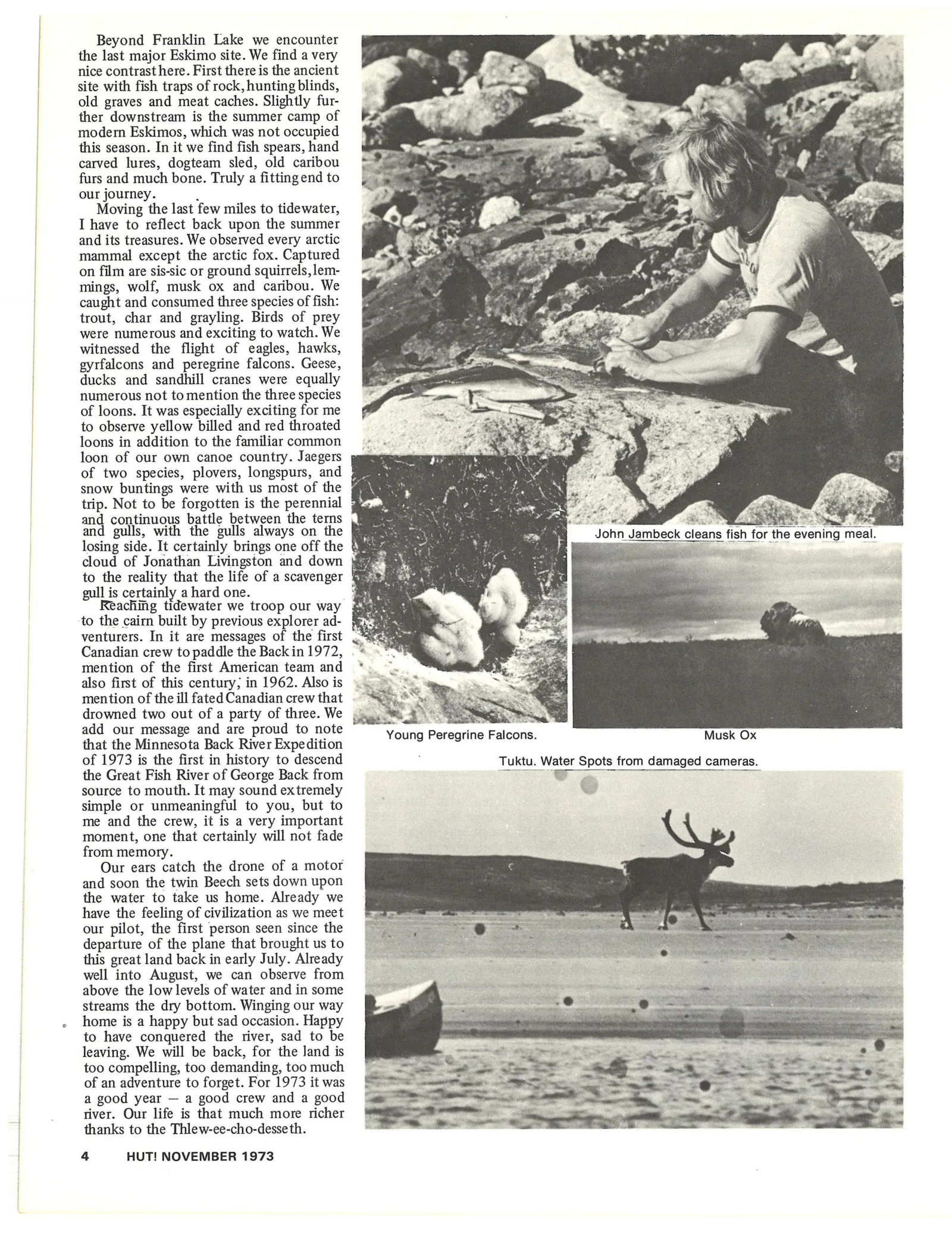
Reaching tidewater we troop our way
to the cairn built by previous explorer ad-
venturers. In it are messages of the first
Canadian crew to paddle the Back in 1972,
mention of the first American team and
also first of this century; in 1962. Alsois .. ~ *~
mention of the ill fated Canadian crew that . © ra :
drowned two out of a party of three. We .. * i oy
add our message and are proud to note ia
Young Peregrine Falcons. Musk Ox
that the Minnesota Back River Expedition
of 1973 is the first in history to descend Tuktu. Water Spots from damaged cameras.
the Great Fish River of George Back from Se Ee
source to mouth. It may sound extremely Ye?
simple or unmeaningful to you, but to
me and the crew, it is a very important
moment, one that certainly will not fade
from memory.
Our ears catch the drone of a motor
and soon the twin Beech sets down upon
the water to take us home. Already we
have the feeling of civilization as we meet
our pilot, the first person seen since the
departure of the plane that brought us to
this great land back in early July. Already
well into August, we can observe from
above the low levels of water and in some
streams the dry bottom. Winging our way
home is a happy but sad occasion. Happy
to have conquered the river, sad to be
leaving. We will be back, for the land is
too compelling, too demanding, too much
of an adventure to forget. For 1973 it was
a good year — a good crew and a good
river. Our life is that much more richer
thanks to the Thlew-ee-cho-desse th.
4 HUT! NOVEMBER 1973
Article contents & approved summaries (0)
No article summaries are available for this view.