
April 1974 · No. 7
April 1974 Magazine (No. 7)
Magazine · 36 pages
Search this issue
For the full-resolution original, use Open PDF above. Your browser handles PDF zoom and navigation.
Searchable text for scan page 4
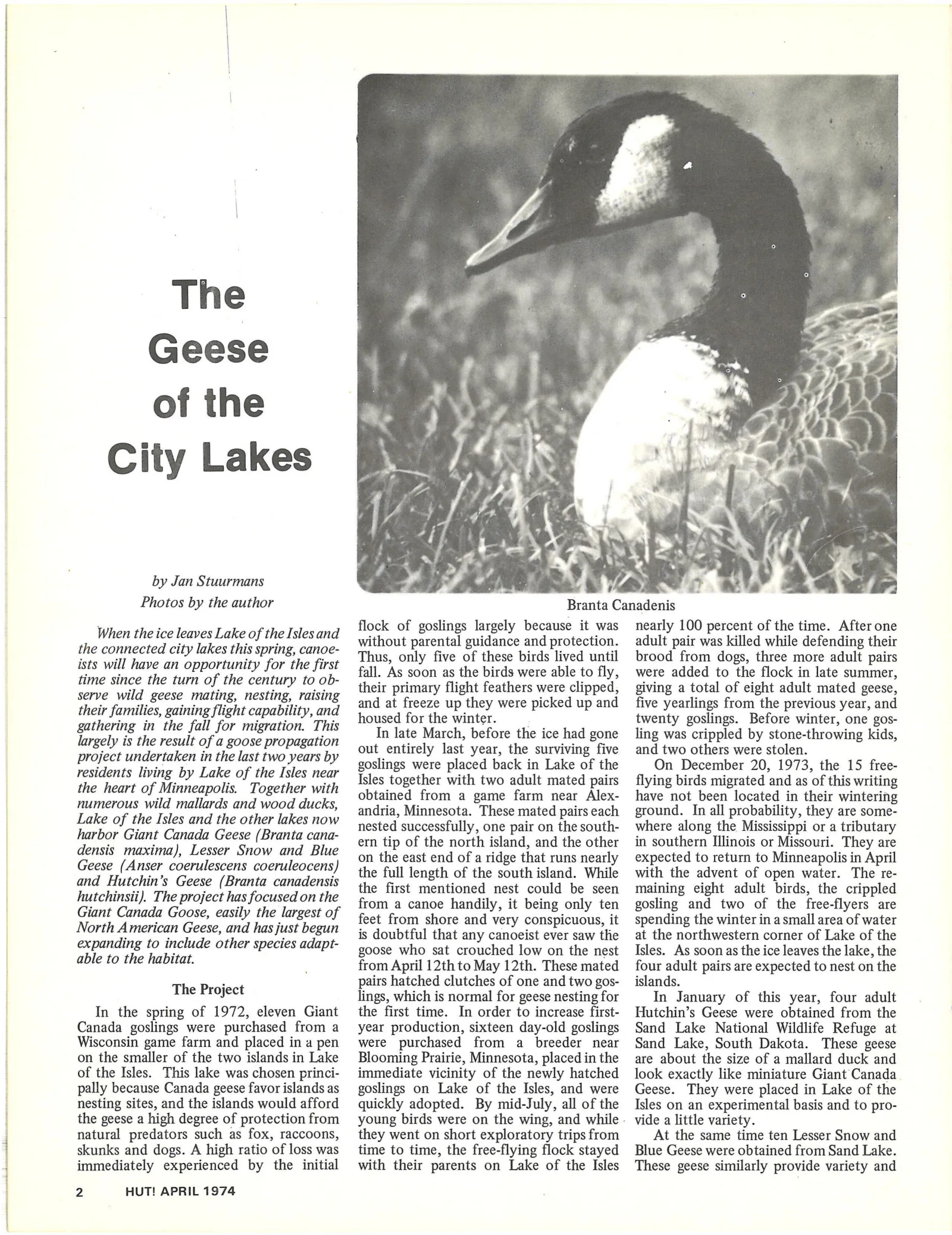
The
Geese
of the
City Lakes
by Jan Stuurmans - ae
Photos by the author Branta Canadenis
flock of goslings largely because it was nearly 100 percent of the time. After one
without parental guidance and protection. adult pair was killed while defending their
Thus, only five of these birds lived until brood from dogs, three more adult pairs
fall. As soon as the birds were able to fly, were added to the flock in late summer,
their primary flight feathers were clipped, giving a total of eight adult mated geese,
and at freeze up they were picked up and five yearlings from the previous year, and
housed for the winter. twenty goslings. Before winter, one gos-
In late March, before the ice had gone _ ling was crippled by stone-throwing kids,
out entirely last year, the surviving five and two others were stolen.
goslings were placed back in Lake of the On December 20, 1973, the 15 free-
Isles together with two adult mated pairs flying birds migrated and as of this writing
obtained from a game farm near Alex- have not been located in their wintering
andria, Minnesota. These mated pairs each acne In all probability, they are some-
E nested successfully, one pair on the south- where along the Mississippi or a tributary
harbor Giant Canada Geese (Branta cana- ory tip of the no ikon. and the other in southern Illinois or Missouri. They are
densis maxima), Lesser Snow and Blue on the east end of a ridge that runs nearly expected to return to Minneapolis in April
Geese (Anser coerulescens coeruleocens) the full length of the south island. While with the advent of open water. The re-
and Hutchin's Geese (Branta canadensis the first mentioned nest could be seen maining eight adult birds, the crippled
hutchinsii). The project has fe ocusedonthe from a canoe handily, it being only ten gosling and two of the free-flyers are
Giant Canada Goose, easily the largest of feet from shore and very conspicuous, it spending the winter in a small area of water
North American Geese, and has j Usk begun is doubtful that any canoeist ever saw the at the northwestern corner of Lake of the
expanding to include other species adapt- goose who sat crouched low on the nest Isles. As soonas the ice leaves the lake, the
When the ice leaves Lake of the Isles and
the connected city lakes this spring, canoe-
ists will have an opportunity for the first
time since the turn of the century to ob-
serve wild geese mating, nesting, raising
their families, gaining flight capability, and
gathering in the fall for migration. This
largely is the result of a goose propagation
project undertaken in the last two years by
residents living by Lake of the Isles near
the heart of Minneapolis. Together with
numerous wild mallards and wood ducks,
Lake of the Isles and the other lakes now
able to the habitat. from April 12th to May 12th. These mated four adult pairs are expected to nest on the
The Project pairs hatched clutches of one and two gos- islands.
ie Etee lings, which is normal for geese nesting for In January of this year, four adult
In the spring of 1972, eleven Giant the first time. In order to increase first- Hutchin’s Geese were obtained from the
Canada goslings were purchased from a_ year production, sixteen day-old goslings Sand Lake National Wildlife Refuge at
Wisconsin game farm and placed ina pen were purchased from a breeder near Sand Lake, South Dakota. These geese
on the smaller of the two islandsin Lake Blooming Prairie, Minnesota, placedinthe are about the size of a mallard duck and
of the Isles. This lake was chosen princi- immediate vicinity of the newly hatched look exactly like miniature Giant Canada
pally because Canada geese favorislandsas goslings on Lake of the Isles, and were Geese. They were placed in Lake of the
nesting sites, and the islands would afford quickly adopted. By mid-July, all of the Isles on an experimental basis and to pro-
the geese a high degree of protectionfrom young birds were on the wing, and while. vide a little variety.
natural predators such as fox, raccoons, they went on short exploratory trips from At the same time ten Lesser Snow and
skunks and dogs. A high ratio of loss was _ time to time, the free-flying flock stayed Blue Geese were obtained from Sand Lake.
immediately experienced by the initial with their parents on Lake of the Isles These geese similarly provide variety and
2 HUT! APRIL 1974
Article contents & approved summaries (0)
No article summaries are available for this view.