
April 1974 · No. 7
April 1974 Magazine (No. 7)
Magazine · 36 pages
Search this issue
For the full-resolution original, use Open PDF above. Your browser handles PDF zoom and navigation.
Searchable text for scan page 5
permit a view of geese not seen in the
United States except in winter. Whether ae
the Hutchin’s and the Snows and Blues ce
will nest in the city at this low latitude is ia
highly conjectual. In the event these birds “wh
do not appear to adapt well, they will be
allowed to leave in mid-summer. 7 ; 4 a ee
The Birds L : ane
Giant Canada Geese used to be abun-
dant in the mid-West, nesting throughout
Minnesota and the Dakotas. They differ
principally from other species of Canada
Geese by size and markings. Some adult
males will weigh over 20 pounds, and all
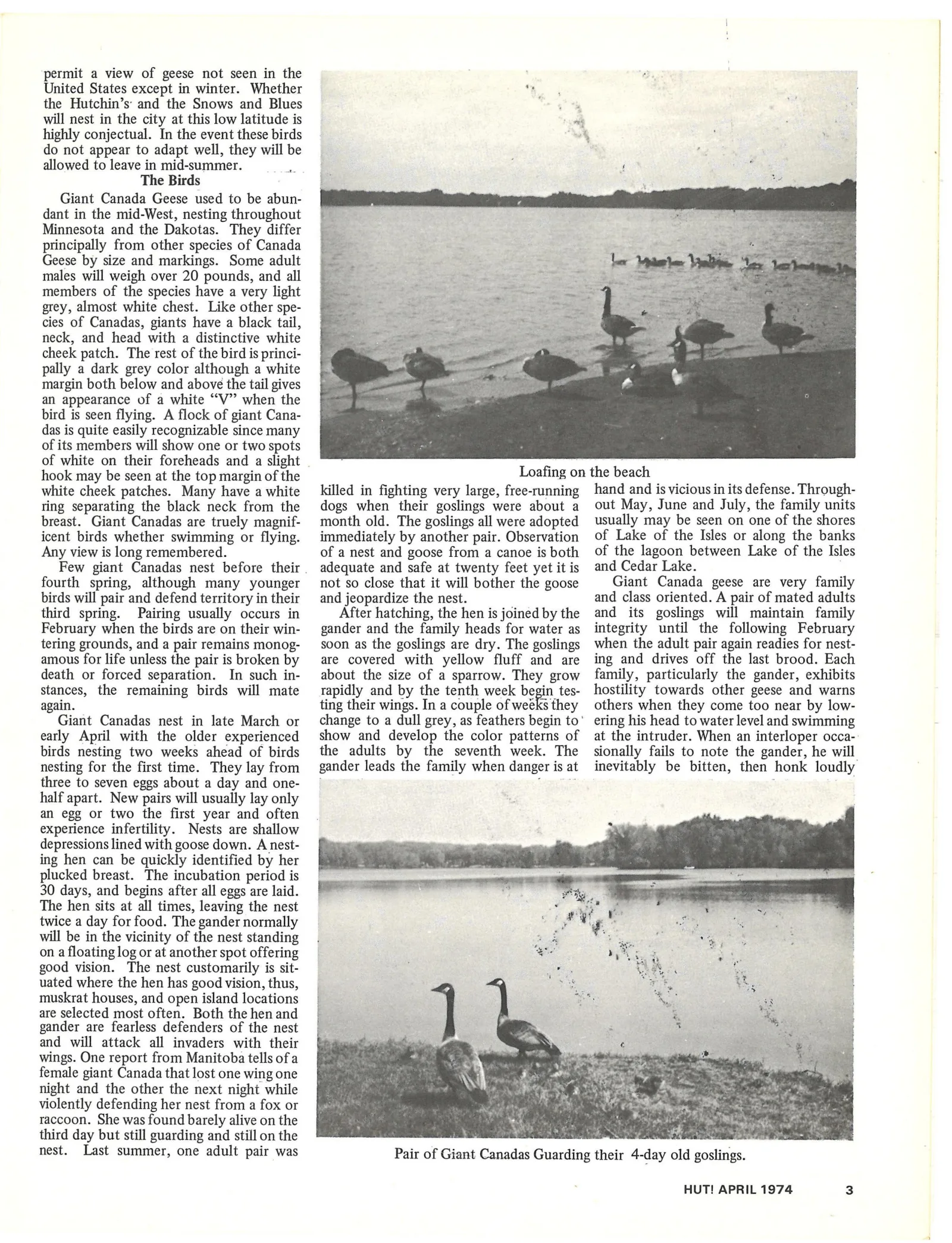
members of the species have a very light
grey, almost white chest. Like other spe-
cies of Canadas, giants have a black tail,
neck, and head with a distinctive white
cheek patch. The rest of the bird is princi-
pally a dark grey color although a white
margin both below and above the tail gives
an appearance of a white “V” when the
bird is seen flying. A flock of giant Cana-
das is quite easily recognizable since many
of its members will show one or two spots
of white on their foreheads and a slight ,
hook may be seen at the top margin of the Loafing on the beach — ooo,
white cheek patches. Many have awhite killed in fighting very large, free-running hand and is vicious in its defense. Through-
ring separating the black neck from the dogs when their goslings were about a out May, June and July, the family units
breast. Giant Canadas are truely magnif- month old. The goslings all were adopted usually may be seen on one of the shores
icent birds whether swimming or flying. immediately by another pair. Observation of Lake of the Isles or along the banks
Any view is long remembered. of a nest and goose from a canoe isboth of the lagoon between Lake of the Isles
Few giant Canadas nest before their adequate and safe at twenty feet yet itis and Cedar Lake.
fourth spring, although many younger not so close that it will bother the goose Giant Canada geese are very family
birds will pair and defend territory in their and jeopardize the nest. and class oriented. A pair of mated adults
third spring. Pairing usually occurs in After hatching, the hen is joined bythe and its goslings will maintain family
February when the birds are on their win- gander and the family heads for water as integrity until the following February
tering grounds, and a pair remains monog- _ soon as the goslings are dry. The goslings when the adult pair again readies for nest-
amous for life unless the pair is broken by are covered with yellow fluff and are ing and drives off the last brood. Each
death or forced separation. In such in- about the size of a sparrow. They grow family, particularly the gander, exhibits
stances, the remaining birds will mate rapidly and by the tenth week begin tes- hostility towards other geese and warns
again. ting their wings. In a couple of weeks they others when they come too near by low-
Giant Canadas nest in late March or change to a dull grey, as feathers begin to’ ering his head to water level and swimming
early April with the older experienced show and develop the color patterns of at the intruder. When an interloper occa-
birds nesting two weeks ahead of birds the adults by the seventh week. The sionally fails to note the gander, he will
nesting for the first time. They lay from gander leads the family when danger is at inevitably be bitten, then honk loudly
three to seven eggs about a day and one- : ss
half apart. New pairs will usually lay only
an egg or two the first year and often
experience infertility. Nests are shallow
depressions lined with goose down. A nest-
ing hen can be quickly identified by her
plucked breast. The incubation period is
30 days, and begins after all eggs are laid.
The hen sits at all times, leaving the nest
twice a day for food. The gander normally
will be in the vicinity of the nest standing
on a floating log or at another spot offering
good vision. The nest customarily is sit-
uated where the hen has good vision, thus,
muskrat houses, and open island locations
are selected most often. Both the hen and
gander are fearless defenders of the nest
and will attack all invaders with their
wings. One report from Manitoba tells of a
female giant Canada that lost one wing one
night and the other the next night while
violently defending her nest from a fox or
raccoon. She was found barely alive on the # >
third day but still guarding and still on the vi
nest. Last summer, one adult pair was Pair of Giant Canadas Guarding their 4-day old goslings.
HUT! APRIL 1974 3
Article contents & approved summaries (0)
No article summaries are available for this view.