
April 1974 · No. 7
April 1974 Magazine (No. 7)
Magazine · 36 pages
Search this issue
For the full-resolution original, use Open PDF above. Your browser handles PDF zoom and navigation.
Searchable text for scan page 6
|
\
|
and splash away. The gander with the.
largest family usually is the flock’s ac-
knowledged leader, and all other geese
respect his position.
Young birds imprint on the area in
which they learn to fly. Thus, although
they may remain away from the home
territory until they are ready to nest in |
their fourth spring, at that time they
return. With respect to, the Lake of the
Isles flock that migrated, there is a good
probability that these young birds will
not be seen locally until the early spring
of 1976, at which time all then still. alive
should be mated and ready to nest. Giant
Canadas during these seasons without
parental duties appear to often fly much
farther north than their nesting area and
spend the summer in remote wilderness
areas. Without any experience with the
Lake of the Isles flock, it is speculation
where the young migrants may wind up
this summer. This phenomenon is often
referred to as a molt migration.
Each summer in June, geese lose all
their flight feathers and are flightless Me aad tow
while new feathers grow to replace the old. 8°05) S58)” ses® . ae. oe yietAss hee
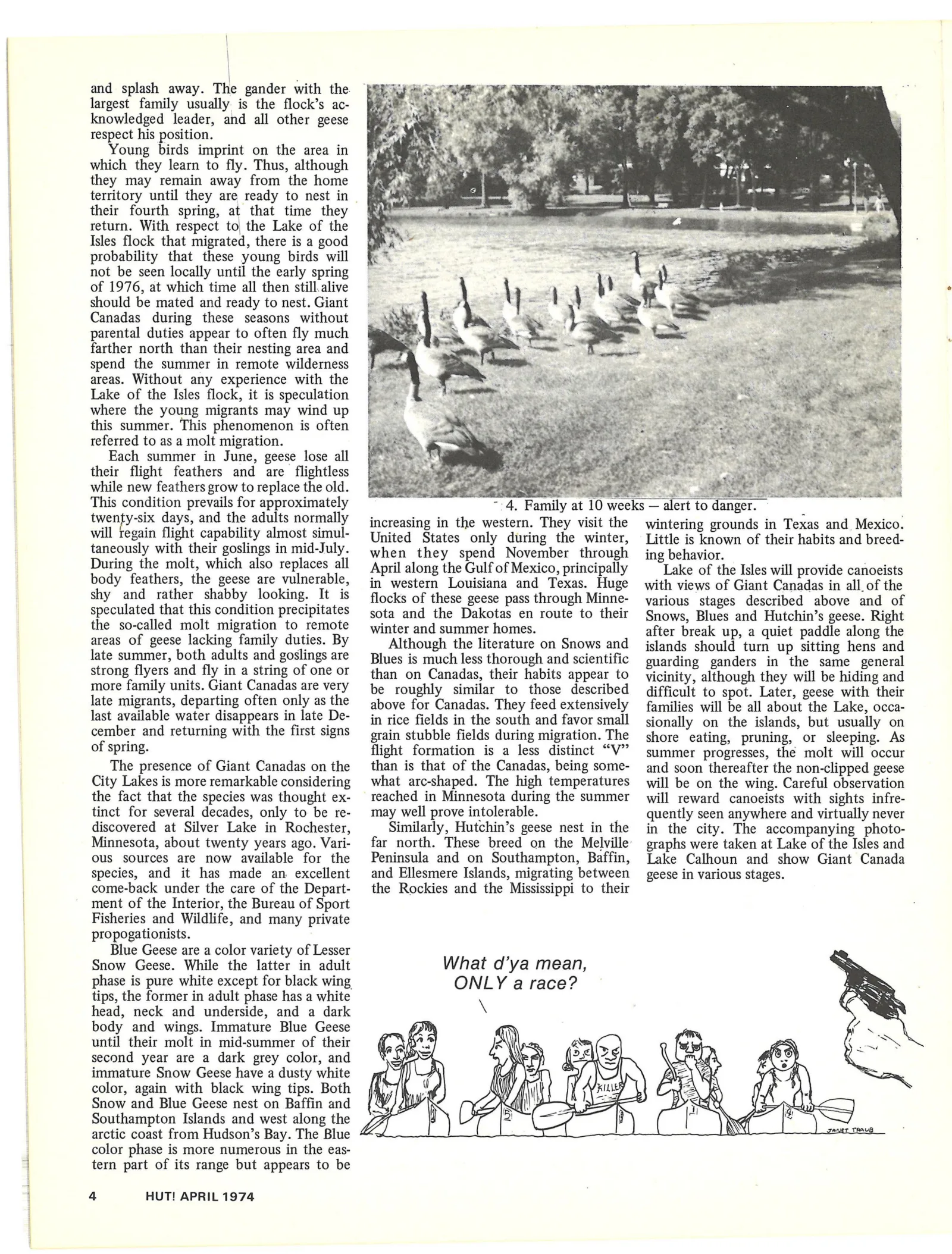
This condition prevails for approximately : a ms eeks—alert to danger.
ag es days, and the adults normally increasing in the western. They visit the wintering grounds in Texas and Mexico.
will regain flight capability almost simul- United States only during the winter, Little is known of their habits and breed-
taneously with their goslings in mid-July. when they spend November through ing behavior.
During the molt, which also replaces all April along the Gulf of Mexico, principally Lake of the Isles will provide canoeists
body feathers, the geese are vulnerable, in western Louisiana and Texas. Huge with views of Giant Canadas in all_ of the
shy and rather shabby looking. It is flocks of these geese pass through Minne- various ‘stages described above and of
speculated that this condition precipitates gota and the Dakotas en route to their Snows, Blues and Hutchin’s geese. Right
the so-called molt migration to remote winter and summer homes. after break up, a quiet paddle along the
areas of geese lacking family duties. By Although the literature on Snows and _jslands should turn up sitting hens and
late summer, both adults and goslings are Blues is much less thorough and scientific guarding ganders in the same general
strong flyers and fly in a string of one or than on Canadas, their habits appear to vicinity, although they will be hiding and
more family units. Giant Canadas are very be roughly similar to those described difficult to spot. Later, geese with their
late migrants, departing often only asthe above for Canadas. They feed extensively families will be all about the Lake, occa-
last available water disappears in late De- in rice fields in the south and favor small sionally on the islands, but usually on
cember and returning with the first signs grain stubble fields during migration. The shore eating, pruning, or sleeping. As
of spring. flight formation is a less distinct “V’ summer progresses, the molt will occur
The presence of Giant Canadas on the than is that of the Canadas, being some- and soon thereafter the non-clipped geese
City Lakes is more remarkable considering what arc-shaped. The high temperatures will be on the wing. Careful observation
the fact that the species was thought ex- reached in Minnesota during the summer will reward canoeists with sights infre-
tinct for several decades, only to be re- may well prove intolerable. quently seen anywhere and virtually never
discovered at Silver Lake in Rochester, Similarly, Hutchin’s geese nest in the in the city. The accompanying photo-
Minnesota, about twenty years ago. Vari- far north. These breed on the Melville’ graphs were taken at Lake of the Isles and
ous sources are now available for the Peninsula and on Southampton, Baffin, Lake Calhoun and show Giant Canada
species, and it has made an excellent and Ellesmere Islands, migrating between geese in various stages.
come-back under the care of the Depart- the Rockies and the Mississippi to their
ment of the Interior, the Bureau of Sport
Fisheries and Wildlife, and many private
propogationists.
Blue Geese are a color variety of Lesser ,
Snow Geese. While the latter in adult What d’ya mean,
phase is pure white except for black wing ONLY a race?
tips, the former in adult phase has a white
head, neck and underside, and a dark
body and wings. Immature Blue Geese
until their molt in mid-summer of their
second year are a dark grey color, and
immature Snow Geese have a dusty white
color, again with black wing tips. Both
Snow and Blue Geese nest on Baffin and
Southampton Islands and west along the
arctic coast from Hudson’s Bay. The Blue
color phase is more numerous in the eas-
tern part of its range but appears to be
4 HUT! APRIL 1974
Article contents & approved summaries (0)
No article summaries are available for this view.