
August 1981 · Volume/issue not printed or unknown
August 1981 Magazine
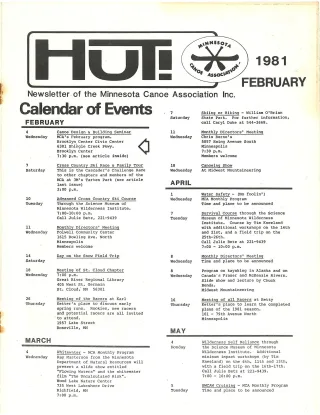
Magazine · 12 pages
Search this issue
For the full-resolution original, use Open PDF above. Your browser handles PDF zoom and navigation.
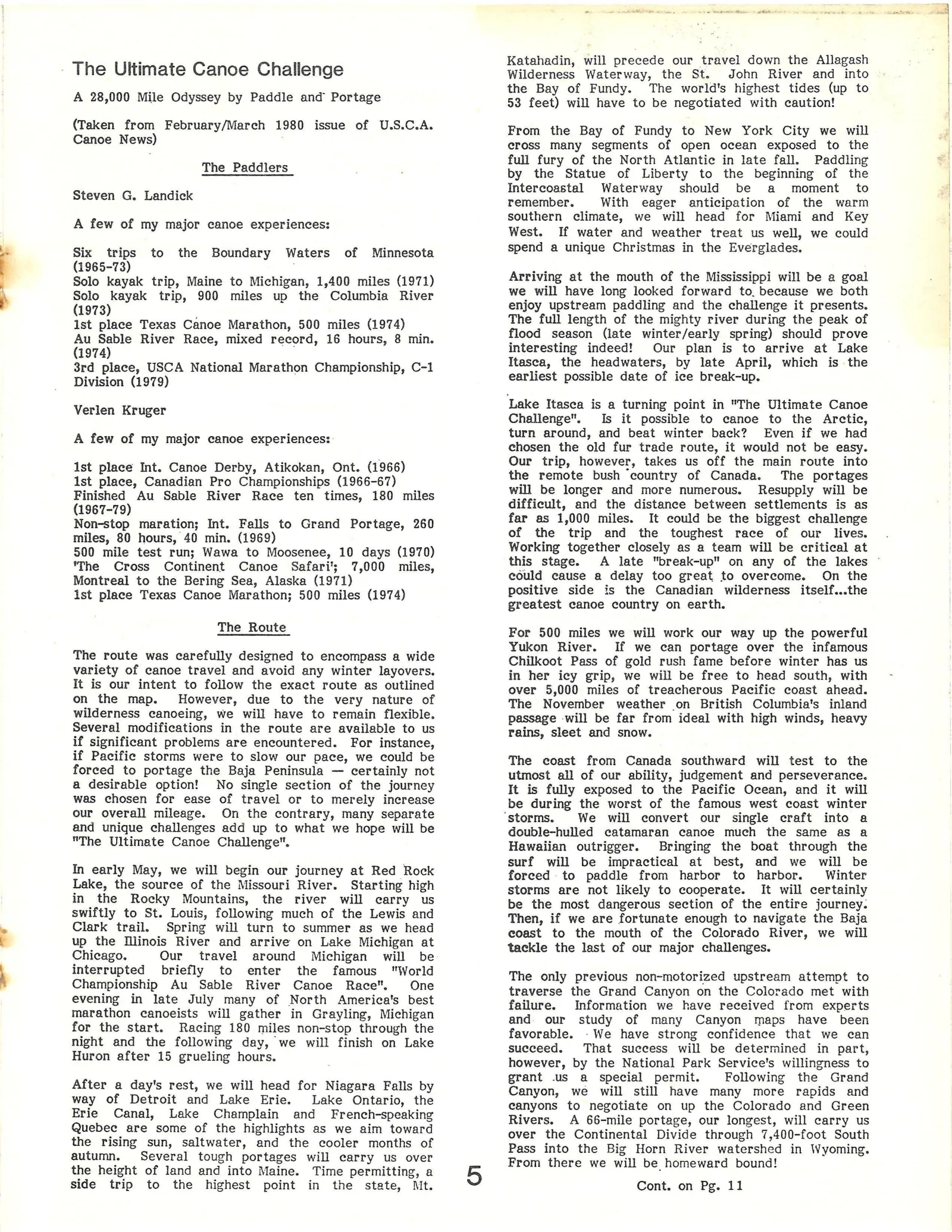
Searchable text for scan page 5
4
. Katahadin, will precede our travel down the Allagash : |
- The Ultimate Canoe Challenge Wilderness Waicousn, the St. John River and into |
the Bay of Fundy. The world's highest tides (up to
53 feet) will have to be negotiated with caution! |
(Taken from February/March 1980 issue of U.S.C.A. From the Bay of Fundy to New York City we will 4
Canoe News) cross many segments of open ocean exposed to the |
full fury of the North Atlantic in late fall. Paddling be
by the Statue of Liberty to the beginning of the |
Intercoastal Waterway should be a moment to =|
remember. With eager anticipation of the warm {
southern climate, we will head for Miami and Key i
West. If water and weather treat us well, we could
Six trips to the Boundary Waters of Minnesota spend a unique Christmas in the Everglades.
(1965-73) {
A 28,000 Mile Odyssey by Paddle and Portage
The Paddlers
Steven G. Landick
A few of my major canoe experiences:
Solo kayak trip, Maine to Michigan, 1,400 miles (1971) Arriving at the mouth of the Mississippi will be a goal
Solo kayak trip, 900 miles up the Columbia River we will have long looked forward to, because we both
(1973) enjoy upstream paddling and the challenge it presents.
The full length of the mighty river during the peak of
pt Bite Tes ated MANEINSD, 200 Bie tery flood season (late winter/early spring) should prove
Au Sable River Race, mixed record, 16 hours, 8 min.
(1974) interesting indeed! Our plan is to arrive at Lake
3rd place, USCA National Marathon Championship, C-1 Itasca, the headwaters, by late April, which isthe
Division (1979) earliest possible date of ice break-up.
Lake Itasca is a turning point in "The Ultimate Canoe
Challenge". Is it possible to canoe to the Arctic,
turn around, and beat winter back? Even if we had
chosen the old fur trade route, it would not be easy.
Ist place Int. Canoe Derby, Atikokan, Ont. (1966) Our trip, however, takes us off the main route into
1st place, Canadian Pro Championships (1966-67) 4 aa bush country of oe The a
Finished Au Sable River Race ten times, 180 miles will be longer and more numerous. Resupply will be
Verlen Kruger
A few of my major canoe experiences:
(1967-79) difficult, and the distance between settlements is as
Non-stop maration; Int. Falls to Grand Portage, 260 far as 1,000 miles. It could be the biggest challenge
miles, 80 hours, 40 min. (1969) of the trip and the toughest race of our lives.
500 mile test run; Wawa to Moosenee, 10 days (1970) Working together closely as a team will be critical at
° : . i 1) <Upl :
'The Cross Continent Canoe Safari’; 7,000 miles, as Biges e —— ge : -« bons an _ ae
Montreal to the Bering Sea, Alaska (1971) y great | °
ist place Texas Canoe Marathon; 500 miles (1974) positive side is the Canadian wilderness itself...the
greatest canoe country on earth.
The Route_ For 500 miles we will work our way up the powerful
Yukon River. If we can portage over the infamous
Chilkoot Pass of gold rush fame before winter has us
in her icy grip, we will be free to head south, with
over 5,000 miles of treacherous Pacific coast ahead.
The route was carefully designed to encompass a wide
variety of canoe travel and avoid any winter layovers.
It is our intent to follow the exact route as outlined
on the map. However, due to the very nature of The November weather on British Columbia's inland
wilderness canoeing, we will have to remain flexible. passage will be far from ideal with high winds, heavy
Several modifications in the route are available to us rains, sleet and snow.
if significant problems are encountered. For instance,
if Pacific storms were to slow our pace, we could be The coast from Canada southward will test to the
forced to portage the Baja Peninsula — certainly not utmost all of our ability, judgement and perseverance.
a desirable option! No single section of the journey It is fully exposed to the Pacific Ocean, and it will
was chosen for ease of travel or to merely increase be during the worst of the famous west coast winter
our overall mileage. On the contrary, many separate ‘storms. We will convert our single craft into a
and unique challenges add up to what we hope will be double-hulled catamaran canoe much the same as a
"The Ultimate Canoe Challenge". Hawaiian outrigger. Bringing the boat through the
, , P , i impractical at best, and we will be
In early May, we will begin our journey at Red Rock foened tb paddle from harbor to harbor. Winter
Lake, the source of the Missouri River. Starting high
in the Rocky Mountains, the river will carry us
swiftly to St. Louis, following much of the Lewis and
Clark trail. Spring will turn to summer as we head
up the Mlinois River and arrive on Lake Michigan at
Chicago. Our travel around Michigan will be
interrupted briefly to enter the famous "World
Championship Au Sable River Canoe Race". One
evening in late July many of North America's best
marathon canoeists will gather in Grayling, Michigan
for the start. Racing 180 miles non-stop through the
night and the following day, we will finish on Lake
Huron after 15 grueling hours.
storms are not likely to cooperate. It will certainly
be the most dangerous section of the entire journey.
Then, if we are fortunate enough to navigate the Baja
eoast to the mouth of the Colorado River, we will
tackle the last of our major challenges.
The only previous non-motorized upstream attempt to
traverse the Grand Canyon on the Colorado met with
failure. Information we have received from experts
and our study of many Canyon maps have been
favorable. .We have strong confidence that we can
succeed. That success will be determined in part,
however, by the National Park Service's willingness to
grant -us a special permit. Following the Grand
Canyon, we will still have many more rapids and
eanyons to negotiate on up the Colorado and Green
Rivers. A 66-mile portage, our longest, will carry us
over the Continental Divide through 7,400-foot South
Pass into the Big Horn River watershed in Wyoming.
From there we will be homeward bound!
Cont. on Pg. 11
After a day's rest, we will head for Niagara Falls by
way of Detroit and Lake Erie. Lake Ontario, the
Erie Canal, Lake Champlain and French-speaking
Quebee are some of the highlights as we aim toward
the rising sun, saltwater, and the cooler months of
autumn. Several tough portages will carry us over
the height of land and into Maine. Time permitting, a 5
side trip to the highest point in the state, Mt.
Article contents & approved summaries (0)
No article summaries are available for this view.