
August 1981 · Volume/issue not printed or unknown
August 1981 Magazine
Magazine · 12 pages
Search this issue
For the full-resolution original, use Open PDF above. Your browser handles PDF zoom and navigation.
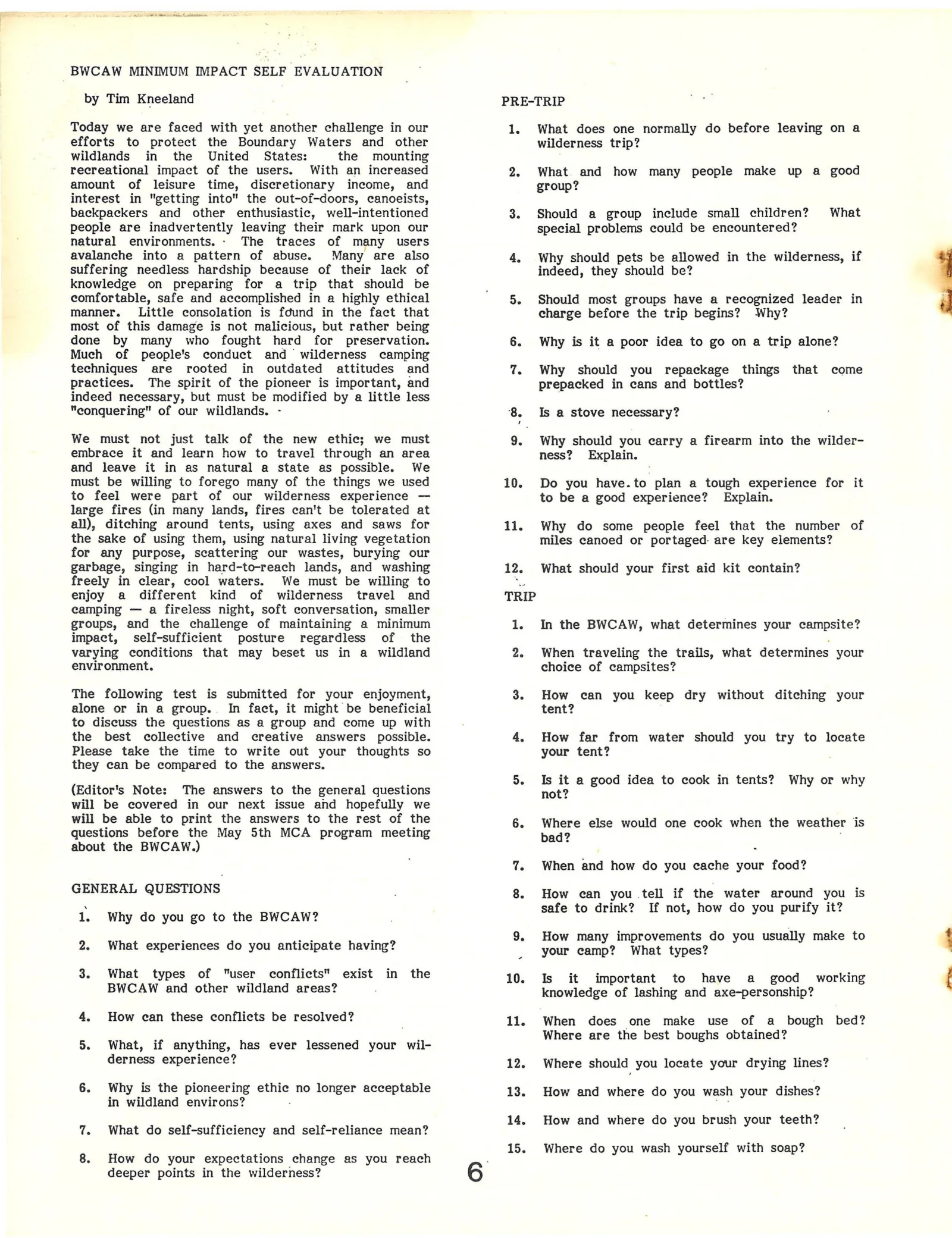
Searchable text for scan page 6
6 NE ne te
BWCAW MINIMUM IMPACT SELF ‘EVALUATION
by Tim Kneeland PRE-TRIP
Today we are faced with yet another challenge in our 1. What does one normally do before leaving on a
efforts to protect the Boundary Waters and other wilderness trip?
wildlands in the United States: the mounting
recreational impact of the users. With an increased 2. What and how many people make up a good
amount of leisure time, discretionary income, and group?
interest in "getting into" the out-of-doors, canoeists,
backpackers and other enthusiastic, well-intentioned 3. Should a group include small children? What
people are inadvertently leaving their mark upon our special problems could be encountered?
natural environments. - The traces of many users
avalanche into a pattern of abuse. Many are also 4. Why should pets be allowed in the wilderness, if
suffering needless hardship because of their lack of indeed, they should be?
knowledge on preparing for a trip that should be ;
comfortable, safe and accomplished in a highly ethical 5. Should most groups have a recognized leader in
manner. Little consolation is found in the fact that charge before the trip begins? Why?
most of this damage is not malicious, but rather being
done by many who fought hard for preservation. 6. Why is it a poor idea to go on a trip alone?
Much of people's conduct and wilderness camping
techniques are rooted in outdated attitudes and 7. Why should you repackage things that come
practices. The spirit of the pioneer is important, and prepacked in cans and bottles?
indeed necessary, but must be modified by a little less ;
"conquering" of our wildlands. - 8. Is a stove necessary?
We must not just talk of the new ethic; we must 9. Why should you carry a firearm into the wilder-
embrace it and learn how to travel through an area ness? Explain.
and leave it in as natural a state as possible. We :
must be willing to forego many of the things we used 10. Do you have.to plan a tough experience for it
to feel were part of our wilderness experience — to be a good experience? Explain.
large fires (in many lands, fires can't be tolerated at
all), ditching around tents, using axes and saws for 11. Why do some people feel that the number of
the sake of using them, using natural living vegetation miles canoed or portaged: are key elements?
for any purpose, scattering our wastes, burying our
garbage, singing in hard-to-reach lands, and washing 12. What should your first aid kit contain?
freely in clear, cool waters. We must be willing to _
enjoy a different kind of wilderness travel and TRIP
eamping — a fireless night, soft conversation, smaller
groups, and the challenge of maintaining a minimum 1. In the BWCAW, what determines your campsite?
impact, self-sufficient posture regardless of the ‘
varying conditions that may beset us in a wildland 2. When traveling the trails, what determines your
environment. choice of campsites?
The following test is submitted for your enjoyment, 3. How can you keep dry without ditching your
alone or in a group. In fact, it might be beneficial tent?
to discuss the questions as a group and come up with 2
the best collective and creative answers possible. 4. How far from water should you try to locate
Please take the time to write out your thoughts so your tent?
they can be compared to the answers.
5. Is it a good idea to cook in tents? Why or why
(Editor's Note: The answers to the general questions not?
will be covered in our next issue and hopefully we
will be able to print the answers to the rest of the 6. Where else would one cook when the weather is
questions before the May 5th MCA program meeting bad? :
about the BWCAW.) 5
7. When and how do you cache your food?
GENERSL QUESTIONS : 8. How can you -tell if the water around you is
1 Why do you go to the BWCAW? safe to drink? If not, how do you purify it?
9. How many improvements do you usually make to
2. What experiences do you anticipate having? your camp? What types?
3. What types of "user conflicts" exist in the 10. Is it important to have a good working
BWCAW and other wildland areas? knowledge of lashing and axe-personship?
4. How can these conflicts be resolved? 11. When does one make use of a bough bed?
Where are the best boughs obtained?
5. What, if anything, has ever lessened your wil- s
derness experience? 12. Where should you locate your drying lines?
6. Why is the pioneering ethic no longer acceptable 13. How and where do you wash your dishes?
in wildland environs? : ae
me ; 14, How and where do you brush your teeth?
7. What do self-sufficiency and self-reliance mean?
, 15. Where do you wash yourself with soap?
8. How do your expectations change as you reach
deeper points in the wilderness? 6
Article contents & approved summaries (0)
No article summaries are available for this view.