
December 1981 · Volume/issue not printed or unknown
December 1981 Magazine
Magazine · 12 pages
Search this issue
For the full-resolution original, use Open PDF above. Your browser handles PDF zoom and navigation.
Searchable text for scan page 8
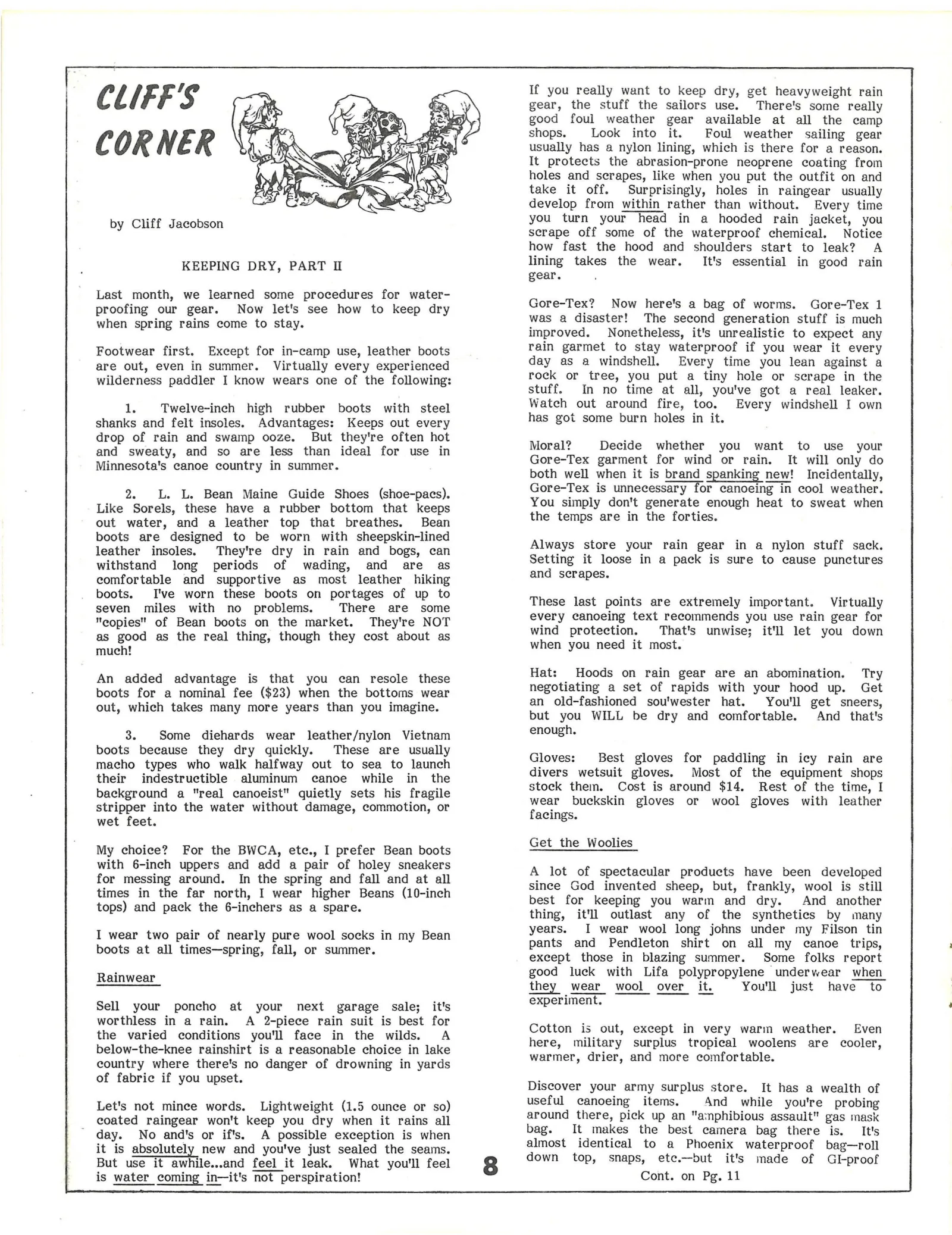
If you really want to keep dry, get heavyweight rain
gear, the stuff the sailors use. There's some really
good foul weather gear available at all the camp
shops. Look into it. Foul weather sailing gear
usually has a nylon lining, which is there for a reason.
It protects the abrasion-prone neoprene coating from
holes and scrapes, like when you put the outfit on and
take it off. Surprisingly, holes in raingear usually
" develop from within rather than without. Every time
. you turn your head in a hooded rain jacket, you
by Cliff Jacobson scrape off some of the waterproof chemical. Notice
how fast the hood and shoulders start to leak? A
KEEPING DRY, PART I — takes the wear. It's essential in good rain
CLIFFS
CORNER
Last month, we learned some procedures for water-
proofing our gear. Now let's see how to keep dry
when spring rains come to stay.
Gore-Tex? Now here's a bag of worms. Gore-Tex 1
was a disaster! The second generation stuff is much
improved. Nonetheless, it's unrealistic to expect any
Footwear first. Except for in-camp use, leather boots rain garmet to stay waterproof if you wear it every
are out, even in summer. Virtually every experienced day as a windshell. Every time you lean against a
wilderness paddler I know wears one of the following: rock or tree, you put a tiny hole or scrape in the
stuff. In no time at all, you've got a real leaker.
1. Twelve-inch high rubber boots with steel Watch out around fire, too. Every windshell I own
shanks and felt insoles. Advantages: Keeps out every has got some burn holes in it.
drop of rain and swamp ooze. But they're often hot
and sweaty, and so are less than ideal for use in
Minnesota's canoe country in summer.
Moral? Decide whether you want to use your
Gore-Tex garment for wind or rain. It will only do
both well when it is brand spanking new! Incidentally,
Gore-Tex is unnecessary for canoeing in cool weather.
You simply don't generate enough heat to sweat when
the temps are in the forties.
2. LL. L. Bean Maine Guide Shoes (shoe-pacs).
Like Sorels, these have a rubber bottom that keeps
out water, and a leather top that breathes. Bean
boots are designed to be worn with sheepskin-lined
leather insoles. They're dry in rain and bogs, can
withstand long periods of wading, and are as
comfortable and supportive as most leather hiking
boots. I've worn these boots on portages of up to
seven miles with no problems. There are some
"eopies" of Bean boots on the market. They're NOT
as good as the real thing, though they cost about as
much!
Always store your rain gear in a nylon stuff sack.
Setting it loose in a pack is sure to cause punctures
and scrapes.
These last points are extremely important. Virtually
every canoeing text recommends you use rain gear for
wind protection. That's unwise; it'll let you down
when you need it most.
Hat: Hoods on rain gear are an abomination. Try
negotiating a set of rapids with your hood up. Get
an old-fashioned sou'wester hat. You'll get sneers,
but you WILL be dry and comfortable. And that's
enough.
An added advantage is that you can resole these
boots for a nominal fee ($23) when the bottoms wear
out, which takes many more years than you imagine.
3. Some diehards wear leather/nylon Vietnam
boots because they dry quickly. These are usually
macho types who walk halfway out to sea to launch
their indestructible aluminum canoe while in the
background a "real canoeist" quietly sets his fragile
stripper into the water without damage, commotion, or
wet feet.
Gloves: Best gloves for paddling in icy rain are
divers wetsuit gloves. Most of the equipment shops
stock them. Cost is around $14. Rest of the time, I
wear buckskin gloves or wool gloves with leather
facings.
My choice? For the BWCA, etce., I prefer Bean boots oa. Soe.
with 6-inch uppers and add a pair of holey sneakers
for messing around. In the spring and fall and at all
times in the far north, I wear higher Beans (10-inch
tops) and pack the 6-inchers as a spare.
A lot of spectacular products have been developed
since God invented sheep, but, frankly, wool is still
best for keeping you warm and dry. And another
thing, it'll outlast any of the synthetics by many
years. I wear wool long johns under my Filson tin
pants and Pendleton shirt on all my canoe trips,
except those in blazing summer. Some folks report
good luck with Lifa polypropylene underwear when
they wear wool over it. You'll just have to
experiment.
I wear two pair of nearly pure wool socks in my Bean
boots at all times—spring, fall, or summer.
Rainwear
Sell your poncho at your next garage sale; it's
worthless in a rain. A 2-piece rain suit is best for
the varied conditions you'll face in the wilds. A
below-the-knee rainshirt is a reasonable choice in lake
country where there's no danger of drowning in yards
of fabric if you upset.
Cotton is out, except in very warm weather. Even
here, military surplus tropical woolens are cooler,
warmer, drier, and more comfortable.
Discover your army surplus store. It has a wealth of
P r 3 useful canoeing items. And while you're probin
Let's not THICe ee. Lightweight (1.5 ee so) around there, mate up an "amphibious assault" oes TES
ee ae wor seer haan ann it ao ater bag It makes the best camera bag there is. It's
ay. o and's or ifts. possible exception is when . : ; ; ‘ ;
it is absolutely new and you've just sealed the seams. anaes oe a oe oe bee ~TOn
But use it awhile...and feel it leak. What you'll feel 8 Ds SNAPS; CtcoUL Its made of Gi-proof
is water coming in—it's not perspiration! Cont. on Pg. 11
Article contents & approved summaries (0)
No article summaries are available for this view.