
December 1981 · Volume/issue not printed or unknown
December 1981 Magazine
Magazine · 12 pages
Search this issue
For the full-resolution original, use Open PDF above. Your browser handles PDF zoom and navigation.
Searchable text for scan page 9
zB 9 around to the other end of the board and take the
Buitders Corner weight as the cut gets into the final part.
Some people are equipped with a radial arm saw with
by Bob Brown long tables and a powerful drive. This type of rig
ean drive a gang saw using three or four blades
Buying the wood for a stripper is an art in itself. making several strips at once; this makes faster work
There is no such thing as a perfect board; we settle of strip cutting.
for the best we can get.
While we're discussing wood, I'd like to discuss shortly
Choice of woods depends on what is available. Any what you build forms from.
straight-grained board can be sawn into strips and
used to build a canoe; some woods are better. First My preference is for 3/4" chip board. Many builders
choice for many builders is cedar. Either red or use plywood—works just fine. I find that chip board,
white, cedar is commonly used in boats. All of the being consistent in texture, seems to hold staples
boats I've built are redwood. Why? It's easy to find quite well. Plywood, on the other hand, has voids in
and generally meets the other requirements. it and you will on occasion find a void right where
you need a staple really bad.
Sitka spruce is sometimes used. It is an excellent
boat building wood, but somewhat heavier than I generally build my forms out of whatever I can get
redwood or cedar. Spruce is dense and very strong. my hands on cheaply and spend my money for better
It is a blond wood, almost white. The finished boat, redwood.
in my mind, isn't as pretty as one built of redwood or
cedar, but if you want to build a bombproof hull, give After you find a pile of wood the right length, the
spruce some consideration. next thing to do is sort through and set aside any
boards with knots. A knot as large as a pencil will
Spruce and mahogany (Phillipine) are good choices of mess up two to three strips. Avoid knots as much as
wood for the trim (gunnels, seats, and thwarts). possible.
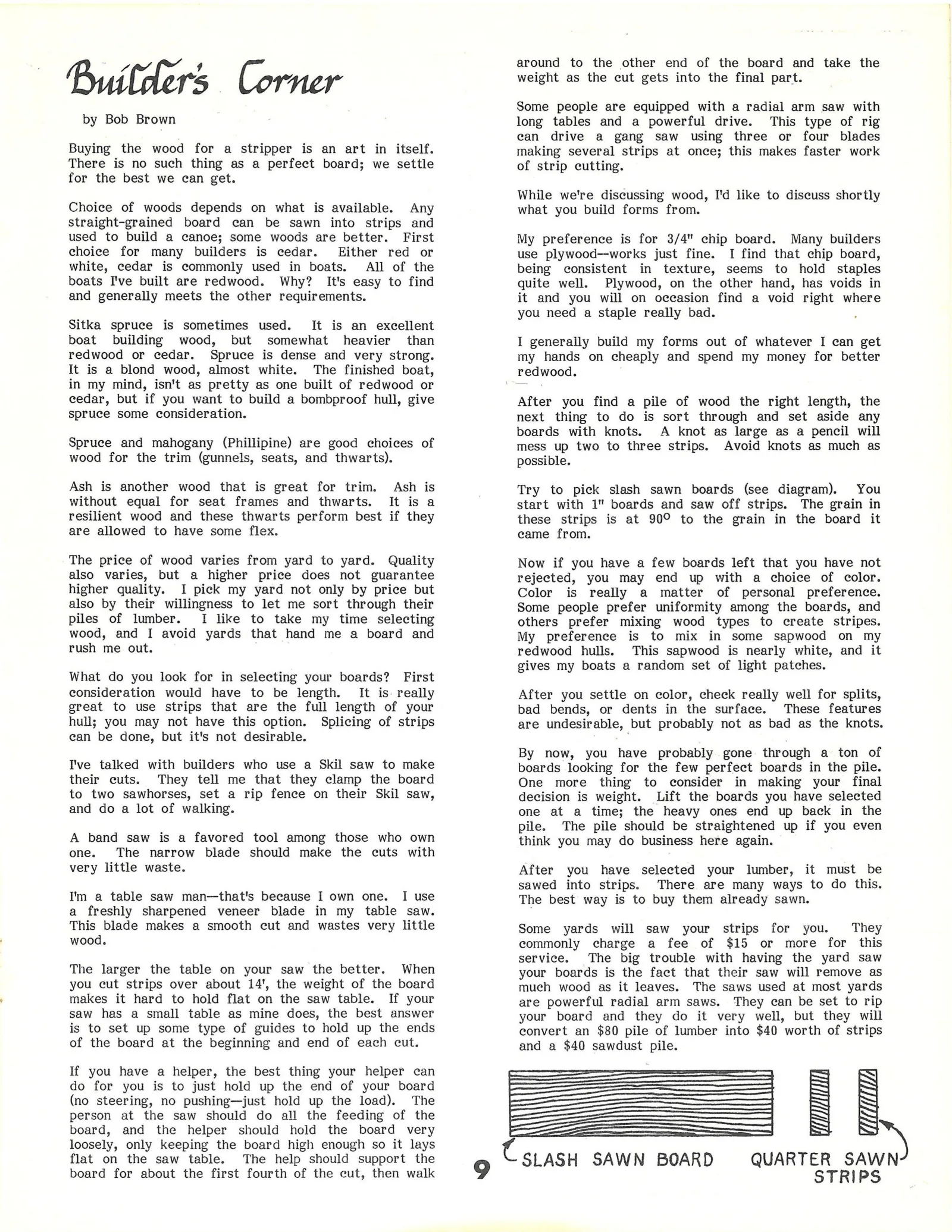
Ash is another wood that is great for trim. Ash is Try to pick slash sawn boards (see diagram). You
without equal for seat frames and thwarts. It is a start with 1" boards and saw off strips. The grain in
resilient wood and these thwarts perform best if they these strips is at 90° to the grain in the board it
are allowed to have some flex. eame from.
The price of wood varies from yard to yard. Quality Now if you have a few boards left that you have not
also varies, but a higher price does not guarantee rejected, you may end up with a choice of color.
higher quality. I pick my yard not only by price but Color is really a matter of personal preference.
also by their willingness to let me sort through their Some people prefer uniformity among the boards, and
piles of lumber. I like to take my time selecting others prefer mixing wood types to create stripes.
wood, and I avoid yards that hand me a board and My preference is to mix in some sapwood on my
rush me out. redwood hulls. This sapwood is nearly white, and it
. gives my boats a random set of light patches.
What do you look for in selecting your boards? First
consideration would have to be length. It is really After you settle on color, check really well for splits,
great to use strips that are the full length of your bad bends, or dents in the surface. These features
hull; you may not have this option. Splicing of strips are undesirable, but probably not as bad as the knots.
ean be done, but it's not desirable.
By now, you have probably gone through a ton of
I've talked with builders who use a Skil saw to make boards looking for the few perfect boards in the pile.
their cuts. They tell me that they clamp the board One more thing to consider in making your final
to two sawhorses, set a rip fence on their Skil saw, decision is weight. Lift the boards you have selected
and do a lot of walking. one at a time; the heavy ones end up back in the
pile. The pile should be straightened up if you even
A band saw is a favored tool among those who own think you may do business here again.
one. The narrow blade should make the cuts with
very little waste. After you have selected your lumber, it must be
sawed into strips. There are many ways to do this.
Im a table saw man—that's because I own one. I use The best way is to buy them already sawn.
a freshly sharpened veneer blade in my table saw. ;
This blade makes a smooth cut and wastes very little Some yards will saw your strips for you. They
wood. commonly charge a fee of $15 or more for this
service. The big trouble with having the yard saw
The larger the table on your saw the better. When your boards is the fact that their saw will remove as
you cut strips over about 14', the weight of the board much wood as it leaves. The saws used at most yards
makes it hard to hold flat on the saw table. If your are powerful radial arm saws. They can be set to rip
saw has a small table as mine does, the best answer your board and they do it very well, but they will
is to set up some type of guides to hold up the ends convert an $80 pile of lumber into $40 worth of strips
of the board at the beginning and end of each cut. and a $40 sawdust pile.
If you have a helper, the best thing your helper can ’ S
do for you is to just hold up the end of your board _—— >=
(no steering, no pushing—just hold up the load). The ee S
person at the saw should do all the feeding of the SE S
board, and the helper should hold the board very
SS
loosely, only keeping the board high enough so it lays S
flat on the saw table. The help should support the Cs sen SAWN BOARD QUARTER SAWN
board for about the first fourth of the cut, then walk 9 STRIPS
Article contents & approved summaries (0)
No article summaries are available for this view.